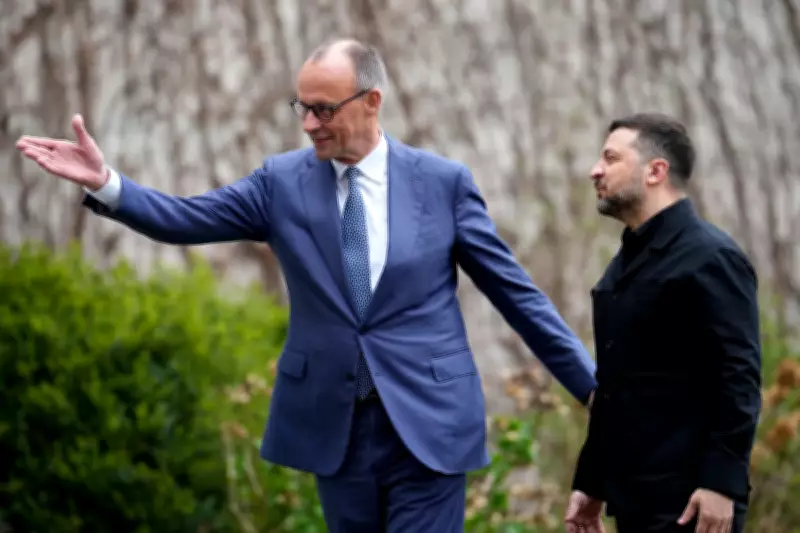
Ukrainian President Volodymyr Zelenskyy held a crucial meeting with German Chancellor Friedrich Merz in Berlin on Tuesday, as Ukraine intensifies its efforts to secure enhanced support from Germany amidst the ongoing conflict with Russia. The discussions come at a pivotal moment, with the war now entering its fifth year and Kyiv facing significant challenges on multiple fronts.
High-Level Talks Amidst Escalating Conflict
The meeting between Zelenskyy and Merz underscores Germany's role as one of Ukraine's most substantial allies, providing military, financial, and diplomatic backing. In a parallel development, German Defense Minister Boris Pistorius engaged in talks with his Ukrainian counterpart, Mykhailo Fedorov, who assumed the defense portfolio in January. Fedorov, previously the digital transformation chief, is renowned for his contributions to advancing military drone technology, which has become a critical asset for Ukraine's defense strategy.
International Dynamics and U.S. Involvement
While the United States has historically led efforts to mediate an end to the war, recent attention has shifted due to the escalating Iran conflict, which has preoccupied the Trump administration. Despite this, Deputy U.S. Ambassador to the United Nations Tammy Bruce reaffirmed Washington's commitment to pursuing a negotiated and durable resolution, as stated in a U.N. Security Council address on Monday.

Western analysts and officials have noted that Ukraine has achieved notable battlefield successes in recent months, effectively disrupting Russia's spring offensive. Improved weather conditions, with drying fields and emerging foliage, have provided Ukrainian forces with enhanced cover, facilitating strategic maneuvers.
Technological Advancements and Economic Pressures
Ukraine's domestically designed long-range drones and missiles have repeatedly targeted oil facilities and manufacturing plants deep within Russian territory, showcasing Kyiv's growing technological prowess. Finnish President Alexander Stubb, speaking at the Brookings Institution in Washington, highlighted Ukraine's improved military position, asserting that last month, Ukraine launched more drones and missiles at Russia than vice versa.
However, Moscow continues to claim progress on the battlefield, though independent verification of these assertions remains challenging. Currently, Russia occupies approximately 20% of Ukrainian territory, including the Crimean Peninsula, which was annexed in 2014.
Financial and Logistical Challenges
Ukraine faces a dire financial crisis, urgently needing a promised 90-billion-euro loan from the European Union, equivalent to around $106 billion. This funding has been obstructed by Hungarian Prime Minister Viktor Orbán, but his recent departure following weekend elections may pave the way for the loan's approval.
Additionally, Kyiv relies heavily on U.S. intelligence for targeting operations inside Russia and requires more sophisticated American-made air defense systems to protect its power grid from Russian missile attacks. President Zelenskyy has expressed concerns that prolonged U.S. involvement in the Iran war could undermine vital support for Ukraine.
Manpower Shortages and Military Struggles
Defense Minister Mykhailo Fedorov revealed in January that the Ukrainian army is grappling with severe manpower shortages, including approximately 200,000 troop desertions and draft-dodging by around 2 million individuals. These issues compound the challenges of sustaining military operations against a larger Russian force.
As the conflict persists, international support remains crucial for Ukraine's resilience and strategic objectives.