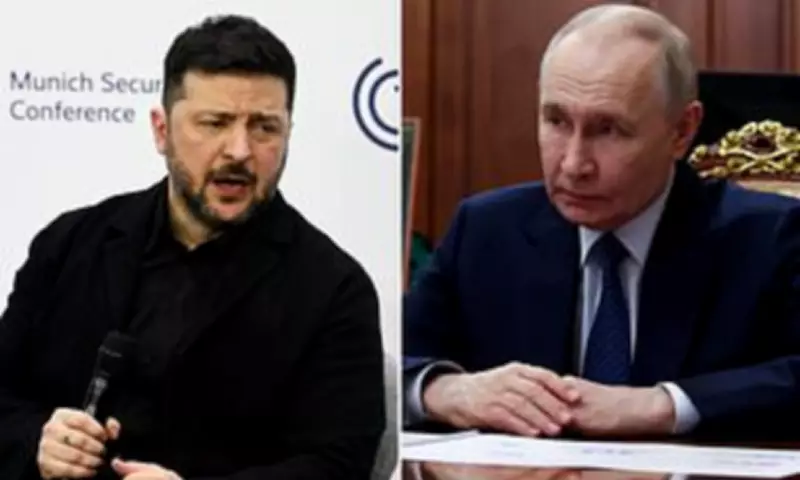
Ukrainian President Volodymyr Zelensky has provocatively stated that Russian leader Vladimir Putin 'doesn't have too much time left' as questions intensify over the Kremlin dictator's mysterious week-long disappearance from public view. Speaking at the Munich Security Conference on Friday, Zelensky made the pointed remark during an interview with Politico, drawing laughter from the audience before emphasising the seriousness of his assertion.
Putin's Prolonged Absence Sparks Speculation
Vladimir Putin, aged 73, was last publicly seen delivering a speech on February 5, with no confirmed appearances since. Moscow state media has resorted to broadcasting pre-recorded footage of the Russian president meeting officials, fuelling widespread speculation about his whereabouts and health. While Putin has vanished from public sight on previous occasions without explanation, this latest absence has prompted renewed theories about potential secret medical treatment or other undisclosed reasons.
European Nations Accuse Russia of Navalny Poisoning
The timing of Zelensky's comments coincides with a significant development regarding Russian opposition leader Alexei Navalny. On Saturday, the foreign ministries of the United Kingdom, France, Germany, Sweden, and the Netherlands jointly announced that analysis of samples from Navalny's body has conclusively confirmed the presence of epibatidine, a potent neurotoxin naturally found in South American dart frogs but also manufacturable in laboratories.

In a strongly worded joint statement, the five European countries declared: 'Russia had the means, motive and opportunity to administer this poison.' They have subsequently reported Russia to the Organisation for the Prohibition of Chemical Weapons for breaching the Chemical Weapons Convention.
Navalny's Legacy and Widow's Pursuit of Justice
Alexei Navalny, who died in an Arctic penal colony on February 16, 2024, while serving what he believed to be a politically motivated 19-year sentence, was President Putin's most prominent domestic critic. The opposition figure crusaded against official corruption and organised massive anti-Kremlin protests throughout his career.
Navalny's widow, Yulia Navalnaya, attended the Munich Security Conference as the second anniversary of her husband's death approaches. She stated she had been 'certain from the first day' that Navalny had been poisoned, adding: 'but now there is proof.' Navalnaya has repeatedly blamed Putin directly for her husband's death, writing on social media: 'Putin killed Alexei with a chemical weapon.'
British Foreign Secretary Yvette Cooper, who met with Navalnaya in Munich, asserted: 'Russia saw Navalny as a threat. By using this form of poison, the Russian state demonstrated the despicable tools it has at its disposal and the overwhelming fear it has of political opposition.'
Historical Context of Russian Poisonings
This incident marks the second known poisoning targeting Navalny, following a 2020 nerve agent attack that he blamed on the Kremlin. After that earlier poisoning, Navalny was flown to Germany for treatment and recovery before returning to Russia five months later, where he was immediately arrested and imprisoned until his death.
The United Kingdom has consistently accused Russia of flouting international bans on chemical and biological weapons, citing the 2018 Salisbury attack that targeted former Russian intelligence officer Sergei Skripal with the Novichok nerve agent. A British inquiry concluded that attack 'must have been authorised at the highest level, by President Putin.'
French Foreign Minister Jean-Noël Barrot wrote on social media that the Navalny poisoning demonstrates 'that Vladimir Putin is prepared to use biological weapons against his own people to remain in power.'
Zelensky's Broader Munich Conference Remarks
During his appearance at the security conference, President Zelensky also commented on European politics, making a pointed reference to Hungarian leader Victor Orban's physical appearance while discussing Ukraine's role in defending European freedom. Zelensky stated that Ukraine's fight against Russian forces allows other European nations to live without immediate military threat, specifically mentioning that 'even one Victor can think about how to grow his belly, not how to grow his army.'

The Ukrainian president highlighted the strained relations between Ukraine and Hungary, noting Orban's continued support for Russia and recent escalated attacks on Ukraine ahead of Hungary's closely contested parliamentary election in April. Zelensky emphasised the human cost of Ukraine's defence, stating: 'Look at the price, look at the pain Ukraine has gone through, look at the suffering Ukraine has faced. It's Ukrainians who are holding the European front.'
Despite Ukraine applying to join the European Union shortly after Russia's invasion, accession talks have stalled due to Orban's repeated vetoes. Hungary remains unique among European nations in maintaining undiversified imports from Russia throughout the ongoing conflict.