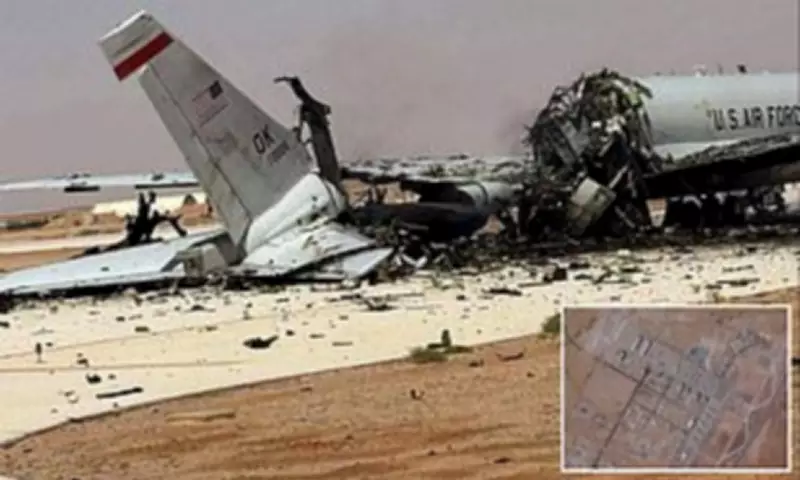
Ukrainian President Volodymyr Zelensky has made a serious allegation that Russia provided Iran with satellite photographs of a key United States military installation in Saudi Arabia just days before a devastating Iranian attack. The strike targeted the Prince Sultan Air Base, located approximately 60 miles south of Riyadh, and resulted in significant damage and casualties.
Details of the Attack and Allegations
On Friday, Iran launched a coordinated assault involving multiple drones and at least one ballistic missile against the Prince Sultan Air Base. The attack inflicted injuries on up to twelve American service members, with two reported to be in serious condition. Most critically, it completely destroyed a sophisticated E-3 Sentry aircraft, a cornerstone of US airborne surveillance.
Dramatic imagery from the scene showed the wrecked plane with its tail section completely severed. The aircraft's distinctive rotating radar dome was utterly obliterated. Tracking data identified the destroyed asset as tail number 81-0005, an E-3G Sentry model assigned to the 552nd Air Control Wing from Tinker Air Force Base in Oklahoma.

Zelensky's Specific Claims
Speaking on Saturday, the day following the assault, President Zelensky asserted that the Prince Sultan air base was among several US military sites photographed by Russian satellites specifically for Iranian interests. He provided a detailed timeline of the alleged imagery collection.
'On March 25th, they took pictures of the Prince Sultan Air Base in Saudi Arabia,' Zelensky stated. 'The Shaybah oil and gas field in Saudi Arabia, İncirlik Air Base in Türkiye, and Al Udeid Air Base in Qatar were all imaged on March 26th.'
The Ukrainian leader further claimed that on March 24, Russian satellites captured images of the US–UK joint military facility on Diego Garcia in the Indian Ocean, as well as Kuwait International Airport and sections of the Greater Burgan oil field's infrastructure.
Expert Analysis and the Significance of the Loss
CNN's military analyst, Cedric Leighton, a former US Air Force colonel, supported Zelensky's assessment. 'Russia most likely gave Iran geographic coordinates and satellite imagery that provided the precise location,' Leighton stated, highlighting the potential for precise targeting.
The loss of the E-3 Sentry represents a major blow. This aircraft is a critical component of the US Airborne Warning and Control System (AWACS). With a length of 152 feet and a wingspan of 145 feet, it can monitor an astonishing 120,000 square miles of airspace from ground level to the stratosphere, tracking up to 600 targets simultaneously.
- Each aircraft costs approximately $540 million, adjusted for inflation.
- The US fleet, once numbering 35 aircraft in 2015, has now been reduced to 17 operational units.
- NATO operates a separate fleet of 14 E-3 aircraft, and nations like France, Saudi Arabia, and Chile also use them.
Colonel Leighton, who has personal experience flying on the E-3, described the destruction as 'a serious breach of our Force Protection efforts.' He noted that extraordinary measures, including fighter escorts and strict avoidance of hostile airspace, are typically employed to safeguard these high-value assets.
The Future of US Airborne Surveillance
Despite its capabilities, the E-3 Sentry is an ageing platform, first introduced in 1978. The Pentagon has been actively retiring them and is in the process of replacing the fleet with the newer Boeing E-7 Wedgetail, each costing around $700 million. This incident accelerates concerns about fleet vulnerability during this transition period.
The US Navy operates a smaller carrier-based aircraft, the E-2 Hawkeye, but it cannot match the E-3's radar coverage or crew capacity. The destruction of this Sentry not only represents a massive financial loss but also a temporary degradation of the US military's broad-area surveillance and command-and-control capabilities in a volatile region.