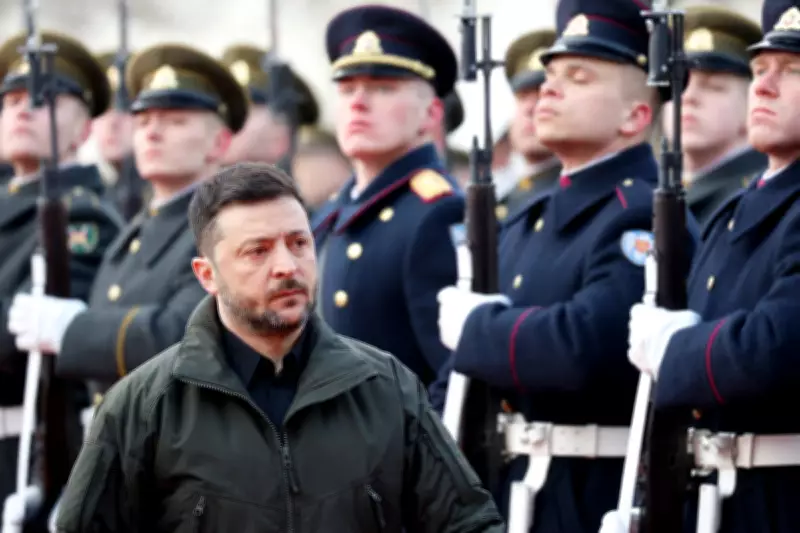
Ukrainian President Volodymyr Zelensky has firmly ruled out holding a referendum on any "bad deal" to end the ongoing war with Russia, emphasising that elections will only proceed once firm security guarantees and a ceasefire are established. Speaking ahead of the Munich Security Conference, Zelensky outlined his conditions in an interview with The Atlantic, stating that Ukraine is prepared for both presidential elections and a peace referendum, but not under current circumstances.
Zelensky's Stance on Peace and Elections
Zelensky clarified that the strategy adopted by Ukraine is to demonstrate to the United States that they do not seek to prolong the conflict unnecessarily. "The tactic we chose is for the Americans not to think that we want to continue the war," he explained. "That’s why we started supporting their proposals in any format that speeds things along." He added, "I don’t think we should put a bad deal up for a referendum," highlighting the need for a fair and secure agreement.
He also dismissed recent reports suggesting he would announce elections and a referendum on February 24, the fourth anniversary of Russia's invasion, calling it an "utterly stupid idea." Zelensky stressed that key details, such as whether the US would commit to shooting down missiles over Ukraine in case of Russian violations, remain unresolved. "No one is clinging to power," he asserted. "I am ready for elections. But for that we need security, guarantees of security, a ceasefire."

Munich Security Conference and International Support
As European leaders gather in Munich, there is anticipation that Zelensky may meet with US Secretary of State Marco Rubio. The conference aims to address concerns over US President Donald Trump's inconsistent geopolitical policies, which have strained transatlantic relations. Zelensky expressed gratitude to the UK, specifically thanking Sir Keir Starmer and John Healey for a "new and timely air defence package" worth £500 million, announced on the eve of the event.
Russian Attacks Escalate Across Ukraine
Meanwhile, Russia has intensified its assaults on Ukrainian infrastructure, causing widespread disruption. In Kyiv, Mayor Vitali Klitschko reported that around 3,500 apartment buildings were without heating on Thursday after recent attacks, with nearly 2,600 high-rise structures losing heating overnight. This adds to 1,100 residential blocks already affected by previous strikes. Residents are coping with electricity and water shortages, relying on emergency services for warm meals and public wells for water.
Ukraine's air force detailed that Russia launched 24 ballistic missiles, one cruise missile, and 219 drones overnight, with air defences downing 16 missiles and 197 drones. Casualties were reported in multiple cities: two people were injured in Kyiv, four in Dnipro—including a baby boy and a four-year-old girl—and four in Odesa, where one victim was hospitalised in serious condition. These attacks targeted energy facilities, residential buildings, and critical infrastructure, exacerbating the humanitarian crisis during freezing winter temperatures.
Broader Implications and Kremlin Actions
The Kremlin has indicated that it expects the next round of peace talks to occur soon, with an understanding of timing and location, though details remain undisclosed. In a related development, Russia has moved to fully block Meta-owned WhatsApp, promoting a state-backed alternative messenger called 'MAX' as part of its crackdown on foreign technology providers since the invasion began. Kremlin spokesman Dmitry Peskov cited Meta's non-compliance with Russian law as the reason for the ban.
Additionally, Ukraine's major private energy company, DTEK, reported that Russia attacked its thermal power plant overnight, marking the eleventh such massive assault since October 2025. This ongoing targeting of energy systems has left tens of thousands without heat, power, and water, underscoring the severe impact of the conflict on civilian life.