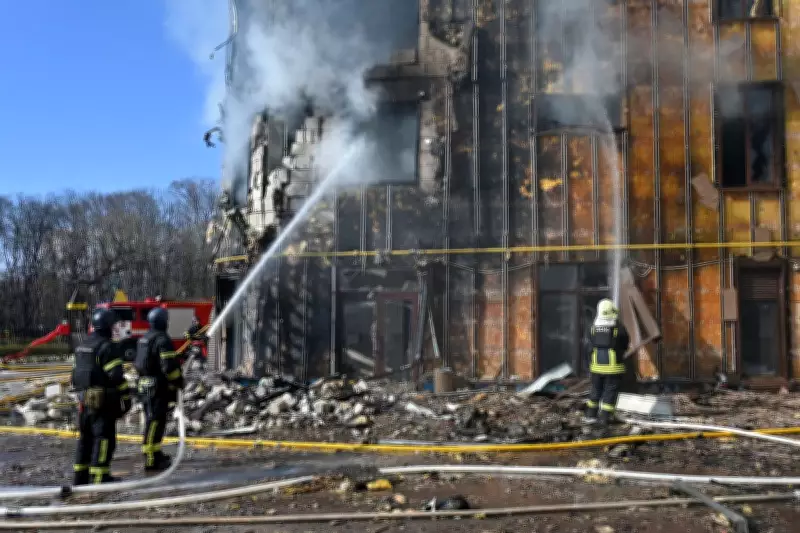
Zelensky Condemns Russia's 'Easter Escalation' Amid Deadly Strikes
Ukrainian President Volodymyr Zelensky has sharply criticised Russia for what he termed an "Easter escalation," following attacks that killed at least five people across Ukraine. This condemnation comes despite Zelensky's earlier proposal for a temporary halt in hostilities during the Easter period.
Deadly Attacks Across Multiple Regions
Officials reported that two individuals lost their lives after residential areas and civilian infrastructure in the central Zhytomyr and Kyiv regions were targeted on Friday. In a separate incident, the governor of the eastern Donetsk region confirmed that a Russian bomb strike claimed three more lives in Kramatorsk, a city frequently assaulted over the past four years of conflict.
In a social media post, Zelensky expressed his frustration, stating, "Not a single hour of peace for our people, and this is Russia’s response to our proposal for an Easter ceasefire. Essentially, the Russians have only intensified their strikes, turning what should have been silence in the skies into an Easter escalation."

Shift in Russian Tactics and Military Context
The recent strikes mark a notable shift in Russian military strategy. Historically, major drone and missile attacks have predominantly occurred at night. However, in recent weeks, Russia has increasingly launched hundreds of drones and missiles during daytime hours, setting a record for the volume of weapons deployed in a single daytime strike on March 24.
Zelensky highlighted that Russian advances have stalled, with the frontline situation for Ukraine being the most favourable it has been in ten months. He attributed this to Ukrainian forces thwarting a planned Russian offensive in March, prompting Moscow to escalate assault operations instead.
Humanitarian Rescue Efforts
Amid the violence, Ukraine successfully rescued eight children and teenagers from occupied territories, as announced by the humanitarian NGO Save Ukraine. Mykola Kuleba, the founder, revealed that these individuals had been living under constant pressure, fear, and threats to their lives.
One rescued 14-year-old, Zoryana, was forcibly separated from her father, who was deported after having his documents confiscated. She was compelled to attend a Russian school where she was indoctrinated about Russia's greatness and trained in weapon use.
Kuleba emphasised, "They are all in our Hope and Recovery centres and are receiving psychological support, documentation assistance, housing, and care—everything to help them regain a sense of security and start building a future. But thousands of children still remain under occupation. They are forced to be silent, conformed, and prepared for war. But we are not stopping."
Political and Financial Pressures
Concurrently, Zelensky urged Ukrainian lawmakers to pass critical legislation next week to avert a funding crisis, support the war effort against Russia, and implement reforms necessary for European Union accession. Economists noted that Ukraine has missed deadlines to unlock billions in funding from key lenders due to lagging reforms and slow legislative progress in late 2025 and early 2026.
With external financing needs estimated at $52 billion this year—approximately a quarter of the annual economic output—the budget situation is described as desperate. Zelensky outlined a list of key draft laws essential for securing funding, ranging from strengthening the court system to reforming energy sector procedures.
David Arakhamia, head of the ruling Servant of the People faction, indicated that lawmakers plan to meet on Monday to discuss the legislation with key ministers, with voting scheduled for April 7 and 8.
International Dynamics and Warnings
Ukraine's reliance on Western financial support remains critical as it confronts a larger and better-equipped adversary. Since the 2022 invasion, Kyiv has received about $174 billion in economic aid. However, funding has been stalled this year after Hungarian Prime Minister Viktor Orban, who maintains close ties with Moscow, blocked a 90 billion euro loan to Ukraine.

In a related development, Russia issued a travel advisory warning its citizens against visiting countries with extradition treaties with the United States. The Russian Foreign Ministry cited increased "punitive justice" from Washington since the 2022 invasion, cautioning that individuals risk lengthy prison sentences if extradited.
The ministry alleged, without providing evidence, that U.S. intelligence agencies engage in fraudulent schemes to lure Russian citizens abroad with enticing commercial or tourist offers.
Additional Incidents and Recap
In other events, a Russian gymnast turned their back during the Ukrainian national anthem after Ukraine's victory in a competition, symbolising ongoing tensions. Additionally, Russia's Federal Security Service (FSB) claimed to have foiled an attack planned by Ukraine's Security Service (SBU) against a senior law enforcement official near a Moscow business centre, though details were sparse.
Recapping the military situation, Russia made no frontline gains in Ukraine during March, the first such occurrence in two and a half years, with Ukrainian forces recapturing 9 square kilometres. This slowdown is attributed to Ukrainian counteroffensives and communication issues, including Russia's ban on Starlink terminals and restrictions on Telegram.