The World Economic Forum in Davos became a focal point for international condemnation this week as global leaders responded forcefully to President Donald Trump's renewed push to acquire Greenland and implement related trade measures.
Diplomatic Tensions Reach Boiling Point
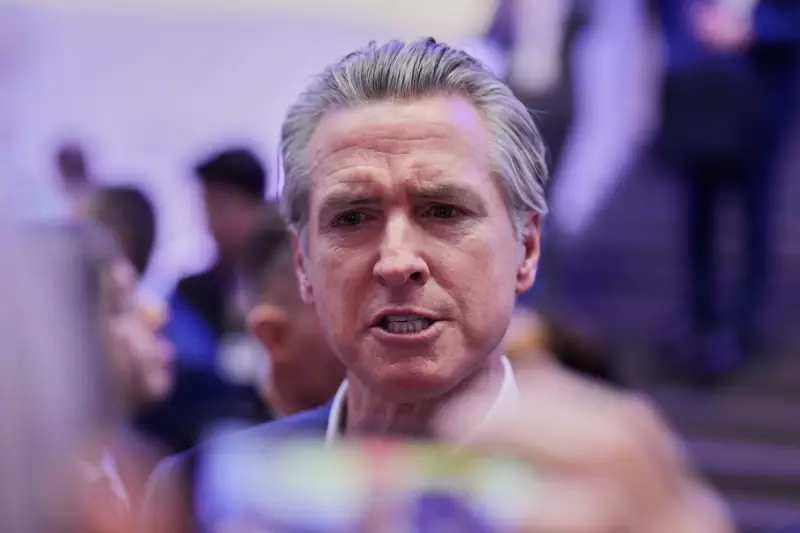
As the annual gathering of political and business elites convened in Switzerland, the Greenland crisis dominated discussions, with European leaders issuing stark warnings about the erosion of international norms while California Governor Gavin Newsom employed particularly colourful language to express his frustration.
European Leaders Voice Grave Concerns
French President Emmanuel Macron, addressing attendees while wearing aviator sunglasses due to an eye infection, delivered a sobering assessment of the geopolitical landscape. "It's a shift towards a world without rules," Macron declared, "where international law is trampled underfoot and where the only law that seems to matter is that of the strongest."

The French leader specifically criticised what he termed "a new colonial approach" that threatened to undermine decades of international collaboration, while taking direct aim at American trade policies he described as "fundamentally unacceptable."
Newsom's Blunt Assessment
California Governor Gavin Newsom, a prominent Democratic figure, offered perhaps the most direct commentary in the forum's entrance hall. "I can't take this complicity," Newsom stated, "People rolling over. I should've brought a bunch of knee pads for all the world leaders."
The governor continued with his scathing critique of current diplomatic approaches to the Trump administration: "Diplomacy with Donald Trump? He's a T-Rex. You mate with him or he devours you. One or the other... Stop with this diplomacy of sort of niceties."
Middle Powers Seek Alternative Paths
Canadian Prime Minister Mark Carney, drawing on his experience as both a political leader and former central banker, urged nations outside the top tier of global power to forge new alliances. "Middle powers do not have the luxury of going it alone," Carney explained, "In a world of great power rivalry, the countries in between have a choice: compete with each other for favour or combine to create a third path with impact."
The Canadian leader offered a memorable analogy for the position of smaller nations: "If we're not at the table, we're on the menu." He explicitly rejected American territorial ambitions in the Arctic, affirming Canada's support for "Greenland and Denmark's unique right to determine Greenland's future."
European Unity Tested
Belgian Prime Minister Bart De Wever framed the Greenland controversy as a fundamental test for transatlantic relations. "So many red lines have been crossed," De Wever remarked during a panel discussion about Europe's global position. "Being a happy vassal is one thing. Being a miserable slave is something else."
The Belgian leader, who plans to meet with President Trump alongside King Philippe, invoked Italian philosopher Antonio Gramsci while suggesting the future of Western alliances now rests with American leadership: "It's up to him to decide if he wants to be a monster - yes or no."
Administration Defense and European Response
With President Trump scheduled to address the forum later in the week, Treasury Secretary Scott Bessent presented the administration's perspective, attempting to downplay the apparent rift. "I think our relations have never been closer," Bessent claimed, urging critics to "calm down the hysteria" surrounding the Greenland issue.
European Commission President Ursula von der Leyen countered this optimistic assessment, warning of a dangerous "downward spiral" in Western diplomacy that would benefit common adversaries. "The proposed additional tariffs are a mistake, especially between long-standing allies," von der Leyen asserted, reminding attendees that "in politics, as in business, a deal is a deal."
The Commission president suggested Europe might need to pursue greater independence if current tensions persist: "If this change is permanent, then Europe must change permanently too."

Broader Implications for Global Order
The Davos exchanges revealed deepening fractures in traditional Western alliances, with leaders expressing concern about the erosion of multilateral frameworks that have governed international relations for decades. The Greenland controversy has emerged as a symbolic flashpoint in broader debates about sovereignty, territorial integrity, and the future of global governance structures.
As the forum continues, observers will monitor whether these strong statements translate into concrete policy shifts or whether diplomatic channels can accommodate the significant differences now apparent between traditional allies.