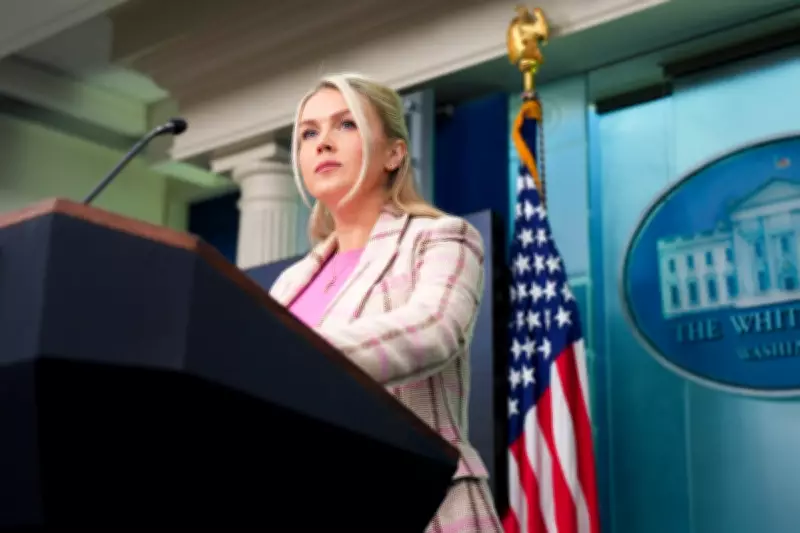
White House Press Secretary Karoline Leavitt has firmly dismissed concerns over a potential Iranian drone attack on the United States, following an FBI bulletin that alerted West Coast law enforcement to the threat. The bulletin, issued on Wednesday, warned that Iran allegedly aspired to conduct a surprise attack using unmanned aerial vehicles from an unidentified vessel off the coast of California, targeting unspecified locations in the state.
Leavitt's Strong Rebuttal
In a statement posted on social media on Thursday, Leavitt asserted, "TO BE CLEAR: No such threat from Iran to our homeland exists, and it never did." She emphasized that the FBI's alert was based on a single, unverified tip, noting that the email to local law enforcement in California explicitly stated the intelligence was unverified. Leavitt criticized ABC News for reporting on the bulletin, accusing the agency of spreading false information to intentionally alarm the American public and calling for a retraction of the story.
FBI Bulletin Details
The FBI bulletin, acquired by the agency in early February 2026, indicated that Iran's alleged plans were contingent on the U.S. conducting strikes against Iran. It specified that the attack would involve drones launched from an unidentified vessel, targeting California. This information prompted heightened vigilance among law enforcement agencies along the West Coast, though Leavitt downplayed its significance, labeling it as unreliable and unsubstantiated.

California Governor's Response
Meanwhile, California Governor Gavin Newsom addressed the situation, stating that drone-related issues have always been a priority for the state. On Wednesday, he remarked, "We've been aware of that information. ... It's all about a posture of preparedness for worst-case scenarios." Newsom's comments reflect a cautious approach, emphasizing readiness without confirming the validity of the threat, in contrast to Leavitt's outright dismissal.
Broader Implications
This incident highlights ongoing tensions between the U.S. and Iran, with cybersecurity and drone warfare becoming increasingly prominent in national security discussions. The conflicting responses from federal and state officials underscore the challenges in assessing and communicating potential threats, particularly when based on unverified intelligence. As debates over national security protocols continue, this episode serves as a reminder of the delicate balance between preparedness and public reassurance in an era of evolving global threats.