
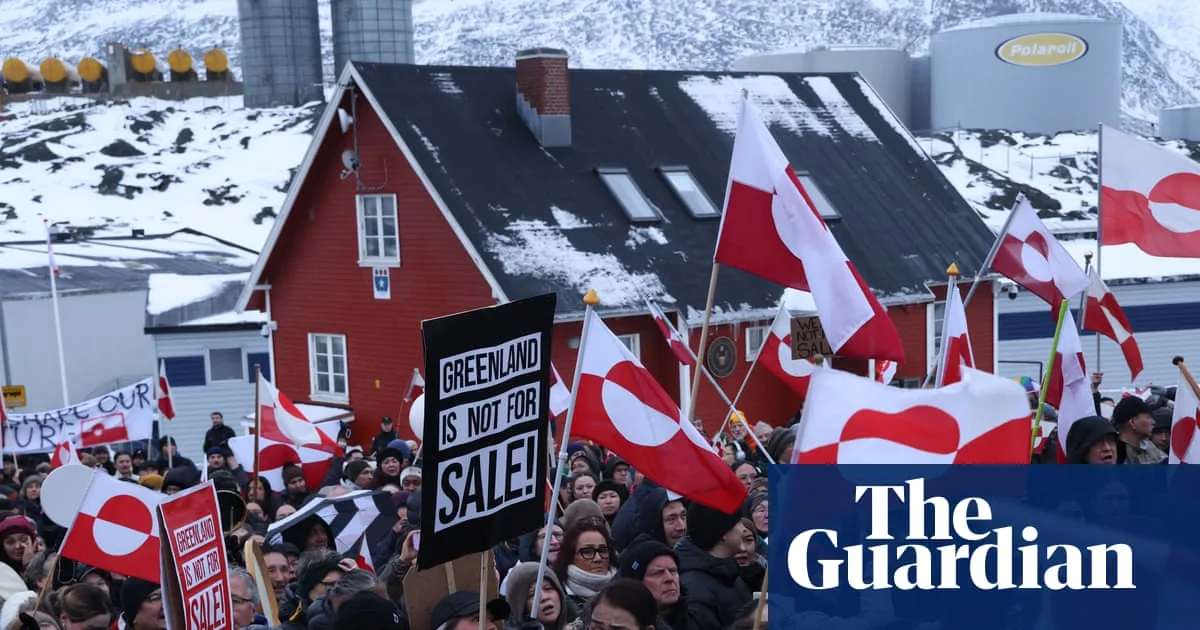
Greenland, the world's largest island, is being thrust into the global spotlight as Donald Trump's threats to gain control over the Danish territory are taken increasingly seriously. The largely autonomous region, sparsely populated but strategically vast, sits between North America, Europe and Russia. As the Arctic ice melts, its importance is growing fast, opening up new sea routes and exposing valuable mineral resources.
Miranda Bryant, the Guardian's Nordic correspondent, recently returned from Greenland's capital, Nuuk. She observed a marked shift in mood since Trump's re-election. 'Returning this January, the tone and the mood was quite markedly different in terms of how seriously Trump's threats were being taken,' she said. Families are quietly wondering whether they will have to flee as politicians find themselves in the sights of a superpower.
The melting ice is transforming Greenland from a frozen backwater into a vital piece of infrastructure. In any future conflict between nuclear powers, missiles would pass over the polar region. The US already operates early-warning systems at Pituffik in north-west Greenland. Russia has rebuilt cold war-era bases across its Arctic coastline, and China has declared itself a 'near-Arctic state'. For Trump, access and cooperation are no longer enough; control is the prize.
Trump's rhetoric has forced a brutal reprioritisation in Greenland's politics. All major parties support eventual independence from Denmark, but security concerns have pushed sovereignty down the agenda. Premier Jens-Frederik Nielsen stated: 'Greenland does not want to be part of the US … We choose the Greenland we know today, which is a part of the Kingdom of Denmark.' However, the second biggest party, Naleraq, thinks Greenland should negotiate directly with the US, without Denmark, creating a crack Trump could exploit.
Denmark's military presence in Greenland is more than the two dog sleds Trump has mocked it as, but it is not a dominant presence. As the Arctic ice continues to retreat, the island's strategic value will only increase, making it a focal point of global geopolitics.




