Venezuela's Uncertain Future: Hope and Fear After US-Led Regime Change
Thirty days after the United States military captured then-President Nicolás Maduro, Venezuela remains in a profound state of turmoil. The nation is grappling with a complex mix of hope for economic relief and fear of further instability, as the initial shock of the dramatic regime change gives way to a lingering atmosphere of uncertainty.
A Nation in Limbo
Time in Venezuela feels distorted, moving both too fast and too slow for its citizens. The pillars of the country's long-standing socialist government are either collapsing at a dizzying pace or not quickly enough to satisfy public demands. Economic relief, desperately needed by millions, is perceived as either finally on the horizon or already tragically too late to prevent further hardship.
Adults and children alike are struggling to comprehend the events unfolding around them. The pervasive fear of another military attack or renewed government repression continues to hang over daily life, even as some dare to hope for positive change.

Caracas: A Capital of Contradictions
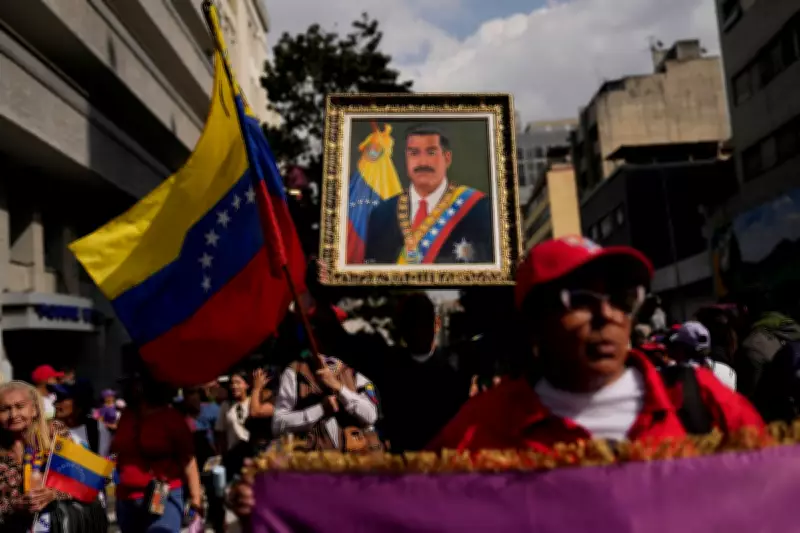
In the capital, Caracas, government-sponsored billboards and graffiti demand the release of Nicolás Maduro, creating a visual landscape of defiance. Yet, among residents, there is deep scepticism about the autonomy of acting President Delcy Rodríguez.
Many question whether she is merely capitulating to White House demands, acting as Maduro by another name, or if she possesses genuine independence. Crucially, for citizens facing extreme poverty, there is uncertainty about whether to believe her promises of a long-sought wage increase.
"It's an important change, certainly, but everything is the same, everything," said retiree Julio Castillo, 74, reflecting a widespread sentiment of disillusionment. "I feel as if nothing much has happened."
Government Under Coercion
Venezuela's ruling party and its supporters consider the capture of Maduro and First Lady Cilia Flores to be an act of kidnapping. Acting President Rodríguez and senior officials have pledged to fight for their freedom since US President Donald Trump announced the seizure in early January.
The party has organised demonstrations to show loyalty to Maduro, the chosen successor of the late Hugo Chávez. Their messaging has evolved from threatening a Vietnam-like war with the US to admitting military inferiority and the need to transform the relationship with what they term Goliath.
"The Venezuelan state, and Venezuelans, are accepting this new situation in which we are acting under coercion," said José Vivens, a Maduro loyalist and justice of the peace, referring to Rodríguez's decision to allow US control over Venezuela's vital oil revenues.
Vivens described the night of the attack, hearing a loud whistle and deafening explosion before seeing helicopters flying alarmingly close to his Caracas apartment building. "They've invaded us," was his immediate thought, though he later learned the precise target was Maduro's capture at a nearby compound.
Abandoning Socialist Pillars
Rodríguez has used public events and meetings with Venezuela's private sector to assert her authority, insisting that she, not the Trump administration, governs the country. However, she has acknowledged having a mutual agenda with the United States, a concept unthinkable just weeks earlier.
"The people of Venezuela do not accept orders from any external factor," she declared during a meeting with oil executives. "The people of Venezuela have a government, and this government obeys the people."
Yet her proposed overhaul of the nation's energy law, swiftly approved by lawmakers, opens the oil sector to privatisation, abandoning a fundamental pillar of Chavismo. This move follows Trump's assertion that his administration would take control of Venezuela's oil exports to revitalise the industry through foreign investment.

Opposition Bafflement and Testing Waters
Many within Venezuela's opposition had long expected that Maduro's ouster, particularly if led by Trump, would immediately result in one of their own taking power. Trump's decision to work with Rodríguez instead of opposition leader and Nobel Peace Prize laureate María Corina Machado has left them confused and disappointed.
As Machado's supporters seek signs of White House inclusion, Venezuelans have begun testing Rodríguez's commitment to what she calls a new political moment. Dozens have kept vigil outside prisons demanding the release of loved ones detained for political reasons, including journalists, human rights advocates, and military personnel.
Several opposition leaders who had been silent or in hiding for over a year have reemerged. "I believe that Venezuela's destiny cannot be an oil agreement and a dictatorship headed by Delcy Rodríguez, because we could simply define that as a continuation of the dictatorship," said opposition leader Andrés Velásquez.
In a significant development, a privately owned television channel aired a clip of Machado addressing reporters in Washington, something not seen in years from either public or private media.
Persistent Fear and Self-Censorship
Despite these changes, many Venezuelans continue to self-censor, remaining deeply fearful of government repression. Social media posts avoid political topics, WhatsApp messages refrain from criticising the government, and some video calls involve writing and erasing information on whiteboards for added security.
There have been no large demonstrations calling for a new government or presidential elections. Nor has anyone dared to publicly celebrate Maduro's capture, even if many had long hoped to see him apprehended. Many opposition leaders remain in exile, and wanted posters for the opposition's 2024 presidential candidate, Edmundo González, still adorn airports and government offices.
Balancing Hope and Fear in Daily Life
The psychological impact on citizens, particularly children, has been severe. Margaret García, a teacher, described how her son could not sleep for days after January 3rd and feared returning to school, worried about what to do if another attack occurred.
"We thought we were going to die," she said of the moment her family heard a helicopter open fire near their 15-story apartment building close to where Maduro was captured.
This fear is widespread, with many Venezuelans apprehensive about a second attack if Rodríguez's government fails to meet US expectations, despite Washington's assurances against further escalation. US Secretary of State Marco Rubio told a Senate committee, "I can tell you right now with full certainty, we are not postured to nor do we intend or expect to have to take any military action in Venezuela at any time."
Economic Desperation and Cautious Optimism
García expressed difficulty understanding how anyone could find satisfaction in a US operation that killed dozens. However, she acknowledged that under Rodríguez's leadership, the country might finally see the lasting economic improvements workers have desired for over a decade.
The economic reality remains dire. Many public sector workers survive on roughly $160 per month, while the average private sector employee earned about $237 monthly last year. Venezuela's monthly minimum wage of 130 bolivars, equivalent to just $0.35, has not increased since 2022, placing it far below the United Nations' measure of extreme poverty at $2.15 per day.
"We see that a negative moment has brought us positive things," García said, reflecting the cautious optimism some feel about potential changes Rodríguez has signalled, particularly regarding an envisioned oil boom.
As Venezuela navigates this unprecedented period, its people balance fragile hope against deep-seated fear, uncertain whether the US-imposed government change will lead to genuine improvement or merely a different form of struggle.