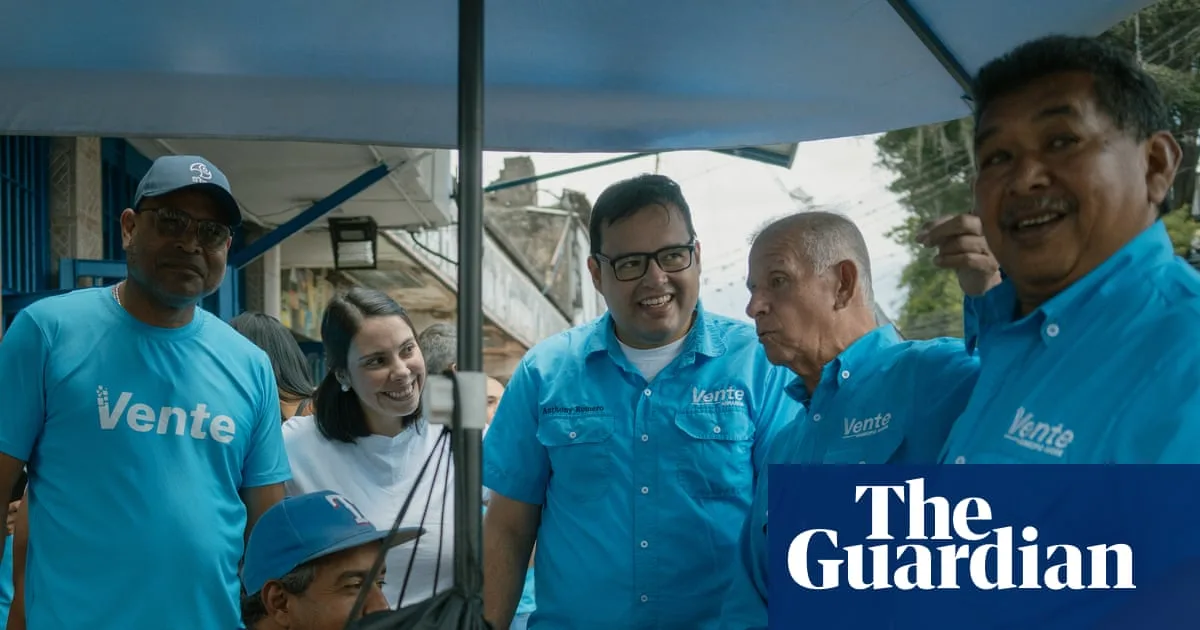
Venezuela's Opposition Faces Uncertainty as Maduro's Regime Endures Without Him
Venezuela's Opposition in Limbo After Maduro's Removal

The dramatic capture of Venezuela's authoritarian leader, Nicolás Maduro, by the United States has not delivered the clean democratic breakthrough many activists had hoped for. With the regime's core structure still firmly in place under acting president Delcy Rodríguez, the nation's opposition is now grappling with a profound sense of uncertainty over its next strategic move.

A Regime Intact, Repression Unabated

Despite the removal of Maduro and the US taking control of Venezuela's vital oil industry, the administration of former US President Donald Trump chose to leave the former dictator's entire cabinet in charge. The White House claimed this structure would now operate under its oversight, but activists report that state repression has continued unabated.

Armed colectivo militias still patrol the streets, searching citizens' mobile phones. In one incident, a group of teenagers was detained for allegedly celebrating Maduro's capture and was only released after a week. Furthermore, despite promises of a mass release, nearly 1,000 political prisoners remain incarcerated for criticising or protesting against the government.

Wide Pickt banner — collaborative shopping lists app for Telegram, phone mockup with grocery list

Sociologist and activist Rafael Uzcátegui, co-director of the NGO Laboratorio de Paz, describes the current situation as "Chavismo 3.0". He argues that with Delcy Rodríguez, her brother Jorge Rodríguez, and feared figures like interior minister Diosdado Cabello still wielding power, the movement founded by Hugo Chávez has simply evolved. "So far, state terrorism remains in place," Uzcátegui stated, expressing deep doubts about the route to a democratic transition.

The Constitutional Quandary: Elections or Installation?

The opposition is united on the desired outcome but divided on the immediate path. There is broad agreement that Venezuela must either hold new, free elections or install retired diplomat Edmundo González, who is widely believed to have legitimately won the 2024 presidential vote before it was stolen by the regime.

María Corina Machado, the main opposition leader and Nobel peace prize winner who was barred from running, has demanded González be sworn in. However, neither option appears to be a current priority for the US administration. Trump has publicly stated that the US must first "rebuild" Venezuela and claimed Venezuelans "wouldn't even know how to have an election right now."

Uzcátegui and others argue that, constitutionally, a new election should be called within three to six months. He fears the Rodríguez siblings plan to cling to power until the 2030 elections, hoping an economic recovery driven by reopened US relations could legitimise them. "Elections should not be at the end of the transition, but at its beginning," he contends, while acknowledging internal opposition debates about undermining the significance of the 2024 result.

A Long Road from Dictatorship to Democracy

Activists stress that the foundations for democracy have been systematically dismantled over more than two decades. Griselda Colina, director of the Global Observatory for Communication and Democracy, noted that not a single public institution remains free from Chavista control. A swift transition, therefore, seems unlikely.

The space for civil society has shrunk further since the 2024 "anti-NGO law" was passed, requiring government authorisation to operate. Most groups still working inside Venezuela now focus solely on humanitarian aid, such as supporting the families of political prisoners.

Deborah Van Berkel of Ideas por la Democracia summarised the mood among activists as "a combination of a certain hopeful expectation, but also a great deal of caution." For any new election to be credible, she lists essential pre-conditions: a truly independent electoral council, unrestricted international observers, a free press, and guarantees of democratic governability for the winner.

Despite the daunting challenges, a resilient hope persists. "We are a people who refuse to live under dictatorship," said Colina. "We carry a democratic reserve in our minds and aspirations – and that has not disappeared." The struggle for Venezuela's future continues, but the immediate roadmap remains frustratingly unclear.

Pickt after-article banner — collaborative shopping lists app with family illustration




