
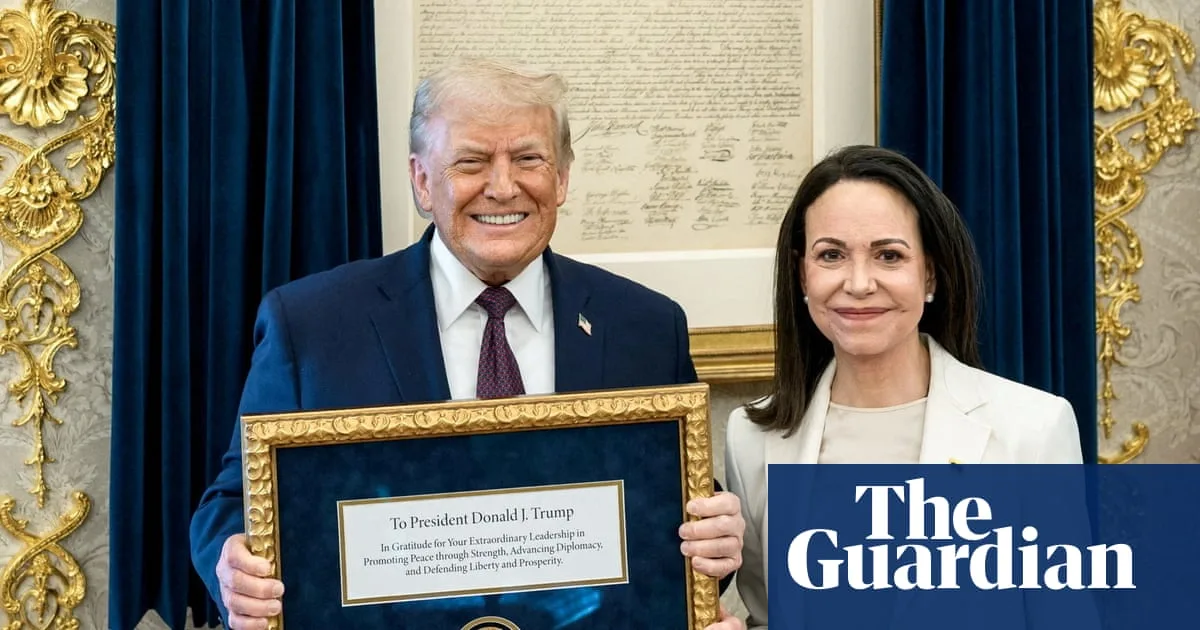
Venezuelan opposition leader María Corina Machado has presented her gold Nobel peace prize medal to Donald Trump during a meeting at the White House, nearly a fortnight after the US president ordered the abduction of Venezuela’s president, Nicolás Maduro.
Machado, who received the award last year for her struggle against Maduro’s “brutal, authoritarian state”, told reporters she had done so “in recognition [of] his unique commitment [to] our freedom”. Several hours later, Trump wrote on Truth Social that Machado “presented me with her Nobel peace prize for the work I have done. Such a wonderful gesture of mutual respect.”
The White House later circulated a photograph showing the framed medal, with a text reading: “Presented as a personal symbol of gratitude on behalf of the Venezuelan people in recognition of President Trump’s principled and decisive action to secure a free Venezuela.” Earlier in the day, Nobel organisers posted on X: “A medal can change owners, but the title of a Nobel peace prize laureate cannot.”
Machado’s movement is widely believed to have beaten Maduro in Venezuela’s 2024 election, but she was unexpectedly sidelined after US special forces captured her political rival in January. Instead, Trump backed Maduro’s vice-president, Delcy Rodríguez, who was sworn in as acting president. Trump had previously said Machado “doesn’t have the support or the respect within the country” to take power.
Analysts saw Machado’s gesture as an attempt to salvage her movement’s waning hopes of taking power. She compared handing over her medal to the Marquis de Lafayette’s 1825 gift of a gold medal featuring George Washington to Simón Bolívar, calling it “a sign of the brotherhood between the people of the US and the people of Venezuela in their fight for freedom against tyranny”.
Machado is not the first Nobel laureate to part with her medal: Ernest Hemingway entrusted his to the Catholic Church in Cuba, Dmitry Muratov auctioned his to help Ukrainian refugees, and Leon Lederman sold his. However, she appears to be the first to do so for such explicitly political reasons, although in 1943 the Norwegian writer Knut Hamsun gave his to Joseph Goebbels as a sign of admiration for the Nazis.




