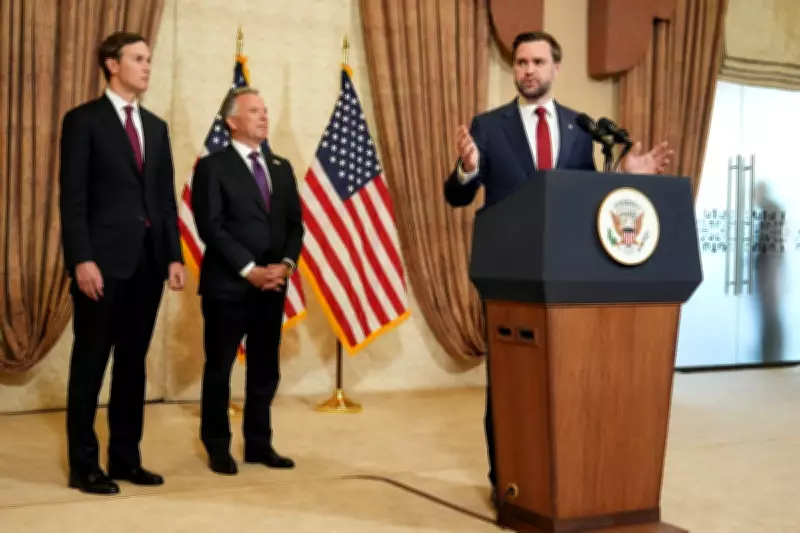
Vance Accuses Iran of 'Economic Terrorism' in Strait of Hormuz Crisis
US Vice President JD Vance has launched a scathing accusation against Iran, labelling its blockade of the strategic Strait of Hormuz as an act of 'economic terrorism against the entire world'. The inflammatory remarks came as American warships initiated a blockade of Iranian ports, dramatically escalating tensions and placing a fragile two-week ceasefire agreement in severe jeopardy.
'Two Can Play That Game' - Vance Issues Stark Warning
In a televised interview with Fox News on Monday, Vance delivered a stark warning to Tehran. 'They've basically threatened any ship that's moving through the Strait of Hormuz. Well, as the President of the United States showed, two can play at that game,' he declared. This rhetoric underscores a significant hardening of the US position, directly linking military action to Iran's maritime strategy.
The Vice President's comments followed the conclusion of a first round of diplomatic talks in Islamabad, which he described as having 'made a lot of progress' but ultimately falling short. 'I wouldn't just say that things went wrong. I also think things went right... They moved in our direction... but they didn't move far enough,' Vance stated, indicating the Iranian delegation required approval from Tehran on terms ostensibly 'set' by the US side.

Military Escalation and International Reactions
The situation on the ground intensified rapidly. President Donald Trump ordered the US military to blockade Iranian vessels and any ships paying tolls to cross the strait, with a statement threatening to eliminate any 'fast-attack' ships approaching the blockade. In a tit-for-tat response, Iran's Revolutionary Guards declared that military vessels approaching the strait would be considered a ceasefire breach and dealt with 'harshly and decisively'.
International allies displayed caution. NATO members Britain and France explicitly stated they would not be drawn into the conflict by participating in the blockade. UK Prime Minister Sir Keir Starmer emphasised his focus was on reopening the strait 'as quickly as possible' to alleviate soaring global energy prices, confirming that UK minesweepers and anti-drone capabilities would remain operational in the region.
Diplomatic Stalemate and Nuclear Demands
Vance outlined the US negotiating stance, suggesting Washington had communicated where it could 'make some accommodation' and where it would remain inflexible. A core, non-negotiable demand, according to Vance, was President Trump's insistence that any enriched nuclear material must be removed from Iran, with a robust verification mechanism established to prevent nuclear weapons development.
Insights from the negotiations, reported by the New York Times, reveal a US proposal for a 20-year 'suspension' of all Iranian nuclear activity, effectively deferring a final resolution to a future administration. Despite the military posturing, diplomatic channels remain tentatively open, with four unnamed sources telling Reuters that negotiating teams from both sides could reconvene in Islamabad this week.
Market Responses and the Path Forward
Remarkably, financial markets responded with cautious optimism. European shares rose on Tuesday, and benchmark crude oil prices fell below $100 per barrel, suggesting investors retain hope for a peaceful resolution. This occurs against the backdrop of a critical deadline, with just one week remaining in the two-week ceasefire originally designed to pave the way for a more enduring peace deal. The world now watches as military brinkmanship and fragile diplomacy collide in one of the globe's most vital maritime chokepoints.