US Weighs Sending Forces into Iran to Secure Nuclear Stockpile
The Trump administration is reportedly considering the deployment of special forces into Iran to secure its stockpile of highly enriched uranium (HEU), which experts say could be used to make at least 10 nuclear warheads. Preventing Iran from acquiring a nuclear bomb is one of Trump's stated war aims, and the 440kg HEU stockpile represents the greatest nuclear threat as it could be turned into weapons-grade uranium relatively easily.
Complexity and Risk of Operation
US Secretary of State Marco Rubio has told Congress that "people are going to have to go and get it." Rubio did not go into greater detail, but there have been US and Israeli reports on discussions between the two countries on how such a mission might be carried out by special forces from either or both militaries. Nuclear experts say the complexity and risk involved would be considerable.
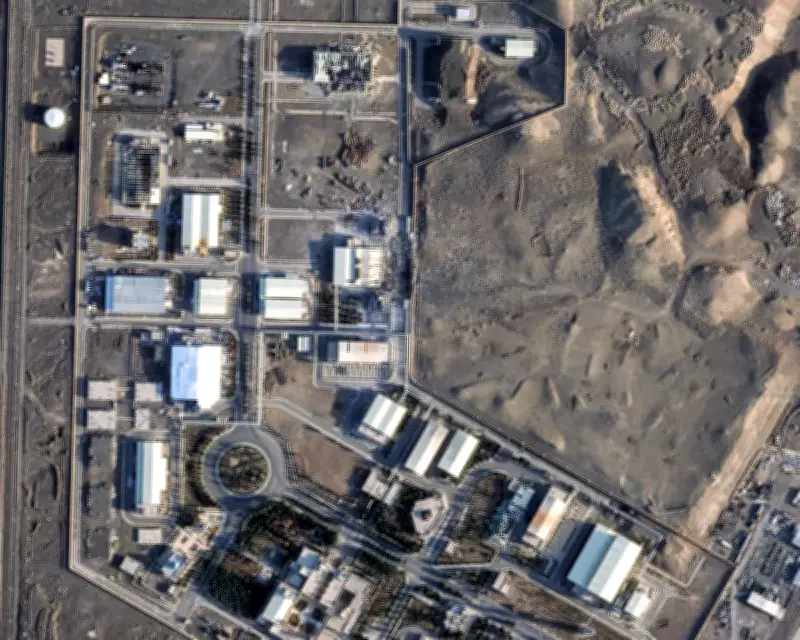
Rafael Grossi, the director general of the International Atomic Energy Agency (IAEA), said on Monday that the UN watchdog body believed that 200kg of Iran's HEU stockpile was in deep tunnels at its nuclear complex outside the city of Isfahan. He added that there was another "amount" of HEU in another nuclear centre at Natanz, where Iranians have constructed a new fortified and deeply buried facility called Kuh-e Kolang Gaz La, known to western analysts as Pickaxe Mountain.

Logistical Challenges
The HEU is in the form of uranium hexafluoride, which is solid at room temperature but turns into a gas when heated allowing it to be further enriched. It is believed to be stored in metal canisters each about the size of a scuba diving tank, stored down deep shafts. US and Israeli special forces have long trained for missions to extract nuclear materials from hostile environments, and the US has developed equipment, known as the Mobile Uranium Facility, designed to contain and remove HEU.
But deploying it along with specialists and a force to protect them would involve major ground operations in at least two sites, both deep in Iran's interior. "That would be tough. It is pretty well defended and its large and bulky, so you're not going to just go in and pick it up," said Jeffrey Lewis, a nuclear proliferation expert at the Middlebury Institute of International Studies at Monterey.
Political and Strategic Considerations
Questioned on the issue on Saturday, Donald Trump acknowledged the challenge involved, and suggested such an operation was not imminent. The president said US troops would not be sent in until Iranian defending forces "would be so decimated that they wouldn't be able to fight on the ground level." He did not rule out a ground operation to secure nuclear material but said it would be at a later stage in the conflict.
The administration's critics have expressed astonishment that a mission to secure the HEU did not appear to have been thought through before the war was launched. A Democratic congressman, Bill Foster, emerged from a classified briefing on the war last week saying he had heard nothing about a plan to address Iran's nuclear capabilities.
Alternative Solutions and Monitoring
Matthew Bunn, a nuclear policy analyst at the Harvard Kennedy School, said it was "just shocking to launch a military operation like this, justified by the nuclear danger, and not have a plan for dealing with the most urgent part of the nuclear danger." He added that the best solution was a postwar deal in which the HEU was diluted or shipped out of the country.
Such solutions were being negotiated in US-Iranian talks brokered by Oman that were under way when Israel and US launched their attack on 28 February. Trying to ship the HEU without Iranian compliance, blending it down or blowing it up where it is, all posed enormous problems, Bunn said.
"For now, it appears the United States and Israel are relying on close monitoring of the site to make sure the canisters aren't removed, while they figure out what to do longer-term," he said. "As long as it stays in Iran, the plan is that if anyone gets near it, they will be killed. That is the strategy as it stands," said Meir Javedanfar, an Iran expert at Reichman University in Israel.

Iran's Nuclear Dilemma
Even if they were able to whisk the HEU out of sight, the surviving members of the Iranian regime meanwhile would also face enormous risks if they attempted to "race to a bomb." Further enrichment, turning the weapons-grade uranium into a metal, shaping it, building an explosive device to trigger it and putting it on a missile or other delivery system, could theoretically be done in a few months, but doing it without being detected would be extremely hard.
Robert Malley, who was the US special envoy to Iran in the Biden administration, said that was the dilemma that had faced the Iranian regime for years. "In the period I was there, there was increasing chatter openly in Iran and in other channels that suggested that they were thinking for the first time in a long time seriously about whether they should acquire a bomb," Malley said.
"I think the problem was always from the moment you make the decision to the moment you acquire the bomb, that's the zone of maximum danger when you're likely to be detected," he added. "And if you're detected you're almost certain to be bombed. And that problem hasn't evaporated." He added: "I'm not saying it's impossible, but it would be a really very dangerous gamble."