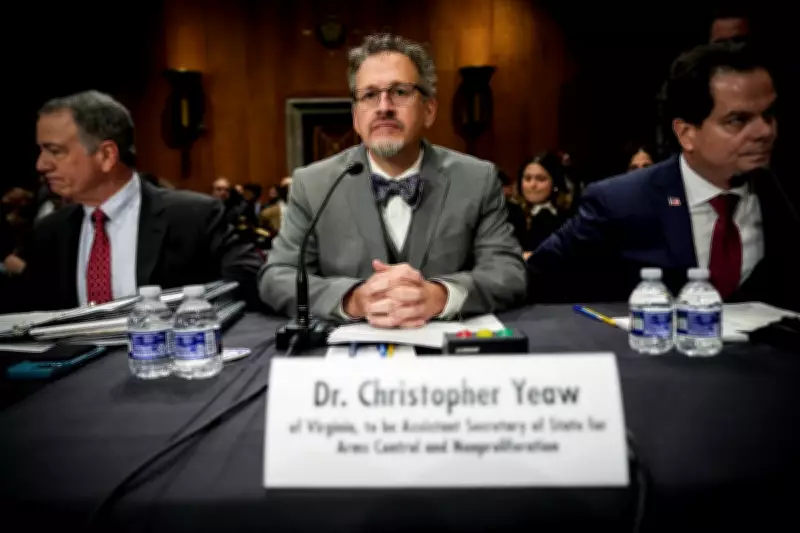
US Arms Control Official Declassifies Details of Alleged Chinese Nuclear Test
A senior United States official specialising in arms control has publicly disclosed what he described as newly declassified information concerning an alleged Chinese underground nuclear test that occurred nearly six years ago. Christopher Yeaw, the Assistant Secretary of State for the Bureau of Arms Control and Nonproliferation, presented the details on Monday, urging the international community to exert pressure on both China and Russia to enhance their commitments to nuclear disarmament.
Post-New START Expiration Raises Global Concerns
Yeaw delivered his remarks to a United Nations-backed body, the Conference on Disarmament in Geneva, following the expiration this month of the last remaining nuclear arms control pact between the United States and Russia. The lapse of the New START treaty has effectively terminated limits on the arsenals of the world's two largest nuclear powers, sparking widespread apprehension about the potential onset of a new and destabilising arms race.
In his address, Yeaw criticised the New START treaty for several shortcomings, notably its failure to address Russia's substantial arsenal of non-strategic nuclear weapons, estimated to include up to 2,000 warheads. "But perhaps its greatest flaw was that New START did not account for the unprecedented, deliberate, rapid and opaque nuclear weapons buildup by China," he told the assembled delegates.

Seismic Data Points to "Probable Explosion" at Lop Nur
The US official cited specific seismic data collected from an international monitoring station in neighbouring Kazakhstan. He referenced an event detected at China's Lop Nur underground test site in western China on June 22, 2020, registering a magnitude of 2.75.
"It was a probable explosion based upon comparisons between historic explosions and earthquakes," Yeaw asserted. "The seismic signals were indicative of a single fire explosion, not typical of mining explosions." He further accused China of making it "difficult" for the international community to monitor its testing activities, noting that Beijing had rejected proposals to allow seismic testing stations at a comparable distance to Lop Nur, similar to what the US permits near its Nevada test site.
US Calls for Transparency Amidst Rapid Chinese Buildup
Yeaw expressed deep concern over China's nuclear expansion, stating that Beijing "has deliberately, and without constraint, massively expanded its nuclear arsenal" despite public assurances to the contrary. He lamented a complete lack of transparency regarding China's ultimate nuclear goals or "endpoint." "We believe China may achieve parity within the next four or five years," he warned, referencing US intelligence assessments.
Secretary of State Marco Rubio, writing earlier this month, provided specific figures: "Since 2020, China has increased its nuclear weapons stockpile from the low 200s to more than 600 and is on pace to have more than 1,000 warheads by 2030." The US has stated its willingness to pursue diplomatic solutions through various channels—bilateral, small-group, or broader multilateral talks—to address these developments.
China Rejects Accusations as "Unfounded" and Politically Motivated
China's ambassador to the conference, Jian Shen, delivered a robust rebuttal on Monday. He stated that Beijing "resolutely rejects the unfounded accusations" by the United States and condemned what he called the "continued distortion and smearing of China’s nuclear policy by certain countries."
"The U.S. accusation that China conducted a nuclear explosion test is completely unfounded and is merely a pretext for resuming its own nuclear testing," Ambassador Shen declared. He argued that it was "unfair, unreasonable and unfeasible" to demand China participate in three-way nuclear arms control talks with the US and Russia, given the disparity in arsenal sizes and differing strategic security environments.
Shen reaffirmed China's support for the goals of the Comprehensive Nuclear Test Ban Treaty, insisting Beijing has "always adhered" to commitments by nuclear weapons states to suspend testing and has "never" engaged in treaty-violating activities.

Diplomatic Engagements and Historical Context
The diplomatic exchanges in Geneva occurred amidst a series of meetings. Yeaw met with a Russian delegation on Monday and was scheduled to meet with Chinese and other national delegations on Tuesday. US officials have also held repeated consultations with partners, including nuclear-armed allies France and Britain.
The issue resonates with recent history. In October, President Donald Trump indicated US intentions to resume nuclear testing for the first time since 1992, though Energy Secretary Chris Wright later clarified such tests would not involve nuclear explosions. During his first term, President Trump unsuccessfully attempted to broker a trilateral nuclear pact that would include China.
In his concluding appeal to the conference, which brings together approximately 65 countries, Yeaw called for collective action: "We are looking to all of you to help encourage nuclear-weapon states like China and Russia to engage meaningfully in a multilateral process." The international community now faces heightened tensions and a critical challenge in fostering dialogue to prevent a renewed and dangerous nuclear arms competition.