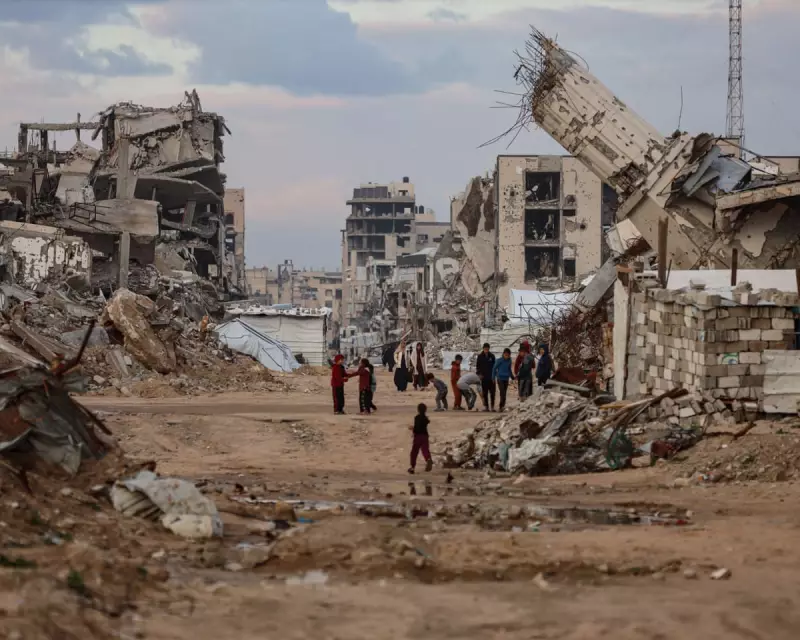
The United States has formally announced the commencement of the second phase of the ceasefire plan for Gaza, a move that includes establishing a committee of Palestinian technocrats intended to assume the day-to-day administration of the war-torn territory.
A Committee of Technocrats to Take the Helm
The announcement was made via social media by Steve Witkoff, the special envoy appointed by former US President Donald Trump. However, the statement provided no specific details or names for the proposed "national committee for the administration of Gaza." This committee, expected to be composed of non-political experts, is not slated to begin its work until it receives a mandate from a Trump-chaired "peace board," which itself has not yet been formed.
Witkoff stated that this second phase would initiate the "full demilitarisation and reconstruction of Gaza," with a primary focus on disarming all unauthorised armed groups. This comes amidst a backdrop where no agreement has been reached on disarming Hamas, the militant group that controls the strip.

Ongoing Violence and Hostage Concerns
Despite the ongoing truce process, violence has not fully abated. The Israeli military bombardment has lessened in intensity but has not ceased entirely. According to reports, approximately 450 Palestinians have been killed since the initial ceasefire began on 10 October. That first phase involved a prisoner exchange, with Israeli hostages held by Hamas swapped for Palestinian detainees in Israeli jails. Israeli forces subsequently withdrew to a designated truce line, maintaining control over most of the territory.
The US declaration faced criticism from some quarters. Two prominent groups representing former Israeli hostages and their families had urged Washington to delay the announcement until the remains of the final unaccounted-for hostage, Ran Gvili, were returned by Hamas. Hamas has claimed it has been unable to locate Gvili's body. In his statement, Witkoff emphasised, "The US expects Hamas to comply fully with its obligations, including the immediate return of the final deceased hostage. Failure to do so will bring serious consequences."
Regional Diplomacy and Next Steps
In a parallel development, Egyptian Foreign Minister Badr Abdelatty announced a few hours prior that an agreement had been reached on all 15 members of the interim Palestinian committee. He stated the body would be "deployed to the Gaza Strip to manage daily life and essential services." While expected to be technocrats, some members are believed to have affiliations with the Fatah party, which dominates the Palestinian Authority. Names floated as potential leaders include Ali Shaath, a former deputy minister of planning, and Majed Abu Ramadan, the current PA health minister.
Diplomatic sources indicate that the work of this transitional committee will be overseen by Nickolay Mladenov, a respected Bulgarian diplomat and former UN envoy for the Middle East peace process. Mladenov, who has been shuttling between regional capitals, would ultimately report to the prospective Trump peace board, expected to comprise a group of international leaders.
Discussions in Cairo on implementing the second phase are also said to be focusing on several critical issues:
- A further withdrawal of Israeli forces from Gaza.
- The reopening of the vital Rafah border crossing with Egypt.
- The entry of aid stockpiled on the Egyptian side of the border.
- A general increase in the flow of humanitarian goods and commercial supplies into Gaza.
The path forward remains fraught with challenges, as the US-led plan seeks to navigate complex security demands, humanitarian needs, and deep-seated political divisions within Palestinian society and across the region.