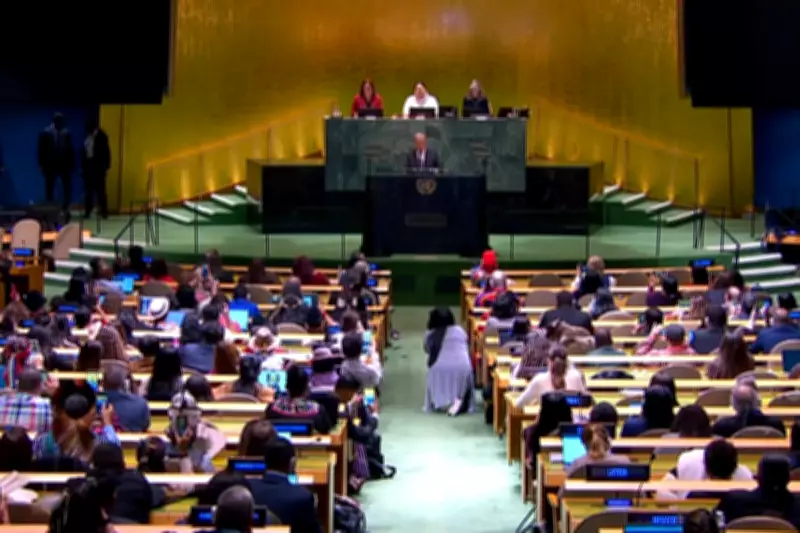
The United States and Iran have clashed over Tehran’s nuclear program as a review of the treaty meant to prevent the spread of atomic weapons got underway at the United Nations. The confrontation, which occurred during the opening session of the monthlong conference, is almost certain to be repeated throughout the meeting.
Election of Iran as Vice President Sparks Dispute
At the heart of the dispute was the election of Iran as one of 34 vice presidents of the conference, where 191 parties to the Nuclear Nonproliferation Treaty (NPT) are reviewing its implementation. This review takes place every five years since the treaty took effect in 1970. Iran was a candidate of the so-called “nonaligned movement,” comprising 121 mainly developing countries.
Tensions Over Nuclear Program Escalate
Tensions over Tehran’s nuclear program have escalated ahead of the Iran war, with President Donald Trump vowing to ensure the country cannot build an atomic weapon. Iran has enriched uranium to near weapons-grade levels, but Tehran insists its program is only for civilian purposes. The meeting began as Iran offered to reopen the Strait of Hormuz if the United States lifted its blockade of Iranian shipping and ended the war, while delaying talks about the nuclear program.

Iran is a party to the NPT, which requires cooperation with the U.N. nuclear agency. However, Iran has not given inspectors from the International Atomic Energy Agency (IAEA) access to nuclear sites that were bombed by the United States last June.
US Condemns Iran's 'Contempt' for Treaty
Christopher Yeaw, U.S. assistant secretary of state for arms control and nonproliferation, stated that while there may be differing views about Iran’s ultimate intent and how to address its program, Iran has shown “contempt” for its commitments under the treaty. “Rather than choosing to use this review conference to defend the integrity of the NPT and call Iran to account, we instead elect Iran a vice president,” Yeaw said. “It is beyond shameful and an embarrassment to the credibility of this conference.”
The United States was backed by Australia and the United Arab Emirates. The United Kingdom, France, and Germany — parties to the 2015 nuclear deal to curb Iran's nuclear program, from which Trump pulled the U.S. in 2018 — also expressed “concern.”
Iran Rebuts Allegations
Iran's ambassador to the U.N. in Vienna, Reza Najafi, called the U.S. allegations “baseless and politically motivated,” declaring its opposition to the U.S. as a vice president of the review conference. He said the United States was the only country to use nuclear weapons and accused it of expanding its nuclear arsenal in violation of the treaty and obstructing progress toward a Middle East free of nuclear weapons by supporting Israel.
Equally alarming, Najafi said, are the U.S. and Israeli attacks twice in less than a year on Iran’s “peaceful nuclear facilities,” which he called “a grave violation of international law and a direct assault on the integrity of the global nonproliferation regime.”
Russia Urges De-escalation
Russian Ambassador-at-Large Andrey Belousov, head of its delegation to the conference, objected to singling out Iran and expressed hope that the criticism and “politicization” starting on day one will not affect the outcome, which he expressed hope will be successful. Also Monday, Iranian Foreign Minister Abbas Araghchi met with Russian President Vladimir Putin, Russian state news agency Tass said. Russia broadly has stayed out of the latest conflict even as it has been floated as a possibility to take in Iran’s highly enriched uranium.
At the last treaty review conference in August 2022, which was delayed for a year because of the COVID-19 pandemic, Russia blocked agreement on a final document over its February 2022 invasion of Ukraine and references to Moscow’s occupation of the Zaporizhzhia nuclear plant and shelling at Europe’s largest nuclear power facility.

UN Chief Urges Unity Against Nuclear Threat
At the opening session Monday, U.N. Secretary-General António Guterres urged the treaty parties “to stand together and safeguard humanity from the grave threat of nuclear annihilation.” For the first time in decades, he said, the number of nuclear warheads is rising and nuclear testing is on the table. For too long, he added, the pact's commitments remain unfulfilled.
He urged all countries to recommit to disarmament and nonproliferation, and in the new technological era of artificial intelligence and quantum computing to “ensure that, until nuclear weapons are eliminated, humanity never cedes control over their use.” Under the treaty, the five original nuclear powers — the U.S., China, Russia, Britain, and France — agreed to negotiate toward eliminating their arsenals someday, and nations without nuclear weapons promised not to acquire them in exchange for a guarantee to be able to develop nuclear energy for peaceful purposes.