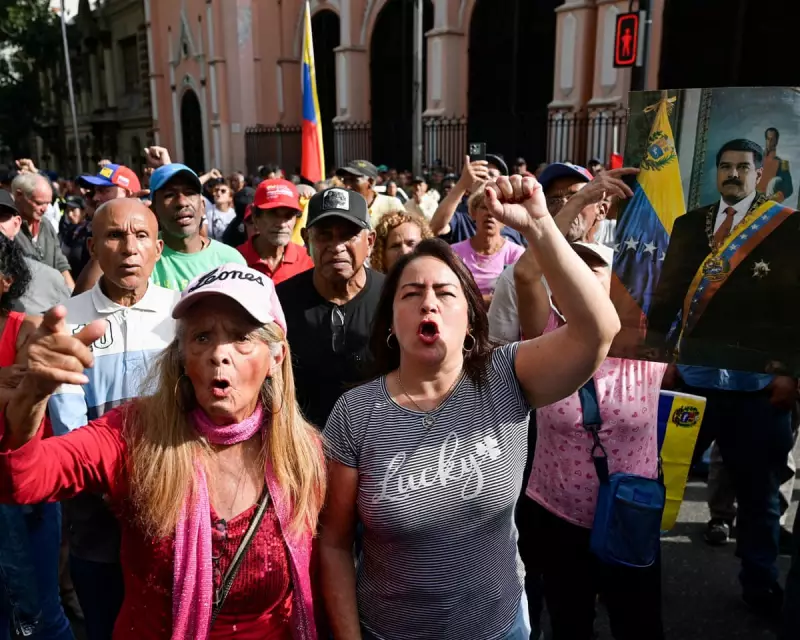
The recent military intervention by the United States in Venezuela and subsequent statements by former President Donald Trump have ignited a fierce debate over the sanctity of international law, with prominent British voices warning of a dangerous precedent.
A Clear Breach of International Norms
Legal experts and commentators argue that Mr Trump's own description of US intentions – to "run" the country until a political transition deemed acceptable by Washington occurs and to install US oil companies – outlines conduct that is plainly illegal. The UN Charter explicitly prohibits the use or threat of force against another state, except in self-defence or with Security Council authorisation. Neither condition applies to the situation in Venezuela.
This principle exists to prevent powerful nations from imposing political outcomes by force, regardless of the perceived legitimacy of a government. Trump's words have been interpreted as an admission of occupation, which under the Hague Regulations and Geneva Conventions carries strict limitations. An occupying power cannot assume sovereign authority, dictate political outcomes, or exploit natural resources for its own benefit; to do so can constitute pillage, a war crime.

UK Political Response Draws Criticism
The reaction from UK Labour leader Sir Keir Starmer has also come under scrutiny. While welcoming the end of Nicolás Maduro's regime, he declined to condemn the use of force. Critics, including letter writer Hannah Walker, contend this risks treating legality as conditional on political approval rather than as a binding rule. They note that Starmer, a human rights barrister who previously opined that the Iraq war was illegal without a UN mandate, should be more consistent in upholding this fundamental principle.
The stakes, they argue, extend far beyond Venezuela. The core case against Russia's invasion of Ukraine rests on the same inviolable rule: borders and governments cannot be changed by force. If Venezuela is treated as an exception, the entire foundation of post-war international order collapses. International law cannot be selective.
Calls for a Collective Democratic Response
Faced with what they see as the impotence of the United Nations and the overt contempt of powerful leaders for collaborative norms, other British observers are proposing concrete action. Celia Cashman from Sheffield argues that righteous indignation is insufficient. She suggests the only viable route to challenge such "hostile supremacy" is for Europe to form a new alliance with nations like Canada, South Africa, and Australia.
This coalition would need sufficient defence and trading power to provide real opposition. However, she warns that with Europe divided and resources constrained, progress is alarmingly slow. The public, she urges, must use democratic rights to protest and pressure leaders to forge this crucial alliance before it is too late.
The language used to describe events is also contested. Charlie Owen from London challenges media descriptions of Maduro being "captured," arguing that if any other country had invaded, killed civilians, and taken a head of state, it would rightly be termed an abduction or kidnap. This semantic debate underscores the profound unease about the actions taken and their implications for global justice.