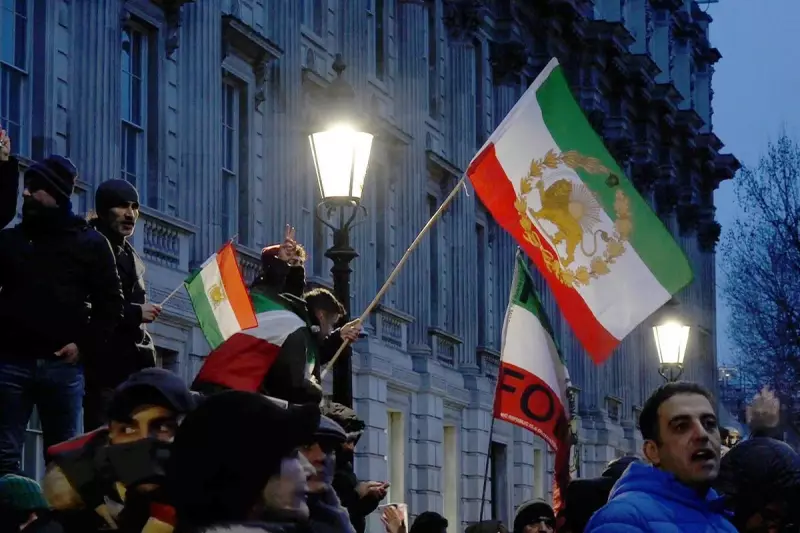
The death toll from ongoing anti-regime protests in Iran has mounted sharply, prompting the UK government to call for restraint from Tehran's leadership. The unrest, which represents the most significant challenge to Supreme Leader Ayatollah Ali Khamenei's rule in years, has seen hundreds killed and thousands detained.
London Protests Target Iranian Embassy
In central London, demonstrators have taken their solidarity directly to the Iranian embassy. For the second consecutive day, the embassy's flag was targeted. On Sunday 11 January 2026, a protester toppled the flagpole outside the building. This followed an incident the previous day where a demonstrator scaled the front of the embassy to replace the Iranian flag with the pre-Islamic revolution lion and sun standard.
The Foreign Office moved to clarify reports from Iran that the UK's ambassador in Tehran, Hugo Shorter, had been summoned over the flag incident. Official sources insisted he merely "had a meeting" at the Iranian Foreign Ministry.

UK Government Response and Calls for IRGC Ban
Earlier on Sunday, demonstrators gathered outside Downing Street to demand the UK government proscribe Iran's Islamic Revolutionary Guard Corps (IRGC) as a terrorist organisation. This call has support from senior parliamentary figures including Labour peer Lord Spellar and former Conservative leader Sir Iain Duncan Smith.
Speaking to Sky News, Transport Secretary Heidi Alexander stated that proscription decisions, made by Home Secretary Shabana Mahmood, followed a "very thorough process" kept under constant review. Ms Alexander emphasised the UK's priority was to "stem the violence" in Iran, describing the country as a "hostile state" that poses a security threat and represses its own population.
Foreign Secretary Yvette Cooper praised the bravery of protesters, stating: "It takes real courage to speak up in an authoritarian system, especially for young women." She stressed that free speech and peaceful assembly are fundamental rights that should not come with the threat of violence.
Escalating Tensions and International Stance
The protests, which began on 28 December 2025 over economic grievances, have intensified despite regime attempts to suppress them by cutting internet and telephone lines. Footage from Tehran and other cities continues to emerge on social media.
According to the US-based Human Rights Activists News Agency, the confirmed death toll has risen to at least 538, comprising 490 protesters and 48 members of security forces. More than 10,000 people have been detained in the two weeks of unrest.
Internationally, tensions are high. Iran has warned it will target US troops and Israel if former President Donald Trump carries out threats of military action. Conservative leader Kemi Badenoch indicated she would support RAF involvement, if necessary, as part of a broad coalition to help oust the Islamic Republic's leadership, citing recent RAF strikes in Syria as a precedent for such action.
The UK government's focus remains on de-escalation, with Ms Alexander expressing a desire for a "peaceful transition" where Iranians can enjoy fundamental freedoms and democratic values.