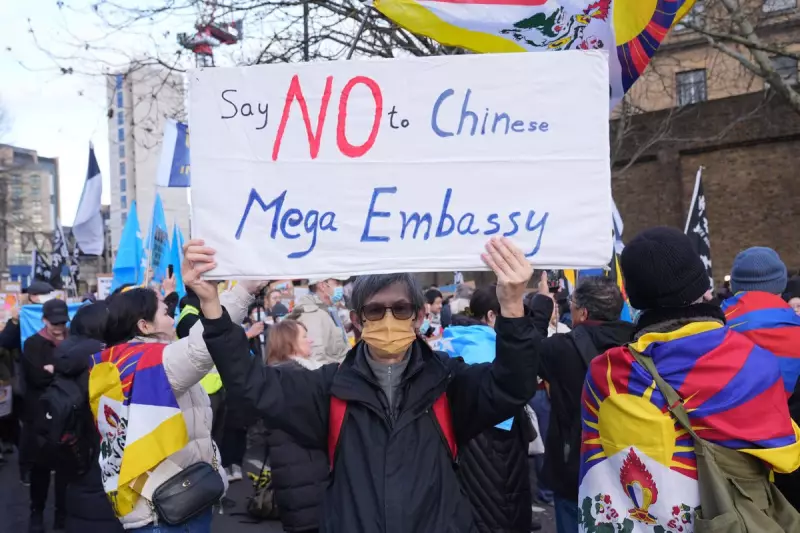
The UK government has given the green light to a new Chinese embassy in London, despite explicit warnings from intelligence agencies that national security risks cannot be completely eliminated. The controversial decision, approved by Local Government Secretary Steve Reed on Tuesday, will see a major diplomatic complex built at Royal Mint Court near the Tower of London.
Security Concerns and Government Assurance
Security Minister Dan Jarvis told Parliament he was "assured that the UK national security is protected" and that any risks posed by the new embassy were being "appropriately managed." This assurance came alongside confirmation from the heads of MI5 and GCHQ that intelligence agencies had developed a "package of national security mitigations" specifically for the embassy project.
However, in a significant qualification, the intelligence chiefs acknowledged in a letter to the Foreign Secretary and Home Secretary that it was "not realistic to expect to be able wholly to eliminate" national security risks posed by foreign embassies, including the new Chinese mission. This admission has fueled criticism from security experts and political opponents who question whether adequate safeguards can truly be implemented.

Political Opposition and Campaigner Outrage
The approval marks the culmination of a prolonged campaign against the proposals, with campaigners and MPs arguing the embassy would serve as a base for Chinese espionage activities and security crackdowns. The Labour-led Joint Committee on the National Security Strategy had urged ministers to reject the plans, warning that what will be China's largest embassy in Europe would "create a hub for expanded intelligence-gathering and intimidation operations."
Sir Iain Duncan Smith, the Conservative MP who has been sanctioned by China, expressed strong disapproval, stating: "At a time when the Chinese Communist Party is intensifying its intimidation of Britain, this decision sends entirely the wrong message." His sentiment was echoed by Christopher Mung, a former Hong Kong district councillor who fled to Britain in 2021, who told the Press Association the decision would "enable" Chinese efforts to repress Hongkongers and others abroad.
"I feel betrayed by the UK Government," Mung added, highlighting the emotional impact on those who have sought refuge from Chinese authorities.
Intelligence Committee's Qualified Support
Parliament's Intelligence and Security Committee, which oversees Britain's intelligence agencies, offered partial support for the government's position. In a statement, the committee said security concerns "can be satisfactorily mitigated," but simultaneously criticised the government's evaluation process for security concerns during the approval deliberations.
The committee also emphasised that China continues to target the UK and its interests "prolifically and aggressively," creating ongoing tension between diplomatic engagement and security protection. This dual assessment reflects the complex balancing act facing policymakers as they navigate relations with Beijing.
Comparisons to Cold War Diplomacy
Lord David Alton, a member of the Interparliamentary Alliance on China, expressed deep skepticism about risk management capabilities during a Westminster press conference. "I am not persuaded that the risks could be managed," he stated, questioning how authorities could effectively monitor espionage activities from diplomatic premises.
Drawing a historical parallel, Lord Alton compared China with the Soviet Union, remarking he could not believe "that any British government would have given the keys to a new embassy, a mega-embassy, in London, to the Kremlin, knowing what they stood for" during the Cold War. This comparison underscores the profound security concerns surrounding the project.
Legal Challenges and Community Opposition
Opponents of the embassy, backed by the Interparliamentary Alliance on China, have vowed to continue their fight through the courts. Mark Nygate, treasurer of the Royal Mint Residents' Association, announced at the same press conference that he expects to mount a judicial review in the coming days.

The association has instructed Lord Charlie Banner KC to prepare the legal challenge, which is expected to focus on whether the decision had been "pre-determined," along with concerns about access to historic ruins at the site and the redaction of numerous rooms from published plans. This legal action represents the next phase of resistance against the embassy's construction.
Government Justification and Process
The Prime Minister's official spokesman defended the decision, noting that classified facilities were "a standard part of any significant diplomatic presence" and that the government had reviewed the plans and was "content that any risks are being appropriately managed."
Mr Reed emphasised that the decision followed "a quasi-judicial process," adding: "This means they must make decisions fairly, based on evidence and planning rules." A written statement from the Communities Secretary further clarified that "all material considerations were taken into account when making this decision" and that "the decision is now final unless it is successfully challenged in court."
Diplomatic Implications and Future Relations
Approval of the embassy removes a significant diplomatic obstacle in the government's attempts to pursue warmer relations with Beijing, potentially paving the way for Prime Minister Sir Keir Starmer to make a widely-anticipated visit to China within weeks. This development represents a strategic shift toward engagement despite ongoing tensions.
Christopher Mung expressed concern about potential compromises during such diplomatic engagements, stating: "We are also worrying that during his trip to China, the Prime Minister will trade off our freedom and human rights for trade and investment. I don't think we should compromise the core values this society is upholding."
Economic Considerations and Strategic Engagement
Meanwhile, Chancellor Rachel Reeves articulated the government's broader approach to China relations during a panel discussion on trade strategy at the World Economic Forum in Davos. "We have got to be in the room to challenge China on areas of disagreement," she stated, appearing alongside US Secretary of Commerce Howard Lutnick.
Reeves elaborated on the economic rationale, noting: "We want to help British businesses as well to be able to export to those fast-growing markets. That's in our national interest, but we also need to make sure that we use that relationship to challenge where necessary in a whole range of areas, including on areas such as dumping and the lack of respect for some rights of activists like Jimmy Lai, which we raise regularly with the Chinese."
This statement reflects the government's attempt to balance economic opportunities with principled criticism, though critics question whether this approach adequately addresses the fundamental security concerns raised by intelligence agencies and parliamentary committees.