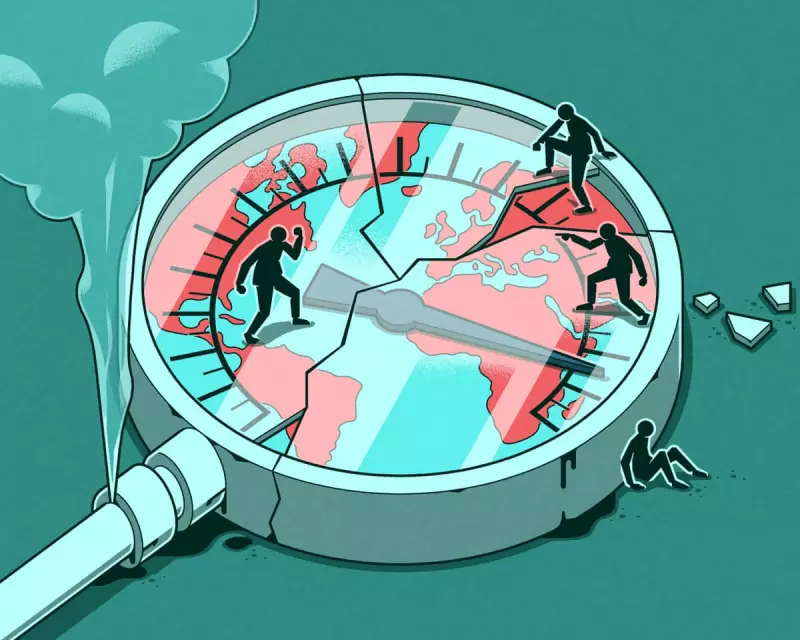
The recent US bombing of Caracas represents more than just another military intervention. According to Guardian columnist Owen Jones, it signifies the morbid symptoms of a declining superpower attempting to reinvent itself as a regional hegemon. While previous administrations cloaked their ambitions in rhetoric about democracy, President Donald Trump has been startlingly candid about his intentions.
The End of Global Hegemony and a Return to Spheres of Influence
The blueprint for this shift is laid bare in Trump's published National Security Strategy. The document formally accepts that the era of unchallenged US global dominance is over. "The days of the United States propping up the entire world order like Atlas are over," it declares, performing what Jones describes as unceremonious funeral rites for superpower status.
What replaces it is a vision of rival empires, each commanding its own sphere. For the United States, that sphere is unequivocally the Americas. The strategy explicitly commits to reasserting and enforcing the Monroe Doctrine, a 19th-century policy that historically served as a fig leaf for US domination over Latin America.

Trump's personal motivation is equally transparent. In 2023, he boasted, "When I left, Venezuela was ready to collapse. We would have taken it over, we would have gotten all that oil." The assault on Venezuela is, therefore, the opening move in a campaign to reverse decades of growing regional independence and external influence, particularly from China.
China's Rise and the Challenge to US Backyard Dominance
For three decades, US influence in Latin America has faced significant challenges. The rise of the progressive "pink tide" governments, led by figures like Brazil's former president Luiz Inácio Lula da Silva, sought greater autonomy. More crucially, the economic power of China, the US's primary global rival, has expanded dramatically across the continent.
The numbers are stark: two-way goods trade between China and Latin America was 259 times larger in 2023 than in 1990. China is now the continent's second-largest trading partner, a position it didn't even hold at the end of the Cold War. Trump's aggressive move against Venezuela is a direct attempt to roll back this encroaching influence and re-establish Washington's primacy.
Believe the Threats: Cuba, Mexico, Colombia, and Greenland
Jones argues that the experience of Trump's first term has led many to underestimate the threat. A second-term Trump regime represents a "full-fat far-right" agenda, unconstrained by earlier accommodations with the Republican establishment. His threats against neighbouring states must be taken at face value.
When he menaces the democratically elected leaders of Mexico and Colombia, or declares "Cuba is ready to fall," he means it. Most astonishingly, his stated desire to acquire Greenland is a genuine intent to annex over two million square kilometres of European territory. Such an act, following the weak European response to Venezuela, could shatter the NATO alliance, founded on collective defence.
This new world order, Jones warns, is one where authoritarian powers use brute force to subjugate neighbours and seize resources. It mirrors a historical pattern identified by Martinican author Aimé Césaire as the imperial "boomerang", where the tools and logic of foreign oppression return to enable domestic repression.
We have already seen the language of the "war on terror" repurposed to label political opponents as "domestic extremist" organisations, and National Guard troops deployed in US cities like an occupying force. Trump's indulgence of Russian ambitions in Ukraine may be part of a grim, realpolitik bargain, trading spheres of influence.
The warnings from America's own past echo loudly. The Democratic party platform of 1900 asserted that "no nation can long endure half republic and half empire." The question now is whether the world has the means and will to fight back against this aggressively emerging order, assembled in plain sight from what was once considered dystopian fantasy.