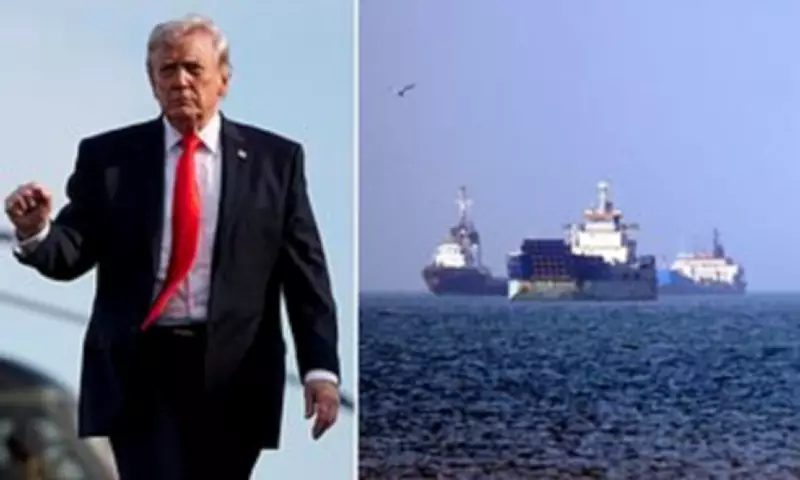
Does President Trump stand any real chance of re-opening the Strait of Hormuz, as he has promised to do? Is it, as some have claimed, an exercise doomed to fail?
On Sunday, throwing down yet another gauntlet to Iran, Trump announced that the US navy, backed by 100 aircraft, would free the 2,000 ships and 20,000 crew trapped in the Persian Gulf. The grandly named 'Operation Freedom', due to have started yesterday morning, was supposed to end Iran's stranglehold on the world's energy and fertiliser supplies. So far, we are yet to see much sign of it.
Perhaps that's no surprise. The risk to Washington is all too obvious: a direct Iranian hit on an American vessel – let alone a sinking – could be enough to inflame opinion at home and force the US navy into a humiliating retreat. But that's not to say the enterprise is completely hopeless, not least because, for all the triumphant rhetoric of the mullahs, Iran and its people are suffering grievously.

The longer this war drags on, the greater the economic hardships they face. And that, in turn, means popular discontent could rear up once again, as it did in January before it was brutally suppressed. Iran's sanctions-hit economy was already ravaged by inflation and shortages; both are now considerably worse.
Thanks to America's tit-for-tat blockade of Iranian shipping, Tehran – its exports of oil dramatically reduced – faces a currency crisis. Indeed, the regime has resorted to desperate do-it-yourself measures. Fleets of small tankers are crossing the Pakistan border and delivering at least a trickle of oil to the outside world. Tanker trains have been rumbling through central Asia to China. But unless Iran can get a normal volume of oil exported through its Kharg island shipping terminal, and within a matter of weeks, then it will run out of storage capacity. Wells will be sealed, maybe never to reopen – because once the flow of oil is stopped, there's a risk of water flooding in and wrecking them for good.
While Iran seems to have plentiful munitions, it might very well run out of cash, and unpaid soldiers have been known to lay down their arms, or even rebel. The fact that Tehran's negotiating demands consistently include the lifting of US sanctions shows how sensitive it is to economic pressure. For its own part, however, Tehran clearly thinks it can withstand America's blockade – and can maintain its grip on the strait despite the attentions of the US fleet.
Trump, too, is under pressure. The mullahs know for a fact that a few dollars on the price of fuel in the US will be painful for American voters, even if Iranians are suffering too. So, if it turns out that the US military cannot reopen the strait after all, the President faces a harsh choice.
He can launch a renewed air campaign to bomb Iran into compliance. To this end he has moved a third aircraft carrier, the USS George H.W. Bush, to the Red Sea, and a mix of troop-carrying smaller carriers with up to 15,000 marines and missile destroyers off Iran's southern coast. He will know, of course, that several weeks of heavy airstrikes have so far failed to dislodge the mullahs or their Gulf blockade. And it could take many more weeks of destruction before Iran buckles – if it buckles – by which time world energy supplies will be in real crisis and global recession will force America's allies to decide: do they stand by Trump and hope his military medicine works, or do they cut their own deals with Iran and hope to face down Washington's wrath?
It's an irony that a major row with European allies might give Trump the excuse he needs to pull back from the Gulf. He would no doubt blame America's lily-livered allies for thwarting his campaign just as it was about to succeed. He could declare 'victory' – again – and leave others to pick up the pieces hoping in classic Trump style to bamboozle voters, although that would be a hard sell, even to his own Republicans.
Such a retreat, indeed, would be akin to Britain's humiliation in 1956 when, with the French and the Israelis, we invaded Egypt in a failed attempt to seize control of the Suez Canal. Winston Churchill – not one of nature's appeasers – remarked after the fiasco (launched by his successor, Anthony Eden): 'I should never have dared start [the Suez operation], but I should never have dared stop.'

The 47th President proudly keeps Churchill's bust on display in the Oval Office. Will he walk away from a potential quagmire or will he plough on? Time will tell, but time is not on his side. The November midterm elections and recession loom ever closer. What Trump initially described as an 'excursion' in Iran could, like Suez, prove an epoch-making failure.
Mark Almond is director of the Crisis Research Institute, Oxford.