Trump Convenes 'Shield of Americas' Summit with Latin American Leaders
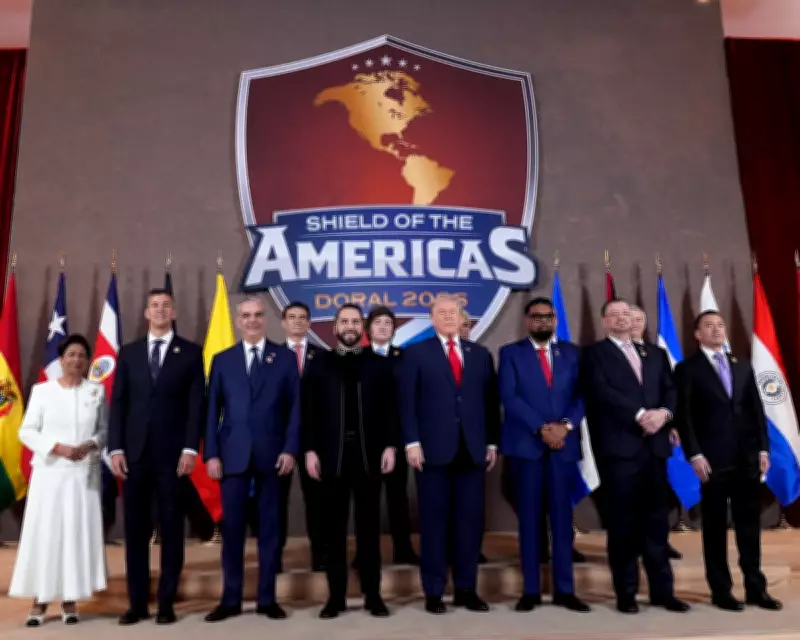
On March 7, 2026, former US President Donald Trump hosted a significant gathering at his golf club in Doral, Florida, bringing together 12 leaders from across Latin America for the 'Shield of the Americas' summit. The event aimed to foster regional cooperation and address pressing security and economic challenges, with a particular focus on countering drug cartels and Chinese political and economic interests in the western hemisphere.
Leaders in Attendance and Key Discussions
The summit featured a notable lineup of regional figures. In the front row were Kamla Persad-Bissessar of Trinidad and Tobago, Santiago Peña of Paraguay, Luis Abinader of the Dominican Republic, Nayib Bukele of El Salvador, Donald Trump, Mohamed Irfaan Ali of Guyana, Rodrigo Chaves Robles of Costa Rica, and Daniel Noboa of Ecuador. The back row included Rodrigo Paz Pereira of Bolivia, Javier Milei of Argentina, José Raúl Mulino of Honduras, and Jose Antonio Kast of Chile.
Trump emphasized the need for a united front against drug cartels, drawing parallels to past coalitions. "Just as we formed a coalition to eradicate Isis, we now need a coalition to eradicate the cartels," he declared. He specifically pointed to Mexico as the epicenter of cartel violence, stating that these groups are responsible for much of the bloodshed and chaos in the region. Despite complimenting Mexican President Claudia Sheinbaum, who was not present, Trump asserted that cartels are worsening and taking over the country, posing a direct threat to US security.

Regional Dynamics and US Policy Shifts
The summit occurred just two months after a US military operation captured Venezuela's former president, Nicolás Maduro, who faces trial in the US on drugs and weapons charges. Trump also praised Delcy Rodríguez, Venezuela's interim president, for collaborating with his administration, following the US's recent legal recognition of the Venezuelan government. Additionally, he predicted the imminent collapse of Cuba, citing its economic struggles and dependence on Venezuelan oil, while expressing optimism for a future transformation.
Trump outlined what he termed the 'Donroe doctrine,' a policy framework aimed at enhancing regional cooperation to counter Chinese influence. "We will not allow hostile foreign influence to gain a foothold in this hemisphere that includes the Panama canal," he stated, underscoring the strategic importance of safeguarding key infrastructure from external threats.
Support from US Officials and International Implications
US Secretary of State Marco Rubio thanked Trump for prioritizing the western hemisphere and commended the attending leaders as steadfast allies. In a pointed remark, Rubio contrasted their reliability with that of other nations, such as the UK, which had shown weak support for US actions in Iran. "At a time when we have learned that an ally, when you need them, may not be there for you, these are countries that have been there for us," he said, highlighting the reciprocal nature of these partnerships.
US Defense Secretary Pete Hegseth echoed this sentiment, criticizing past US foreign policy for focusing too much on distant borders while neglecting those in the western hemisphere. The summit also saw the involvement of outgoing Homeland Security Secretary Kristi Noem, appointed as a special envoy to the regional coalition, signaling a continued commitment to security initiatives.
Recent Operations and Future Outlook
The discussions were informed by recent events, including a raid in Jalisco, Mexico, where US intelligence assisted in capturing Nemesio Oseguera Cervantes, known as 'El Mencho,' leader of the Jalisco New Generation cartel. El Mencho died after being wounded in the shootout, marking a significant blow to drug trafficking networks.
Overall, the 'Shield of the Americas' summit represents a strategic pivot in US foreign policy, emphasizing closer ties with Latin American nations to address shared security threats and economic competition. As Trump and regional leaders forge ahead with this coalition, the implications for hemispheric stability and global power dynamics remain a key focus for observers worldwide.