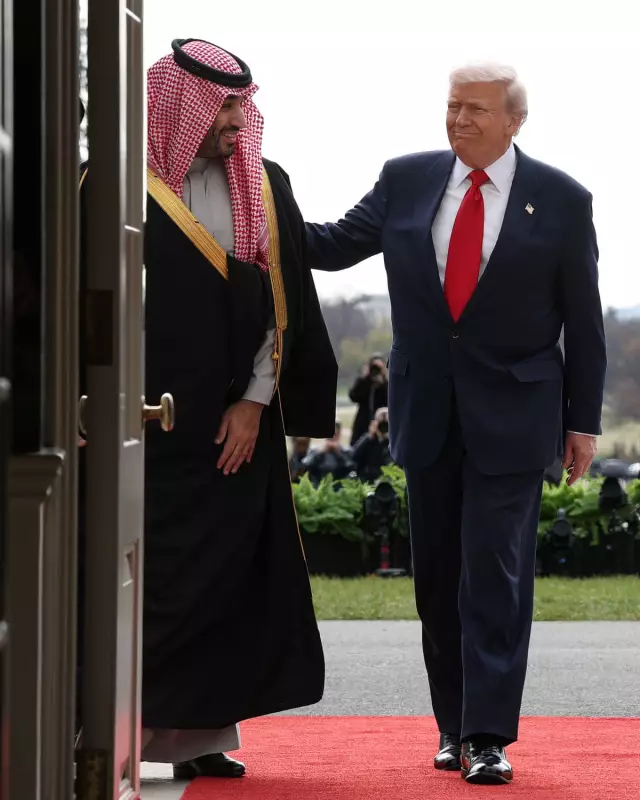
The White House welcome extended to Saudi Crown Prince Mohammed bin Salman represented the most extravagant display of the Trump presidency's foreign policy priorities, signalling a potential recalibration of Washington's traditional alliances in the Middle East.
A Lavish Reception for Saudi Royalty
Despite being officially billed as a working visit, the occasion surpassed previous state visits in its opulence. President Trump greeted the prince on the south lawn, the White House's most prominent stage, complete with uniformed flag bearers on horseback and a dramatic flypast of fighter jets.
Inside the Oval Office, Trump appeared thoroughly captivated, repeatedly grasping the prince's hand and declaring his honour in securing this royal friendship. When questioned about the 2018 murder and dismemberment of Washington Post journalist Jamal Khashoggi – the primary reason for Prince Mohammed's seven-year absence from Washington – Trump vehemently defended the Saudi leader, contradicting US intelligence conclusions about the crown prince's involvement.
Military and Technological Shifts
The F-35 stealth fighter jets featured in the flypast are part of a proposed sale to Saudi Arabia, which Trump confirmed would proceed without conditions. Crucially, he stated that Saudi F-35 specifications would match Israel's, potentially undermining a longstanding principle of US-Israeli relations that ensures Israel maintains a qualitative military edge over regional allies.
"[Saudi Arabia] is a great ally and Israel's a great ally," the president declared. "As far as I'm concerned, I think they are both at a level where they should get top of the line."
In another significant development, the administration announced it would lift the ban on selling advanced AI chips to Saudi Arabia and the United Arab Emirates, boosting Riyadh's ambitions to become a global tech hub. Gregory Gause of the Middle East Institute compared this potential partnership to the US corporate-led development of Saudi oilfields in the 1930s.
Broader Policy Implications
Several recent events suggest at least a temporary shift away from Israeli primacy in US Middle East policy. Just before the Saudi visit, a US-drafted UN security council resolution included language about a potential pathway to an independent Palestine, despite Israeli efforts to remove the clause.
Other notable developments include Trump lifting some sanctions on Syria against Israeli preferences and his Middle East tour in May that showcased Gulf nations while notably excluding Israel. This marks a departure from what many considered the high point in US-Israeli relations, when Trump joined Israel in airstrikes on Iran's nuclear facilities in June.
In Trump's transactional administration, Israel struggles to compete against Gulf wealth. Prince Mohammed promised $1 trillion in Saudi investment in the US economy, while Qatar provided Trump with a $400 million luxury plane. Meanwhile, Saudi Arabia, Qatar and the UAE have collectively invested nearly $5 billion in a fund managed by Trump's son-in-law Jared Kushner.
The relationship dynamics became particularly evident when Trump humiliated Israeli Prime Minister Benjamin Netanyahu during his September White House visit, forcing him to call his Qatari counterpart from the Oval Office to apologise for bombing Doha.
Despite these shifts, some analysts caution against interpreting recent events as a fundamental reset in US Middle East policy. Daniel Levy, president of the US/Middle East Project, argued that "if you just strip away some of the particular stupidity of the Biden administration and add the familial self-interest of the Trump administration... I don't think we're seeing a fundamental reset."