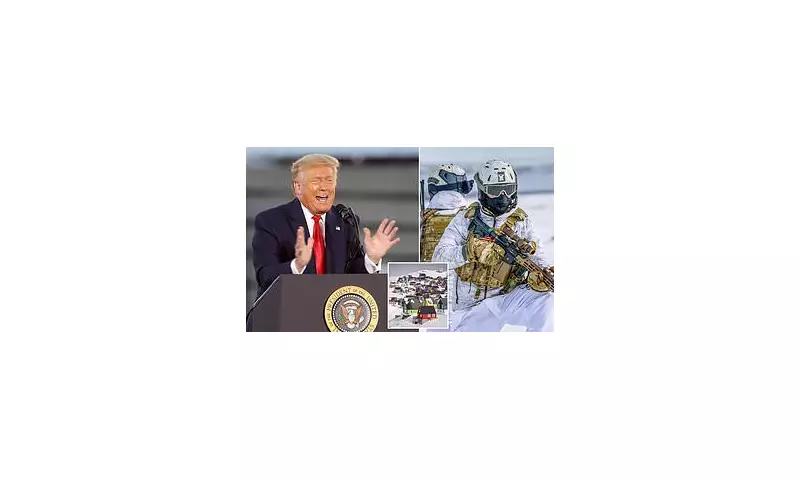
President Donald Trump's unwavering demand for the United States to assume full control of Greenland has been met with bewilderment by military allies and European leaders. Despite existing comprehensive access for US forces, the President insists that only outright ownership is acceptable for American national security.
The Psychology of Possession
In a revealing interview with the New York Times last week, President Trump shifted the focus from practical defence needs to a more abstract concept. He stated that ownership was "psychologically needed for success," arguing it provided elements unattainable through mere treaties or agreements.
This perspective, while politically contentious, aligns with established principles of human behaviour, according to psychologists who spoke to the Daily Mail. Dr Zea Szebeni, a social psychologist at the University of Helsinki specialising in territorial ownership, confirmed the President's statement "actually captures this psychological reality really quite accurately."

She explained that the feeling of ownership fundamentally alters a relationship, tapping into needs for control, identity, and belonging. "It's not just about practical control, but about identity, belonging and the deep-seated sense that 'this is ours,'" Dr Szebeni said.
Control, Certainty, and Legacy
Dr Adi Jaffe, a psychologist and former lecturer at UCLA, elaborated on the instinctual drive. He told the Daily Mail that Trump's description taps into a deep human need for control, certainty, and power. Ownership creates a sense of permanence and dominance, removing ambiguity and shared authority.
"For someone like Trump, whose identity and worldview are strongly shaped by competition, hierarchy, and winning, ownership represents the ultimate form of security and success," Dr Jaffe stated. He also suggested a legacy component, believing the President wants to secure the island for the nation's future.
This stance persists despite the reality on the ground. The US already enjoys full military access to Greenland, the world's largest island, and can station unlimited troops there. During the Cold War, over 10,000 US personnel were based there, though numbers now stand between 150 and 200.
Diplomatic Deadlock and Strategic Reality
The fundamental disagreement over sovereignty continues to strain diplomacy. Following a White House meeting involving Danish and Greenlandic foreign ministers, Vice President JD Vance, and Secretary of State Marco Rubio, a working group was formed. Its aim is to address Trump's security concerns without violating Greenland's territorial integrity.
Denmark and NATO allies have pledged to increase their military presence on the island to counter perceived threats from nations like Russia and China. Canada and Germany have even offered to send troops. Yet, Trump remains unmoved.
Danish Foreign Minister Lars Lokke Rasmussen warned that a "fundamental disagreement" over Greenland's future remains. This echoes previous tensions where Trump's threats led a Danish Prime Minister to suggest it could mean the "end of NATO."
Strategic experts question the necessity of ownership. Retired Navy Admiral James Stavridis, a former NATO supreme allied commander, noted the US can conduct all desired operations without owning Greenland, praising Denmark as a "courteous and responsive host."
Meanwhile, the psychological impact of ownership is clear. Dr Szebeni concluded that it transforms behaviour, leading to greater investment, defence, and emotional attachment. "The more a group invests in and controls something, the stronger the ownership feeling becomes," she said, which can drive military expansion and infrastructure development.
As negotiations continue, the world watches a clash between established diplomatic practice and a powerful psychological impulse for possession, with the future of a vast Arctic territory hanging in the balance.