Trump's Potential Iran Conflict Would Proceed Without Public Consent
If President Trump decides to launch a massive bombing campaign against Iran, as now appears increasingly probable, he must first prepare the American people for the gravity of that decision through a televised national address. The element of surprise is not an option here. What is required is a clear explanation of why such dramatic military action is necessary and what the likely risks are to American military personnel in the region and to civilians, from allies to Iranian citizens.
The High Cost of Military Engagement
The potential cost in blood and treasure would be substantial, with the latter including much of the regional oil infrastructure that supports global economies. Unlike the targeted "bunker-buster" B-2 bomber attacks in June 2025 that severely degraded Iran's key underground uranium-enrichment sites at Fordow and Natanz, this proposed strike would be anything but clinical. It would constitute a countrywide attack from air and sea aimed at destroying Iran's advanced missile capabilities and, collaterally, fatally undermining the theocratic regime—essentially pursuing regime change, which Trump recently touted as "the best thing that could happen."
Achieving regime change without deploying ground troops, something Trump is unlikely to countenance in almost any scenario, represents a dicey if not improbable proposition based on recent military history and Iran's sheer size. Iran's rulers, with foreknowledge that their hold on power is acutely threatened by the scale of the US military buildup and this year's nationwide protests, will mount massive opposition. Officials have publicly confirmed their intention to counterstrike on an unprecedented scale, with a missile salvo far exceeding what befell US bases in Iraq years ago and the bombardment of Israel last year.

The Critical Need for Public Transparency
This is precisely why a public levelling with the American people—before the first USAF sorties are flown—is absolutely essential. What will happen if the country wakes up one morning in the coming weeks to headlines blaring that an American naval vessel has been hit, severely damaged, or perhaps even sunk? Or that multiple US Navy surface ships have suffered the same fate? The same applies to the many US Army, Air Force, and Navy/Marine bases in the region within range of Tehran's highly accurate missiles, most of which are concealed underground and capable of shoot-and-scoot mobile launches.
A combined air-based and sea-based bombardment will be anything but a straightforward operation for the United States. While the Navy has multiple ways of intercepting incoming threats, detecting fast-moving, hard-to-jam missiles that fly just feet above the waves—and then successfully shooting them down—remains an uncertain prospect.
Current Military Posture and Diplomatic Context
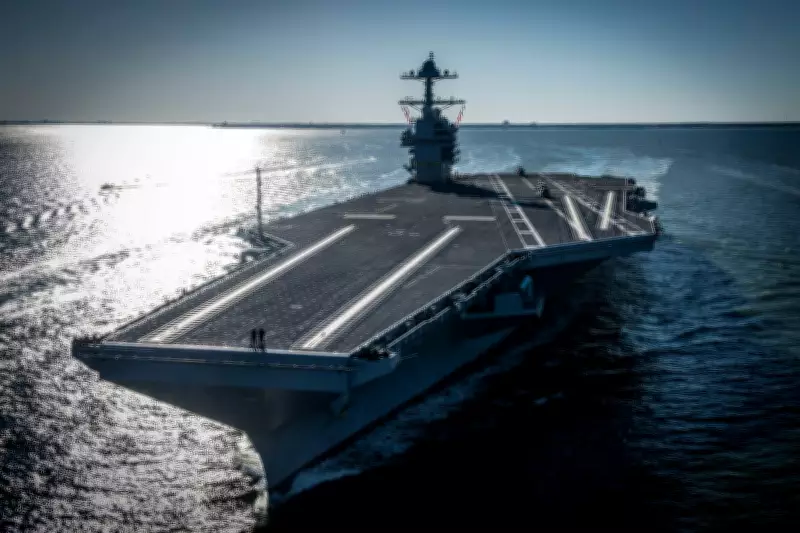
For now, US naval firepower is maintaining a cautious distance from Iran. The nuclear-powered USS Abraham Lincoln aircraft carrier, with its crew of more than 5,500 sailors and Marines and its accompanying strike force, is stationed off the coast of Oman, approximately 450 miles away. Meanwhile, a second carrier, the USS Gerald R Ford, is en route and expected to arrive within two weeks.
It cannot be overlooked that China, critically dependent on Iranian crude oil, has been supplying Iran with its most potent anti-ship missiles. As Iran's supreme leader, Ayatollah Ali Khamenei, postured this week: "More dangerous than the American warship is the weapon that can send it to the bottom of the sea." Both American and Israeli military planners are acutely aware of the Iranian advanced missile threat, which, extending beyond the uranium-enrichment issue, will likely be cited as a casus belli for what could transpire as the next Gulf War.
Indirect talks in Geneva this week between the United States and Iran ended inconclusively, as expected, and without any clarity on Iranian missile limitations—a condition being pushed as a priority by both the United States and Israel. Further talks may occur around the time the USS Gerald Ford strike force is expected to arrive off Iran's coast.

Congressional Duty and Constitutional Imperatives
If President Trump signals a move into kinetic engagement as a consequence of such a last-ditch "diplomatic round," he should address the American people calmly and persuasively as to why he has chosen military action of the size and scope indicated by the recent mass deployment of US aircraft, ships, Patriot anti-missile systems, and other hard assets into the US Central Command region.
Let there be no doubt: it could be little more than a New York minute before military muscle-flexing transforms into something entirely different. Iran, for its part, has been conducting large-scale live-fire naval drills with cruise missiles and other weapons, briefly shutting down the Strait of Hormuz, a global oil choke point for 20 percent of worldwide crude.
Congress has a duty and obligation to invoke the War Powers Resolution in such a scenario, as this will not be a tactical one-off strike, nothing like the recent extraction activity in Venezuela or the uranium-enrichment-site bombings last year. This would be an all-out, full-scale war. And only Congress has the power to declare war, as stipulated in Article 1, Section 8, of the US Constitution.
Warren Getler is a former reporter at The Wall Street Journal, Bloomberg, and the International Herald Tribune. He also served as a senior editor at Foreign Affairs magazine.