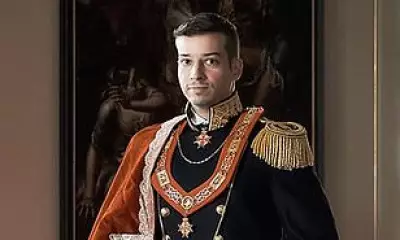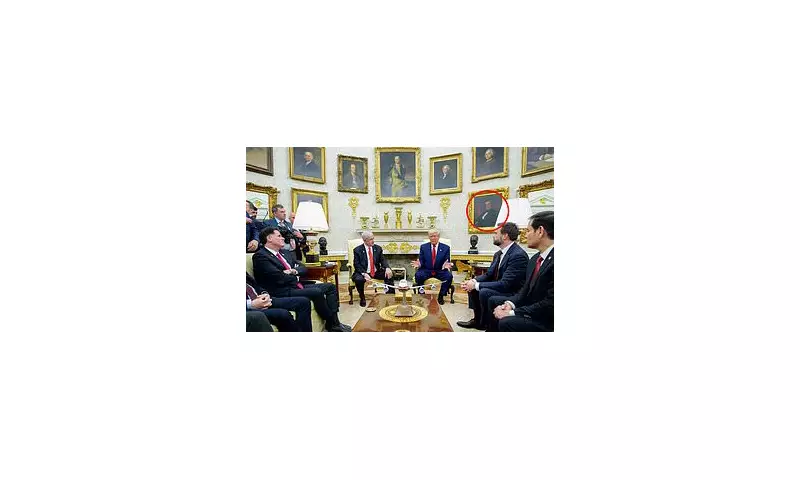
A portrait hanging in the Oval Office offers a subtle yet significant clue about Donald Trump's geopolitical ambitions, specifically his desire to acquire Greenland. The painting depicts James Polk, the 19th-century president who oversaw the largest territorial expansion in United States history.
Historical Parallels and Political Strategy
Last year, Trump orchestrated a deal with Speaker Mike Johnson to replace a Thomas Jefferson portrait in the White House with this painting of Polk, which previously hung in the Capitol. Trump has reportedly told Oval Office visitors, 'He was sort of a real-estate guy. He got a lot of land.' This comment underscores Trump's admiration for Polk's land acquisition achievements and hints at his own aspirations.
The portrait itself, painted in 1911 by a distant relative named Rebecca Polk, shows a brooding figure against a dark backdrop. While Polk remains a relatively obscure president, his legacy of aggressive territorial expansion aligns with Trump's political narrative, much like William McKinley's tariff policies that Trump has championed.

Trump's Modern-Day Expansionist Push
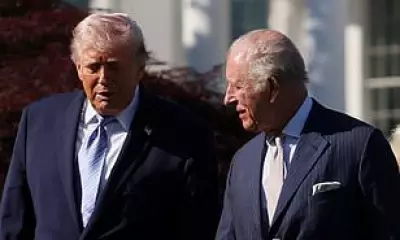
On Saturday, Trump threatened eight European allies, including the UK, Germany, and France, with tariffs unless they agree to his proposal to purchase Greenland from Denmark. This move reflects Trump's belief that such an acquisition would earn Polk's admiration. Polk, known as the 'Napoleon of the stump' for his commanding oratory style, expanded US territory dramatically during his single term.
Polk's presidency was marked by rapid and substantial land gains. He demanded the annexation of Texas, which sparked the Mexican-American War, resulting in the US acquiring what is now California, Nevada, Utah, Arizona, New Mexico, and parts of Colorado and Wyoming through the 1848 Treaty of Guadalupe Hidalgo. Additionally, he pushed for the annexation of Oregon, famously using the slogan 'Fifty-four forty, or fight.' In total, Polk added approximately 1.2 million square miles to the US, surpassing even Thomas Jefferson's Louisiana Purchase.
Greenland as Trump's Polk Moment
Now, a year into his final term, Trump appears to view Greenland as his own 'Polk moment,' an opportunity to significantly enlarge the United States for the first time in over a century. Greenland, a Danish territory larger than Mexico, is believed to contain valuable reserves of oil, gold, graphite, copper, iron, and rare-earth minerals.
Trump argues that the island is crucial for US national security, echoing predecessor Harry Truman's 1946 offer to buy Greenland as a 'military necessity.' This rationale has intensified with China and Russia increasing their presence in the Arctic, where melting ice opens new shipping lanes and exposes natural resources.
Diplomatic and Economic Tactics
Where Polk relied on military force, such as cannon and cavalry, Trump is employing tariffs and diplomatic brinkmanship. He is betting that he can pressure NATO allies before his tenure ends, and has not ruled out the use of military force. If successful, this acquisition would eclipse all territorial gains since Alaska's purchase in 1867, securing Trump a place alongside Polk in the annals of US expansion history.
Polk's background as the son of a wealthy Tennessee farmer and a close friend of Andrew Jackson, who convinced him to run as the Democratic nominee in 1844, adds depth to these parallels. Like Trump, Polk was a dark horse nominee, facing skepticism from opponents who taunted, 'Who is James K. Polk?' Yet, his aggressive campaign and territorial ambitions reshaped the nation.
In summary, the Oval Office portrait of James Polk serves as more than mere decoration; it is a symbolic nod to Trump's grand territorial ambitions, linking historical expansionist fervor with contemporary geopolitical strategy over Greenland.