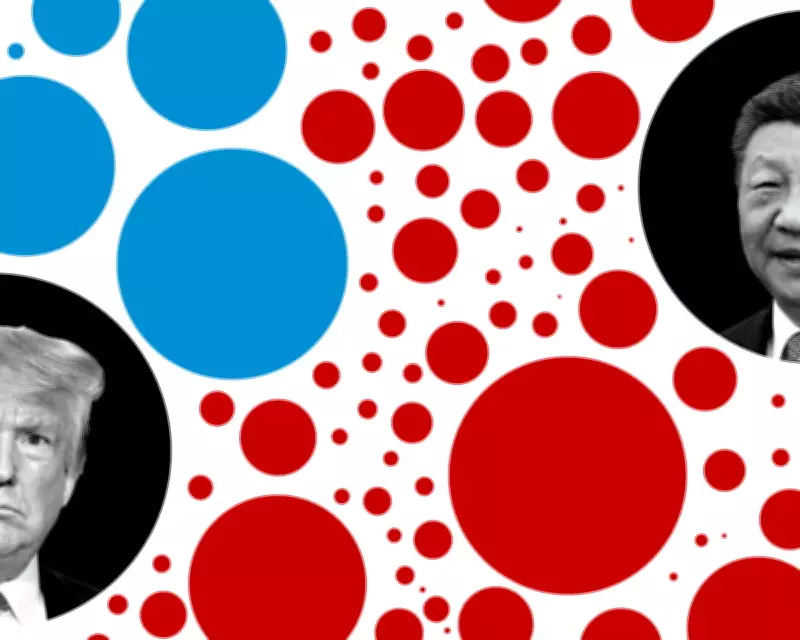
Trump's America First Agenda Accelerates Global Shift Toward China
Donald Trump's return to the White House has dramatically accelerated a fundamental realignment of global power dynamics, according to comprehensive new analysis of United Nations voting patterns. The research reveals how Washington's isolationist "America First" policies have begun redrawing the geopolitical map in Beijing's favour, with the world now diplomatically closer to China than at any point in recent memory.
UN Voting Records Reveal Stunning Realignment
Focal Data's detailed examination of UN General Assembly voting patterns demonstrates that countries which consistently vote together on contested resolutions typically share common strategic interests. By measuring how closely each nation's voting record correlates with those of the United States or China, researchers have mapped a significant movement of the geopolitical centre of gravity away from Washington and toward Beijing.
The collapse of American diplomatic influence has been particularly stark under Trump's leadership. When comparing all of Trump's years in office, including his first term, with those of his immediate predecessors Barack Obama and Joe Biden, the number of countries strongly aligned with the United States has plummeted from forty-six to just seven. Meanwhile, China has maintained its network of approximately seventy-three allied nations with remarkable consistency.

Traditional Allies Distance Themselves from Washington
Some of the most significant movements have occurred among America's traditional allies in Europe, North America, and Asia. Canada, South Korea, Japan, Germany, and the United Kingdom have all dramatically reduced their alignment with US voting patterns during 2025. The research assigns each country a voting score ranging from +1 (always voting with China) to -1 (always voting with the United States), revealing clear distancing trends.
"Our report uncovered not only how quickly the global order is shifting, but also the structure of influence between the two major poles of the US and China," explained Patrick Flynn, a data journalist and author of the comprehensive report. "We liken China's network to a beehive, diffuse and unlikely to collapse from individual rifts. In contrast, US influence is more like a Jenga tower, heavily reliant on a solid bloc of European countries that are quickly moving away from their transatlantic allies."
Key Flashpoints Driving the Diplomatic Divide
Several critical international issues have highlighted the growing divide between the United States and its traditional partners. In February 2025, Washington sided with Russia, Belarus, and North Korea to vote against a resolution condemning Russia for the ongoing conflict in Ukraine. This positioning placed America at odds with most Western nations.
The situation in Gaza has further strained relationships. In June 2025, the United States voted against a resolution calling for the protection of civilians and upholding of legal and humanitarian obligations in Gaza, instead aligning with Israel against the measure. China and the vast majority of Western countries supported the resolution's passage.
Additional disagreements have emerged on environmental, health, and migration resolutions, where China and most Western nations found common ground while the United States maintained opposition. These positions have contributed to NATO and European states, once the backbone of American global influence, voting less reliably with their transatlantic partner.
Regional Patterns and Economic Implications
On a regional level, Asia, Africa, and South America demonstrate stronger alignment with China, though South America began moving toward the United States during Trump's first term. Europe, Oceania, and South America have moved furthest from Washington under the current administration.
The research reveals particularly significant developments regarding the United Kingdom. Britain's alignment with the United States in UN votes has reached its lowest level since records began, with a steep decline occurring over the past year. This shift coincides with London's efforts to thaw previously icy relations with Beijing, including the first visits by Canadian and British prime ministers to China in eight years.

The economic implications of this realignment are substantial. The combined economic power of Chinese-aligned countries now exceeds that of US-aligned nations under Trump—a complete reversal from the Obama and Biden years when Western allies collectively represented superior economic strength. When countries are plotted by projected economic growth, the fastest-growing economies cluster closer to Beijing than Washington, with these nations predominantly located in Asia, Africa, and Latin America.
Long-Term Projections and Future Implications
This geopolitical shift appears likely to continue evolving. "Weighting our axis by historic GDP levels, we see that the centre of gravity has been slowly moving towards China over the last thirty years," Flynn noted. "With China's outsized influence among the fastest-growing economies, the global centre of gravity could well move into Chinese territory for the first time in the late 2030s."
The report highlights that only Argentina and Israel maintained strong alignment with the Trump administration in 2025, while China preserved its substantial voting bloc. This developing landscape suggests a fundamental restructuring of international relations that may reshape global diplomacy, trade relationships, and strategic alliances for decades to come.