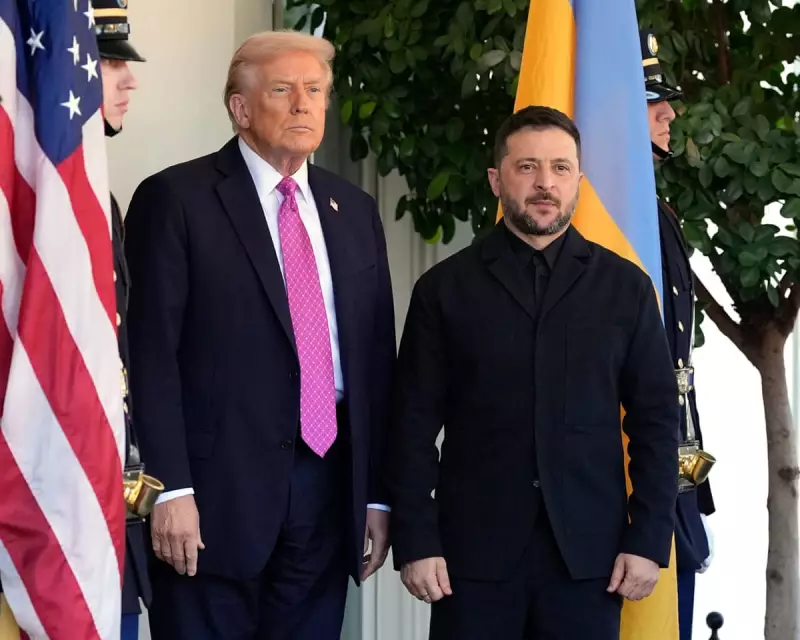
Ukrainian President Volodymyr Zelenskyy confronts what may become the most defining challenge of his leadership as former US President Donald Trump advances a controversial peace proposal that appears to secure all of Vladimir Putin's war objectives. European leaders have described the 28-point plan as amounting to capitulation, creating an unprecedented dilemma for Kyiv as the conflict approaches its fourth winter.
The Trump Administration's Controversial Proposal
The proposed peace deal, reportedly consisting of 28 specific points, would require Ukraine to surrender the eastern Donbas region - including territories it currently controls - significantly reduce its military capacity, relinquish long-range weaponry, and formally abandon its ambition to join NATO. This represents a dramatic shift from Ukraine's position during the early stages of Russia's full-scale invasion in February 2022.
According to Shaun Walker, the Guardian's central and eastern Europe correspondent, the Trump administration appears determined to secure an agreement, potentially aiming for completion around December 5th, when Trump is scheduled to receive FIFA's newly established peace prize. The timing creates additional pressure on Zelenskyy, who recently warned Ukrainians they face a very tough choice between preserving their dignity and risking the loss of a key partner.
Military Stalemate and Diminishing Options
The battlefield situation offers little hope for either side achieving decisive victory in the foreseeable future. While Russia maintains what Walker describes as military momentum in the bleakest sense, their advances come at tremendous cost. Russian forces have demonstrated they cannot capture territory without first reducing it to ruins through relentless bombardment.
The prospect of either army achieving a sweeping territorial breakthrough appears increasingly unlikely. Neither the grinding infantry battles on the eastern front, Moscow's aerial bombardment campaigns against Ukrainian cities, nor Kyiv's long-range strikes on Russian infrastructure show potential to significantly alter the current equilibrium.
Walker suggests that while sudden collapses or unexpected breakthroughs cannot be entirely ruled out, the likelihood of either side achieving what could be considered a clear military victory remains remote in the short to medium term.
Political Pressures and Domestic Challenges
Zelenskyy navigates his most precarious political position since the invasion began, facing not only external pressure from Washington but also domestic challenges including corruption scandals involving individuals close to his administration. The Trump administration's peace proposal timing may have inadvertently provided Zelenskyy with temporary political relief by refocusing public attention toward an existential external threat.
Ukrainian society exhibits significant war fatigue, with increasing voices questioning how much longer the conflict can continue. The mood this winter appears more despondent than at any point since the full-scale invasion began. Previous winters carried some measure of hope - belief in potential counteroffensive successes or expectations that Trump's election might bring transformative solutions. This winter, according to Walker, no plausible medium-term positive outcome for Ukraine appears visible.
The best-case scenario currently imaginable involves maintaining the status quo: a grinding, attritional conflict where Ukraine preserves its sovereignty and prevents further territorial collapse. While this represents a preferable outcome to complete defeat, it provides limited motivation for a population enduring its fourth year of war.
Broader Implications and Future Scenarios
In Moscow, Vladimir Putin has indicated the draft peace plan could serve as a basis for future negotiations, though he insists Ukraine must surrender territory for any agreement to proceed. Russian society has largely mobilized behind the official narrative framing the invasion as a defensive struggle against Western aggression rather than colonial expansion.
Putin himself faces difficult choices. Continuing the war indefinitely places increasing strain on Russia's economy, potentially leading to eventual domestic unrest. However, ending the conflict without clear achievement after such significant losses presents its own political risks.
The proposed peace plan includes provisions for Ukrainian elections within 100 days of conflict resolution, though Walker expresses concerns about potential destabilization as political tensions suppressed during the war effort resurface.
For now, Ukraine confronts what may become its most difficult winter yet, with diplomatic pressure intensifying as military options diminish and fatigue deepens among its citizens and international partners.