

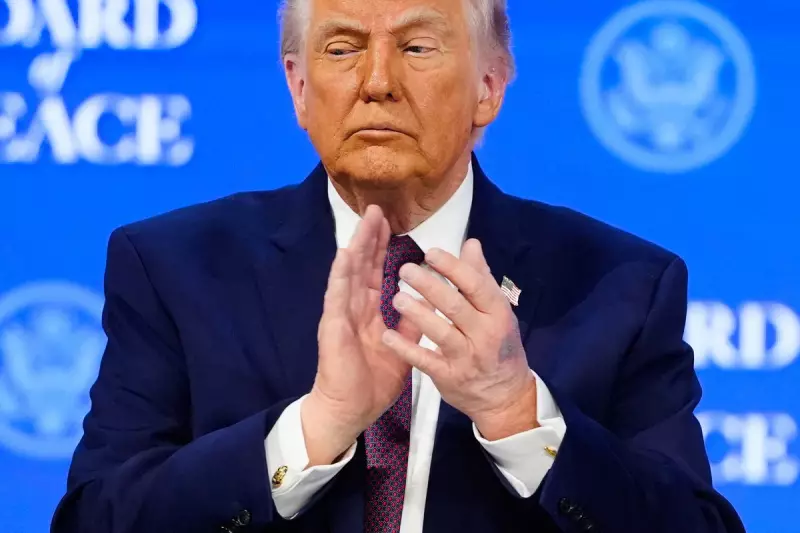
Trump's 'Board of Peace' Highlights Presidential Isolation Following Davos Controversy
President Donald Trump's newly established 'Board of Peace' has emerged as a potent symbol of his growing diplomatic isolation, coming immediately after his contentious appearance at the World Economic Forum in Davos. The organisation, which Trump has positioned as an alternative international body, notably excludes America's traditional allies while welcoming autocratic leaders and nations willing to pay substantial membership fees.
A Davos Departure That Set the Stage
The foundation for this diplomatic shift was laid during Trump's turbulent visit to Davos, where he threatened tariffs against long-standing allies and controversially expressed interest in acquiring Greenland. These remarks strained relationships that had endured for over eight decades, creating the backdrop against which he would unveil his alternative to established international institutions.
The Grand Unveiling: Stagecraft Over Substance
At a signing ceremony orchestrated by White House Press Secretary Karoline Leavitt, Trump joined a disparate collection of world leaders to launch the 'Board of Peace'. The event's theatrical presentation, reminiscent of reality television formats that first brought Trump to public prominence, featured leaders holding up signed documents for cameras in what observers described as classic Trumpian fashion.

The ceremony's visual backdrop proved particularly telling: a large screen displayed a logo strikingly similar to United Nations branding but with North America deliberately centred, symbolising Trump's America-first approach to international relations.
An Organisation Built on Exclusion and Fees
While initially conceived as a mechanism to implement the Gaza ceasefire agreement brokered between American, Israeli and Hamas negotiators, the Board's charter reveals significantly broader ambitions. The document makes no mention of the Gaza conflict specifically, instead describing an organisation seeking to "promote stability, restore dependable and lawful governance, and secure enduring peace in areas affected or threatened by conflict."
Membership operates on an invitation-only basis, with Trump serving as permanent chairman—a position he can maintain for life according to the charter. Nations must contribute $1 billion for permanent membership, unless subsequently removed by the chairman's discretion. This financial requirement has created what critics describe as a "pay-to-play peace club" accessible primarily to nations with substantial resources and political alignment with Trump's worldview.
Notable Absences and Controversial Presences
The Board's membership roster reveals Trump's diplomatic priorities and growing isolation. Traditional American allies including France, the United Kingdom and Canada have declined participation, with Trump publicly rescinding Canada's invitation following Prime Minister Mark Carney's critical Davos speech. Instead, the organisation includes leaders from Argentina, Turkey, Hungary, Bulgaria, Bahrain, Kazakhstan, Kosovo, Qatar, Armenia, Azerbaijan, Morocco, Paraguay and Pakistan.
Perhaps most controversially, Trump has extended invitations to Chinese President Xi Jinping and Russian President Vladimir Putin, with Putin indicating willingness to participate using frozen funds from sanctions imposed after Russia's 2021 invasion of Ukraine. While several member nations belong to NATO, none represent nuclear powers or traditional Western allies, creating an organisation markedly different from established international bodies.
The Nobel Ambition and Broader Motivations
Behind the Board's creation lies Trump's longstanding desire for recognition as a peacemaker, particularly his coveting of the Nobel Peace Prize—an honour awarded to his political rival Barack Obama. According to sources close to the president, he views himself as a transformative figure in international diplomacy who deserves such recognition.
However, his overt campaigning for the prize has alienated the Norwegian Nobel Committee, leading Trump to pursue alternative avenues for recognition. The Board of Peace represents not just a mechanism for conflict resolution but potentially an attempt to render existing international honours and organisations irrelevant to his legacy.

Structural Concerns and Future Implications
The Board's structure raises significant questions about its long-term viability and relationship with existing international institutions. Trump will serve as both permanent chairman and initial American representative, with the latter position passing to his presidential successor. This arrangement could theoretically allow Trump to remove the United States from the organisation should he disapprove of his successor.
More fundamentally, the Board's expansive mandate and exclusion of traditional allies positions it as a potential rival to the United Nations—a development that has concerned diplomatic observers and contributed to Western nations' reluctance to participate.
A Symbol of Changing Alliances
Ultimately, the Board of Peace serves as a tangible manifestation of Trump's evolving diplomatic approach. By surrounding himself with leaders who share his disdain for what he terms "woke" concerns like human rights and democratic processes, Trump has created an organisation reflecting his personal political preferences rather than traditional Western values.
Whether this new body can achieve meaningful progress in Gaza or other conflict zones remains uncertain. What appears clearer is that after alienating traditional allies through tariff threats and controversial statements, Trump's "dues-paying autocratic friends" may represent his primary remaining international constituency—a development with profound implications for America's global standing and the future of international diplomacy.





