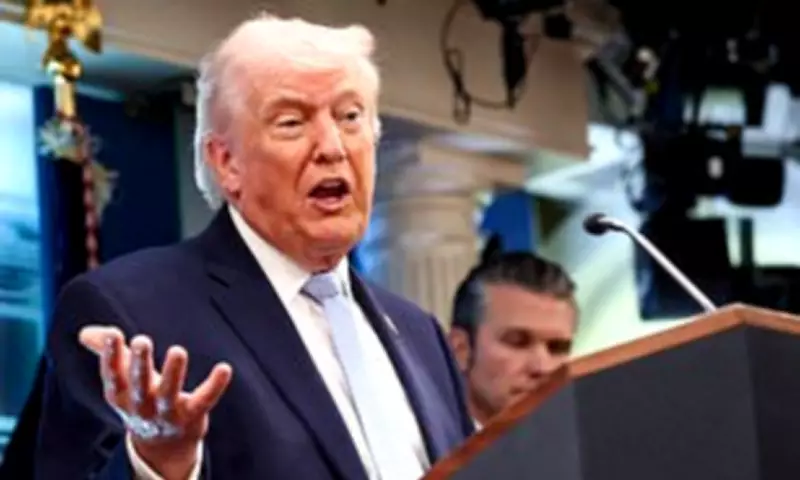
In a dramatic escalation of tensions, former US President Donald Trump issued a stark warning to Iran last night, declaring he was 'loading up the ships with the best ammunition' in case today's critical peace negotiations collapse. This threatening rhetoric came just hours after Vice President JD Vance departed Washington for in-person talks with Iranian officials in Pakistan, aiming to broker a fragile ceasefire.
Contrasting Messages from US Leadership
As he boarded Air Force Two, Vice President Vance struck a more diplomatic tone, expressing hope that the discussions would yield positive results. 'If the Iranians are willing to negotiate in good faith, we're certainly willing to extend the open hand,' Vance stated. 'If they're going to try to play us, then they're going to find that the negotiating team is not that receptive. We're going to try to have a positive negotiation. The President gave us some pretty clear guidelines, so we'll see.'
However, Trump's approach was markedly different. In a social media post, he asserted that Iran had 'no cards' left to play following devastating US bombing campaigns. 'The Iranians don't seem to realise they have no cards, other than a short-term extortion of the world by using international waterways. The only reason they are alive today is to negotiate!' Trump wrote, underscoring his hardline stance.

Fragile Ceasefire and Regional Complications
The ceasefire announced by Trump late Tuesday has proven extremely fragile, with both sides issuing threats and conditions. A major sticking point in any potential long-term peace agreement is the inclusion of Lebanon, where Israel has continued missile strikes despite the broader ceasefire.
On Wednesday, Beirut reported that civilians bore the brunt of an Israeli operation that targeted 100 sites in just ten minutes, resulting in at least 33 children killed and 153 injured. Israeli Prime Minister Benjamin Netanyahu initially stated he believed Lebanon—home to Hezbollah—was excluded from the peace deal.
Behind-the-Scenes Pressure
It later emerged that Trump and White House envoy Steve Witkoff had instructed Netanyahu to 'be more low-key' and 'calm down' the strikes to avoid jeopardising negotiations. 'I spoke with Bibi and he's going to low-key it,' Trump told NBC. 'I just think we have to be sort of a little more low-key.'
Despite this, Israeli Defence Force chief Eyal Zamir maintained that Israel remained 'in a state of war' in Lebanon. 'We are not in a ceasefire. We continue to fight here [in Lebanon], this is our primary combat zone. In Iran, we are in a ceasefire, and we can return to fighting there at any moment, and in a very powerful way,' Zamir declared.
Iran's Demands and Economic Stakes
Mohammad Bagher Ghalibaf, speaker of Iran's parliament, insisted that a full ceasefire in Lebanon and the release of Iran's blocked assets must occur 'before negotiations begin.' He claimed these measures had been agreed upon but not yet implemented.
Trump revealed he had agreed to a two-week, ten-point ceasefire plan with Iran, though details remain undisclosed. He emphasised that the full reopening of the Strait of Hormuz—through which 20% of global oil and gas passes—was 'non-negotiable.'
While some tankers have navigated the strait since the ceasefire, reports indicate Iran is charging tolls of $1 per barrel in bitcoin, potentially amounting to £2.2 million per ship. Trump warned they had 'better not' be engaging in this practice but suggested a potential 'joint venture' with Iran and Oman to levy tolls.
Diplomatic Challenges and Controversial Statements
The in-person talks in Islamabad are led by Vance, Witkoff, and Jared Kushner, Trump's son-in-law. However, the negotiations faced immediate controversy when Pakistan's Defence Minister Khawaja Asif tweeted that Israel was 'a curse for humanity' and that 'genocide is being committed in Lebanon.' The since-deleted message added, 'I hope and pray people who created this cancerous state on Palestinian land to get rid of European jews [sic] burn in hell.'
Netanyahu condemned the tweet as 'outrageous,' stating, 'This is not a statement that can be tolerated from any government, especially not from one that claims to be a neutral arbiter for peace.'

Hezbollah's Position
Meanwhile, Hezbollah chief Naim Qassem urged the Lebanese government to cease offering 'free concessions' to Israel. 'We will not accept a return to the previous situation, and we call on officials to stop offering free concessions,' Qassem asserted, as the two governments prepare for negotiations in Washington next week.
The high-stakes diplomatic efforts unfold against a backdrop of military posturing, regional violence, and deep-seated animosities, with the world watching to see whether dialogue or conflict will prevail in this volatile geopolitical landscape.