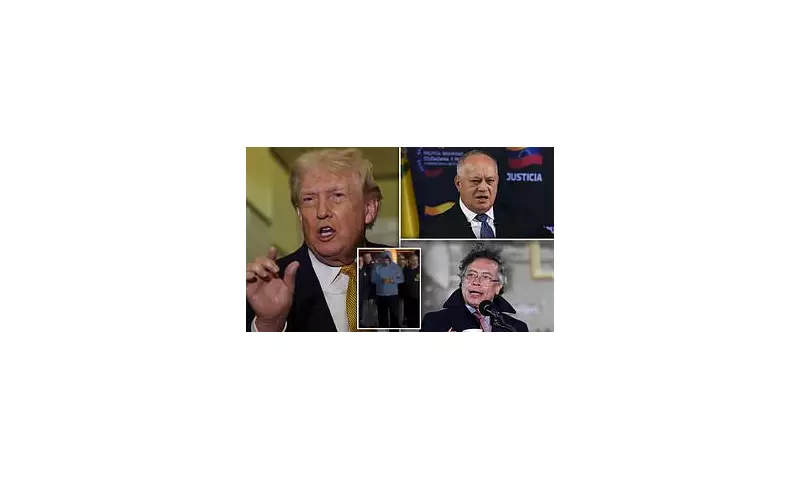
Former US President Donald Trump has issued a stark warning to Colombia, suggesting it could be the next nation to face American military intervention, while firmly stating the United States is now "in charge" of Venezuela following the dramatic capture of its leader, Nicolás Maduro.
Trump's Threats and Regional Tensions
The provocative statements came during a series of exchanges over the weekend. The flashpoint began when Colombia's leftist President, Gustavo Petro, condemned Washington's military action in Venezuela as an "assault on the sovereignty" of Latin America. Trump responded bluntly on Saturday, telling Petro to "watch his a**".
While speaking to reporters aboard Air Force One on Sunday, Trump intensified his rhetoric. He labelled Colombia as "very sick, too, run by a sick man, who likes making cocaine and selling it to the United States", adding, "he's not going to be doing it very long". When directly questioned on whether the US would pursue a military operation against Colombia, Trump replied, "It sounds good to me."

Aftermath of the Venezuela Raid
These threats follow the audacious US operation that captured Venezuelan President Nicolás Maduro. He was due to make his first appearance in Manhattan's federal court on Monday to face drug-trafficking charges. A new indictment released on Saturday paints his administration as a "corrupt, illegitimate government" fuelled by a cocaine-trafficking operation.
However, the political situation in Caracas remains contested. Maduro's Interior Minister, Diosdado Cabello, insists Maduro remains the nation's lawful president. In contrast, Venezuela's acting president, Delcy Rodríguez, has adopted a more conciliatory tone. On Sunday, she called for "peace and dialogue, not war" and extended an invitation to the US government to work on a cooperative agenda.
A Broader Assertion of US Power
Trump's comments underscore a more expansive and assertive US role in the Western Hemisphere, a stance formalised in his administration's recent National Security Strategy. He has referenced historical doctrines like the Monroe Doctrine and even quipped about a "Don-roe Doctrine".
His focus wasn't limited to South America. Trump also renewed calls for the US to acquire Greenland from Denmark for national security reasons, citing Russian and Chinese presence. Furthermore, he suggested Cuba "is going down", though stopped short of threatening military action.
When pressed on who is running Venezuela, Trump was unequivocal: "It means we're in charge." This aggressive posture, combining direct threats with claims of control, is sending shockwaves through the region, leaving allies and adversaries alike questioning the limits of Washington's renewed interventionism.