Trump Issues Stark Warning to Iran Following Revolutionary Guard Attacks
Former President Donald Trump has issued a dramatic warning to Iran, promising to strike the Islamic Republic with "a force that has never been seen before" in response to attacks on American military installations across the Middle East. This escalation follows the Islamic Revolutionary Guard Corps (IRGC) announcement that they had targeted nearly 30 US military bases throughout the region on Sunday morning.
Iran's 'Most Intense Offensive Operation'
The targeted assaults on American assets in the destabilized region represent what Iran has described as its "most intense offensive operation in history." This aggressive action comes as direct retaliation for the killing of Supreme Leader Ayatollah Ali Khamenei, who had led Iran for 37 years, during a joint US-Israeli operation codenamed Epic Fury on Saturday morning.
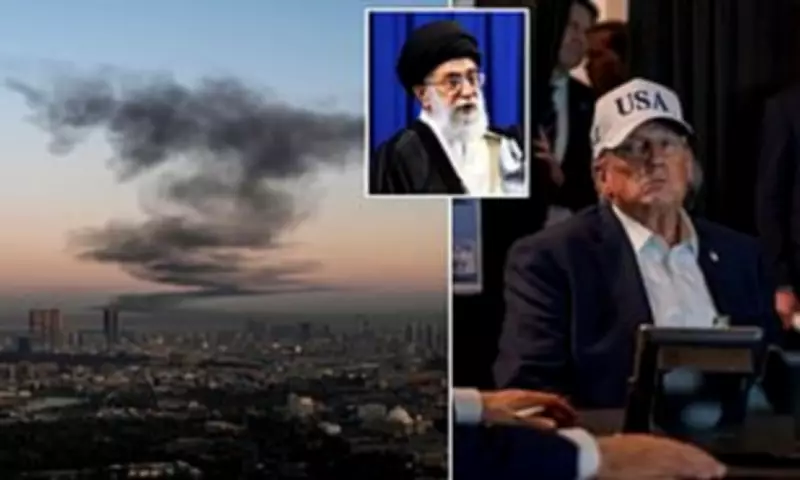
Visual evidence of the conflict emerged with black smoke billowing from a US airbase at Erbil International Airport in northern Iraq at sunrise, following the IRGC's promise of their most ferocious counterattack to date. Khamenei, along with members of his immediate family, were reportedly decimated by bombardment in Tehran during the coordinated military action.

Trump's Midnight Ultimatum
Trump responded forcefully via a midnight Truth Social post, declaring: "Iran just stated that they are going to hit very hard today, harder than they have ever hit before. THEY BETTER NOT DO THAT, HOWEVER, BECAUSE IF THEY DO, WE WILL HIT THEM WITH A FORCE THAT HAS NEVER BEEN SEEN BEFORE!"
This exchange of threats has dramatically intensified an already volatile situation in the Middle East, with Israel announcing in the early hours of Sunday that it had initiated a new "strike wave" targeting Iran's ballistic missiles and aerial defense systems. This Israeli action followed Iran's earlier launch of drones and missiles toward Tel Aviv, which were successfully intercepted and shot down.
Escalating Military Actions
In response to these developments, the IRGC stated it was executing a "sixth wave" of extensive missile and drone attacks specifically targeting 27 US military bases throughout the region. The full extent of damage caused by these coordinated assaults remains unclear as military assessments continue.
The conflict reached a critical juncture as Iran formally confirmed that Supreme Leader Khamenei had been killed in his home office. An Iranian news agency marked the moment with the traditional Islamic phrase: "To Allah we belong and to Him we shall return."
High-Profile Casualties and Leadership Vacuum
The Tehran strikes on Saturday morning resulted in significant casualties beyond Khamenei himself. Two high-level military leaders—Rear Admiral Ali Shamkhani and IRGC commander Major General Mohammad Pakpour—along with four of Khamenei's close family members were also obliterated in the bombardment.
State news agency IRNA reported additional casualties early Sunday morning, confirming that Iranian army chief of staff Abdul Rahim Mousavi and Defense Minister Aziz Nasirzadeh were among the dead. This has created a substantial leadership vacuum within Iran's military and political hierarchy.
Divergent Public Reactions
The death of Iran's long-standing leader has provoked dramatically different reactions both within Iran and internationally. Jubilant protesters inside Iran were seen toppling a statue of the Ayatollah in the early hours of Sunday, celebrating his demise following the bombardment.
Similar celebratory scenes unfolded across America, particularly in Washington DC and Los Angeles, where Iranian-Americans heralded what they viewed as the toppling of the Islamic regime. By stark contrast, hundreds of wailing male and female mourners gathered in Tehran's Enqelab Square on Sunday morning, waving flags and mourning Khamenei's death in emotional displays of grief.
Regional Fallout and Civilian Impact
While the precise damage caused by Iran's early-morning attacks on American bases remains under assessment, the unfolding violence has already wreaked havoc for civilians and tourists throughout the Middle East. Sites including tourist-filled hotels in Dubai and Bahrain have suffered collateral damage following Trump's decisive mission to eliminate the Ayatollah on Saturday morning.

Iranian State news agency IRNA announced on Sunday that Iran's president, judiciary chief, and a Guardian Council jurist would temporarily assume power to oversee the transition following the Supreme Leader's death, indicating preparations for a potentially turbulent leadership succession.
International Responses and Diplomatic Tensions
Israel's Defense Minister Israel Katz publicly congratulated Prime Minister Benjamin Netanyahu and the country's military following the killing of Iran's Supreme Leader in the airstrikes. "He who acted to destroy Israel - has been destroyed," Katz declared in a statement posted to X. "Justice has been served, and the axis of evil has suffered a mortal blow."
Conversely, Iran's parliamentary speaker Mohammad Bagher Qalibaf declared on state television that Tehran would "get even" in response, vowing severe retaliation. "Trump and Netanyahu have crossed a red line and will pay the price for it," he asserted. "We will strike you with such painful blows that you will beg for mercy, you will see."
Iranian President Masoud Pezeshkian characterized the killing of Ali Khamenei as "a great crime" and promised that Iran would respond decisively. A statement from his office read: "This great crime will never remain unanswered and will turn a new page in the history of the Islamic world and Shiism. The pure blood of this high-ranking leader will flow like a roaring spring and will eradicate American-Zionist oppression and crime."
Diplomatic Exchanges and Civilian Tragedy
At the United Nations, Iran's representative delivered a terse message to the United States following the deadly airstrikes. Ambassador Amir Saeid Iravani told US representatives to be "polite" during discussions in New York City, stating: "I have one word only. I advise to the representative of the United States to be polite. It will be better for yourself and the country you represented, thank you."
The human cost of the conflict became tragically apparent with reports that at least 108 people were killed in a US-Israeli airstrike on a girls' school in the southern Iranian city of Minab on Saturday morning. According to regime-controlled news outlets Tasnim and Fars, the majority of the dead were schoolgirls aged between seven and twelve.
A teacher at the school described the horrific scene to the London-based outlet Middle East Eye, recalling how she returned to find carnage after hearing the blast. "I felt like I had gone mute. I couldn't speak," she recounted. "You could hear the sound of children crying and screaming." This tragic incident underscores the devastating civilian impact of the escalating military confrontation.