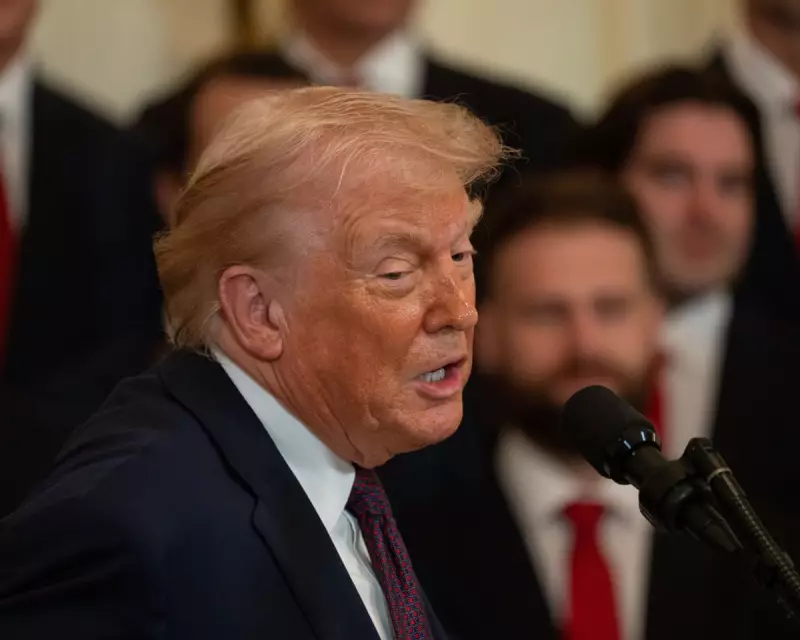
President Donald Trump has, for the moment, stepped back from the precipice of ordering a major US military strike against Iran. This follows two weeks of escalating threats directed at Tehran's regime over its brutal crackdown on nationwide protests.
A Last-Minute Diplomatic Intervention
On Tuesday, Trump appeared poised for action, posting on his Truth Social platform that help was "on its way" to Iranian protesters and signalling he was leaning towards an attack ahead of a Pentagon briefing. However, by Wednesday, he reversed course. The president stated he had received assurances from "very important sources" that Iran had halted the killing of demonstrators and was not proceeding with executions.
This dramatic pullback is widely attributed to a concerted, last-ditch effort by key US allies in the Middle East. Nations including Saudi Arabia, Qatar, Oman, and Turkey are understood to have warned the White House that airstrikes could trigger a devastating regional conflict. While many Sunni-led Arab states resent Shia Iran's influence, they fear retaliatory attacks by Tehran and its proxies, a potential flood of refugees, and the catastrophic collapse of the Iranian state.

The Cycle of Threats and the 'Red Line'
The immediate crisis was sparked by Trump's own public ultimatum. On 2 January, he laid down a red line, warning the Iranian government that if it "violently kills peaceful protesters" the US "would come to their rescue". As the regime's violent suppression intensified, killing thousands and cutting off internet access, aides reported the president felt increasingly obligated to act.
This instinct is rooted in Trump's long-standing criticism of predecessors he viewed as weak, particularly Barack Obama's decision not to enforce his own "red line" against Syria's use of chemical weapons in 2013. Trump, who admires authoritarian strongmen, is profoundly averse to projecting weakness, even at the risk of provoking Iranian retaliation against US bases or the closure of the vital Strait of Hormuz.
His perceived military successes have further emboldened him. The attack on Caracas on 3 January, which saw US special forces depose Venezuelan President Nicolás Maduro, was followed by new threats against Cuba, Colombia, and Mexico. The once-dismissed demand for the US to own Greenland has also taken on a more ominous tone.
A Chaotic and Contradictory Iran Policy
Trump's approach to Iran has been marked by volatility since his first term. In 2018, he unilaterally withdrew the US from the landmark 2015 nuclear deal (the JCPOA), reimposing crushing sanctions. He branded the agreement "horrible" and "one-sided," insisting he could negotiate a superior one.
Upon returning to power last year, he sought to make good on that claim. In March, he sent a letter to Iran's Supreme Leader, Ayatollah Ali Khamenei, proposing direct talks, coupled with a public threat of unprecedented bombing should diplomacy fail. Special envoy Steve Witkoff was dispatched for indirect negotiations mediated by Oman. Five rounds of talks were held, with some Iranian officials appealing to Trump's desire to be a peacemaker, notably in an April essay by Foreign Minister Abbas Araghchi in the Washington Post.
These nascent negotiations were shattered in mid-June by a surprise Israeli attack that killed top Iranian military officials and scientists. Trump then briefly joined the conflict, ordering US warplanes to bomb three Iranian nuclear facilities. While this destroyed his chance for a new deal, it aligned with his image as a decisive strongman.
Public Weariness and Unpredictable Leadership
Trump's actions fly in the face of clear public sentiment. Polls show only a third of Americans supported the Venezuela raid, and a significant 70% oppose military action in Iran. Many of his supporters voted for the "candidate of peace" who promised to end forever wars, a pledge reiterated in his second inaugural address.

Yet, in this term, US forces have struck targets in Yemen, Syria, Iran, Iraq, Nigeria, Somalia, and Venezuela. Critics argue he ignores both public exhaustion and the constitutional principle that war powers reside with Congress, not a presidential social media post. His approach is seen less as a strategic application of Nixon's "madman theory" and more as a product of showmanship, vengeance, and self-aggrandizement.
For now, the plan to attack Iran appears shelved. But the episode has underscored Trump's astounding power to command global attention and unleash the US military at a time and place of his choosing, keeping the world perpetually on edge.