

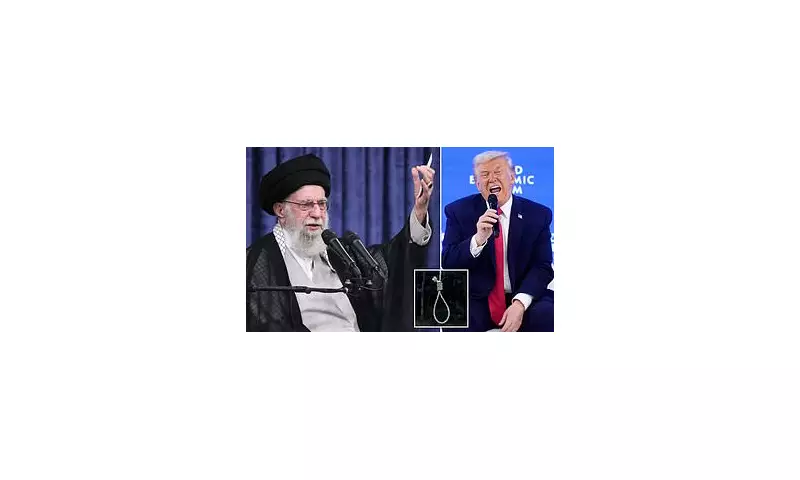
President Donald Trump has made a striking claim that he personally intervened to stop a mass execution in Iran by issuing what he described as a "nasty" and ominous threat to the regime. In an interview with CNBC's Joe Kernen that aired today, the President detailed a high-stakes diplomatic standoff that he asserts saved the lives of nearly 1,000 individuals.
Trump's Assertion of Life-Saving Intervention
When questioned about whether his manoeuvres had preserved lives, Trump was emphatic in his response, claiming the number was in the "thousands, more than that." He elaborated on a specific incident that deeply affected him, stating, "Well, they had one thing specifically that really got me. They were going to hang, the old-fashioned hanging. They were going to hang 837 people on Thursday." According to Trump, the Iranian government was prepared to proceed with these executions, which he noted involved "mostly young people," until he stepped in with a direct message.
The Nature of the Threat
Trump revealed that he told the Iranian authorities, "I told them you can't do that. If you do that, it's going to be bad." While he chose not to disclose the exact wording of his communication, he characterised the message as "nasty." He added, "I don't want to say exactly what I said, but nasty. And they canceled it, hopefully permanently." This claim emerges amidst heightened tensions in the Gulf region, where the United States has been actively moving military assets, including carrier strike groups and jet fighters.

Military Buildup and Strategic Posturing
Recent military movements have seen U.S. F-15 Strike Eagles arrive in Jordan as part of a broader strategic buildup. This includes the westward transit of the USS Abraham Lincoln Carrier Strike Group, which is currently moving from the South China Sea toward the Persian Gulf. This naval force is equipped with destroyers, F-35 stealth fighters, and electronic-jamming aircraft, underscoring the volatile situation.
When pressed on whether these asset movements signalled a "prelude to further action," Trump remained coy, stating, "Well, we hope there's not going to be further action, but, you know, they're shooting people indiscriminately in the streets." He was referencing the civil unrest and protests within Iran, highlighting the regime's harsh crackdowns.
Boasting Military Capabilities
Trump also used the interview to boast about the U.S. military's advanced capabilities. He pointed to the strike on the Fordow nuclear facility, claiming it utilised B-2 bombers to devastating effect. "We hit them hard, the B-2 bombers," Trump said, noting that the U.S. has recently ordered 25 additional aircraft of that model. He described them as "unbelievable, those things, that they were totally undetectable... with no moon, in the dark of night, late in the evening, every single one of those bombs, and they're giants, every single one of those bombs hit its targets and just obliterated the place."
However, according to initial available intelligence assessments, the U.S. severely damaged the Iranian nuclear program, setting it back by months rather than fully destroying it. This nuance adds complexity to Trump's narrative of overwhelming success.
Political Reactions and Broader Context
Kernen noted that Democrats had given the president "grief" for his actions in Iran, suggesting that even if he "walked on water," critics would say he "can't swim." Trump responded dismissively, stating, "It's, look, they're sick people. They really are. They are, we call it Trump derangement syndrome." This exchange reflects the deeply partisan nature of U.S. politics and the polarised views on Trump's foreign policy approach.
Iranian Retaliation and Warnings
Following Trump's calls for the Iranian Supreme Leader to step down, Iranian General Abolfazl Shekarchi issued a stern warning. He stated that any hostile actions toward Ayatollah Ali Khamenei would face severe consequences, saying, "Trump knows that if any hand of aggression is extended toward our leader, we not only cut that hand but also we will set fire to their world." This rhetoric escalates the verbal sparring between the two nations, raising concerns about potential military confrontations.

Future Implications and Red Lines
Trump concluded the discussion by suggesting that the world should "stay tuned" regarding further developments in Iran. He made clear his red line would be nuclear activity in the country, asserting that if the regime continues to experiment with the technology, "it's going to happen again." This stance underscores the ongoing geopolitical chess game, with Trump positioning himself as a decisive leader willing to use both threats and military force to achieve his objectives.
The broader debate continues: is this an example of strong leadership that saves lives through bold actions, or is it irresponsible talk that risks inflaming an already tense situation? As military assets gather and diplomatic warnings fly, the international community watches closely, aware that any miscalculation could have far-reaching consequences for regional stability and global security.





