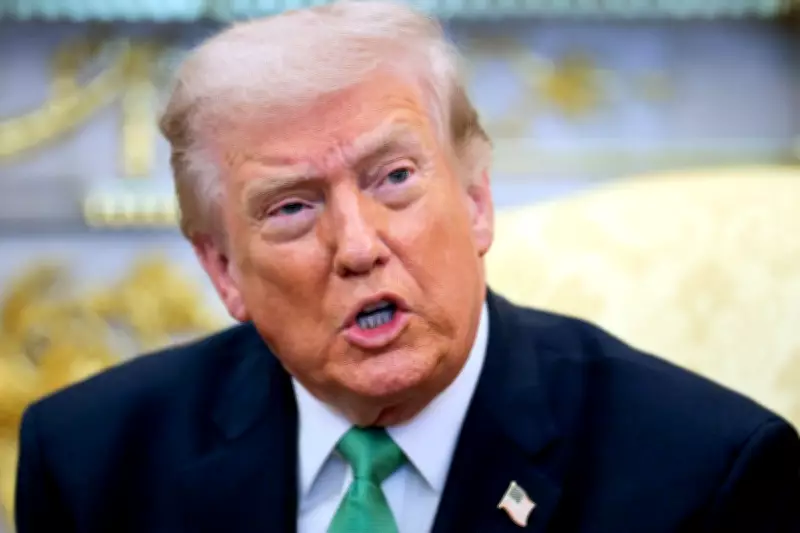
Trump's Fury Over NATO Refusal to Back Iran Military Operations
US President Donald Trump has unleashed a blistering attack on America's NATO allies after multiple nations rejected his request for military assistance in the ongoing conflict with Iran. The president described their refusal to deploy warships to help reopen the strategically vital Strait of Hormuz as a "foolish mistake" that demonstrated what he called a one-sided alliance relationship.
Growing Diplomatic Isolation and Internal Dissent
The president's outburst comes amid increasing diplomatic isolation and internal administration turmoil. Several key European allies, including the United Kingdom, Germany, and France, have declined Trump's request to support US operations aimed at securing the Strait of Hormuz, through which approximately twenty percent of global oil supplies normally flow.
European Union foreign policy chief Kaja Kallas has urged both the United States and Israel to seek an immediate cessation of hostilities, stating that "the problem with wars is that it's easier to start than to stop them, and it always gets out of hand." Kallas revealed that European diplomats have been consulting with regional powers including Gulf states, Jordan, and Egypt to develop proposals that would allow all parties to "save face" while ending the conflict.

Key Resignation and Strategic Concerns
The administration suffered a significant blow when Joe Kent, director of the United States National Counterterrorism Center and a previously loyal Trump supporter, resigned in protest. In a social media post, Kent stated he could not "in good conscience support the ongoing war in Iran," adding that "it is clear that we started this war due to pressure from Israel and its powerful American lobby."
This resignation follows growing questions about the conflict's justification and potential conclusion. According to sources speaking to The Washington Post, US intelligence assessments predict that despite joint US-Israeli operations, the Iranian regime will likely remain intact, raising questions about the war's strategic objectives.
Regional Escalation and Humanitarian Crisis
The conflict has triggered significant regional destabilization, with multiple Middle Eastern powers becoming involved and global oil prices spiking due to severe supply disruptions. The Strait of Hormuz has remained largely closed since Islamic Revolutionary Guard Corps forces claimed "complete control" of the waterway at the conflict's outset.
Countries across the Gulf region, including Qatar and the United Arab Emirates which host major US military installations, have faced renewed Iranian missile attacks targeting critical oil and gas infrastructure. While most intercepts were successful, these strikes have caused substantial airspace disruption throughout the region.
Mounting Casualties and Diplomatic Complications
The human cost continues to escalate dramatically. In Lebanon, where Israel's military campaign persists, humanitarian organizations report over one million displaced persons with at least 886 confirmed fatalities according to the country's health ministry. Meanwhile in Iran, displacement figures have surpassed 3.2 million people with more than 1,300 reported killed.
Diplomatic efforts face additional complications following Israel's claim to have assassinated Ali Larijani, Iran's top security chief, on Tuesday. Defense Minister Israel Katz confirmed the operation, which if verified would make Larijani the most senior Iranian figure killed since Supreme Leader Ayatollah Ali Khamenei's death in a US-Israeli strike on February 28th. Iranian state media subsequently published what appeared to be a handwritten note from Larijani commemorating sailors killed in US attacks, though Tehran offered no official confirmation of his status.
As the conflict enters its third week with no clear resolution in sight, Trump faces mounting pressure to develop an exit strategy while maintaining his insistence that "the United States is the most powerful country in the world and does not need anyone's help" in the Middle Eastern confrontation.