
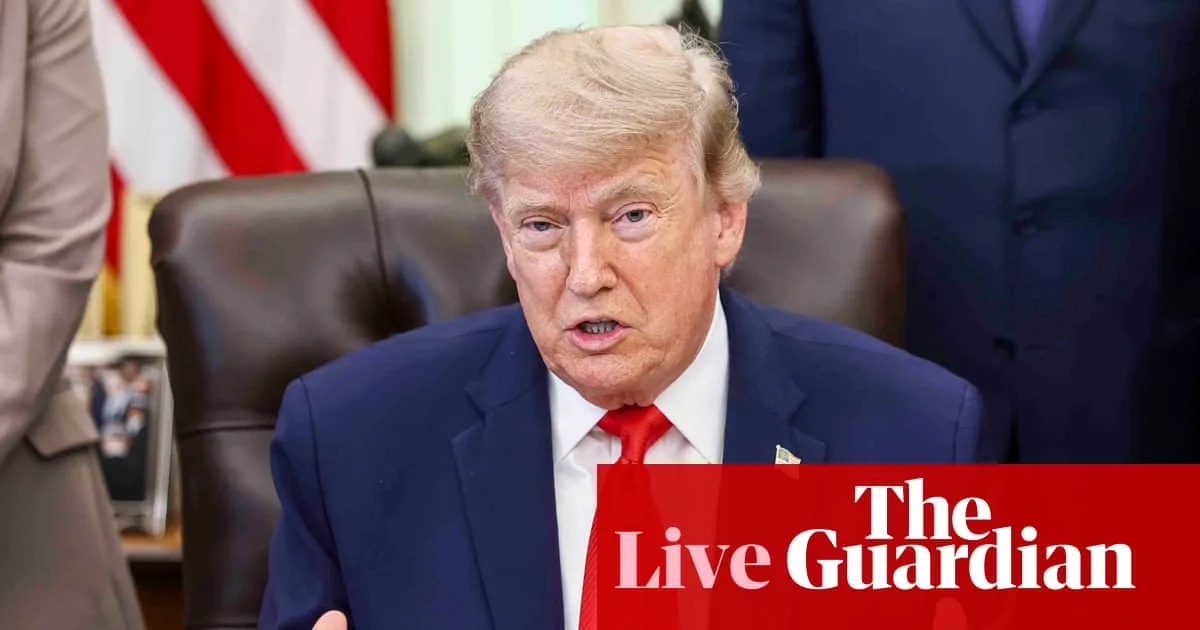
Donald Trump has said he is cancelling further airstrikes on Iran after Tehran approved an agreement with the US that would be signed “soon, very soon, maybe over the weekend in Europe”. The US president claimed the strait of Hormuz would reopen “as soon as we sign” the documents of the “great settlement”, adding that “the whole Middle East is happy”.
Iran’s foreign ministry later said it had not made a final decision on the agreement, with state media reporting that Tehran would not compromise on its “red lines”. A spokesperson said a large part of the text had been finalised but the US had repeatedly changed its positions during talks. Trump said the “final points” had been approved by the US, Israel, Saudi Arabia, UAE, Qatar, Turkey, Pakistan, Bahrain, Kuwait, Jordan, Egypt and others.
Israel said it was “not a party to” the emerging memorandum of understanding between the US and Iran. Prime Minister Benjamin Netanyahu’s office said the final agreement would include the removal of Iran’s enriched material, the dismantling of enrichment infrastructure, limits on missile production, and the cessation of Iran’s support for its regional proxies – measures that have previously been red lines for Tehran.
Oil prices plunged to two-month lows on hopes of a deal, with US West Texas Intermediate crude falling 1.9% to $86.08 a barrel and Brent dropping 1.5% to $89.08 a barrel. Asian stocks rallied, with South Korea’s Kospi surging 7.4% and Japan’s Nikkei up 2.7%. The new agreement reportedly provides a timeline for demining the Hormuz strait, during which the US naval blockade would continue, and discusses mechanisms for further nuclear talks and the release of frozen Iranian assets, but lacks concrete agreements on implementation.
Trump earlier threatened to seize Iran’s Kharg Island but later said the seizure would be off the table “if we sign this agreement”. Iranian forces prevented a tanker from transiting the strait without coordination, and US forces shot down two Iranian drones as Tehran appeared to attempt to strike commercial ships. In Lebanon, a strike wounded 10 hospital staff in Tyre, while India protested after three Indian seafarers were killed in US strikes on oil tankers.




