Syrian government troops moved into two key northern towns on Saturday morning following a decision by Kurdish-led forces to evacuate the area, a move intended to avert further bloodshed. The development marks a significant shift in control near Aleppo, Syria's largest city.
Military Advance and Conflicting Accusations
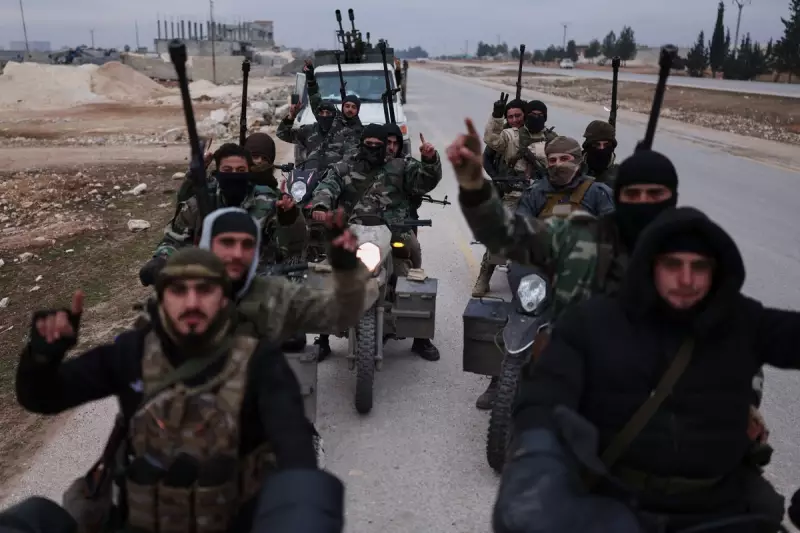
On Saturday 17 January 2026, an Associated Press correspondent witnessed government tanks, armoured personnel carriers, and technical vehicles fitted with heavy machine guns entering the town of Deir Hafer. This came after bulldozers cleared barriers, with no sign of the Kurdish-led Syrian Democratic Forces (SDF) on the town's outskirts.
The Syrian military announced it had assumed full control of Deir Hafer and captured the nearby Jarrah air base to the east. Operations to clear mines and explosives were underway, with forces preparing to advance toward the adjacent town of Maskana, where an AP reporter later saw a military convoy arriving.

However, the transfer of control was marred by discord. The SDF stated that, under an agreed plan, Syrian forces were only to enter Deir Hafer and Maskana after the Kurdish-led fighters had completed their withdrawal. "Damascus violated the terms of the agreement and entered the towns before our fighters had fully withdrawn, creating a highly dangerous situation with potentially serious repercussions," the SDF said in a statement.
In a counter-claim, the state news agency SANA reported that SDF fighters had broken the ceasefire by targeting an army patrol near Maskana, killing two soldiers and wounding others. SANA added that government troops continued moving east, reaching two villages in Raqqa province.
Background of the Conflict and Mass Displacement
The shift in control follows deadly clashes earlier this month between government troops and the U.S.-backed SDF in Aleppo, which concluded with Kurdish fighters evacuating three neighbourhoods. The tension escalated on Friday night when government forces began shelling SDF positions in Deir Hafer.
In response, the SDF's top commander, Mazloum Abdi, declared on X that his forces would withdraw from contested areas in northern Syria, relocating east of the Euphrates River starting at 7 a.m. (0400 GMT) on Saturday. This decision came after U.S. military officials visited Deir Hafer on Friday for talks with SDF leaders, urging calm.
The violence and government offensive prompted a significant humanitarian exodus. Over the preceding two days, more than 11,000 civilians fled Deir Hafer and Maskana, using side roads to reach government-held territory.
Political Context and Kurdish Rights Decree
The SDF's withdrawal coincided with a major political announcement from Damascus. On Friday, Syria's interim President, Ahmad al-Sharaa, issued a decree aimed at bolstering the rights of the nation's Kurdish minority, who constituted roughly 10% of Syria's pre-war population of 23 million.
The decree formally recognised Kurdish as a national language alongside Arabic and adopted the Kurdish Newroz spring festival as an official holiday. For decades under the Baath Party's rule, which ended with Bashar Assad's fall in December 2024, Kurds faced marginalisation and cultural suppression.
However, the Kurdish-led authority in northeast Syria responded cautiously on Saturday, arguing that Kurdish rights should be enshrined in the constitution, not protected by "temporary decrees." It stated that a presidential decree "does not form a real guarantee for rights of Syria's ethnic groups."
Amidst the military manoeuvres, diplomatic efforts continued. Commander Mazloum Abdi was scheduled to meet with U.S. Special Envoy to Syria, Tom Barrack, in Irbil, northern Iraq, on Saturday.