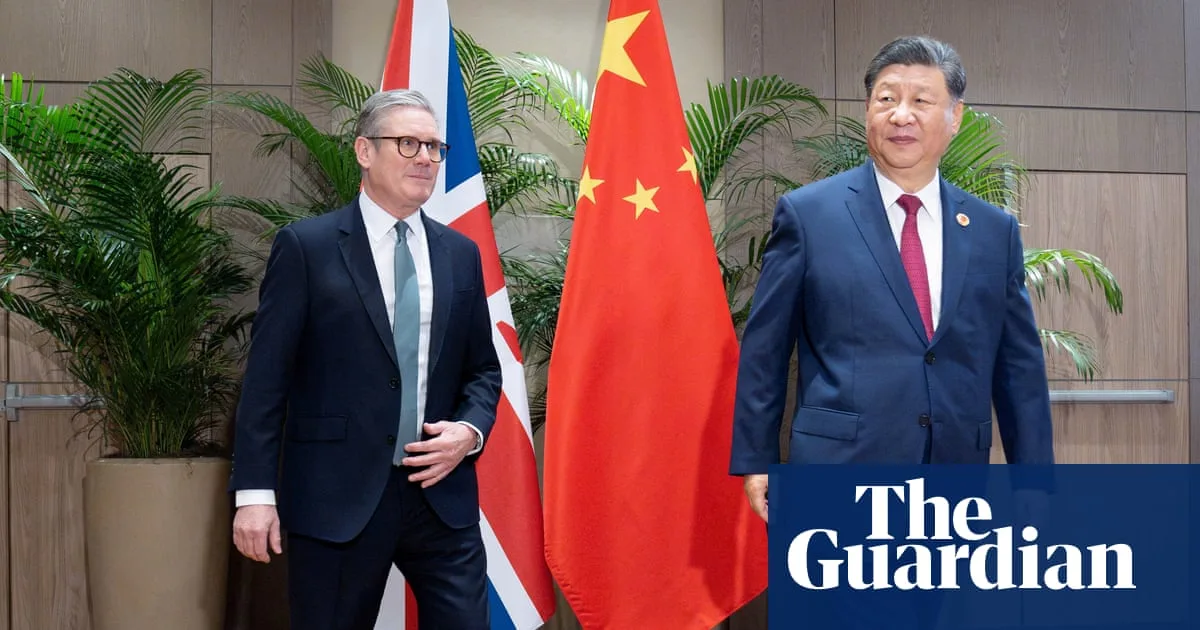
Starmer's Diplomatic Tightrope: Navigating Human Rights, Security and Trade on China Visit
Starmer's Diplomatic Tightrope on China Visit

Prime Minister Keir Starmer has embarked on a significant diplomatic mission to China, pledging to introduce "stability and clarity" to the United Kingdom's approach towards Beijing. This visit marks the first by a British prime minister in eight years, following what Starmer has characterised as years of "inconsistency" under previous Conservative administrations. However, his quest to bolster ties with the world's second-largest economy is immediately confronted by a complex array of challenging issues that threaten to complicate negotiations.

The Human Rights Conundrum

One of the most delicate matters on the agenda is the case of Jimmy Lai, the imprisoned former media magnate and a prominent pro-democracy advocate from Hong Kong. As a British citizen, Lai's recent conviction on national security charges—which the UK government views as politically motivated—has sparked considerable concern. Foreign Secretary Yvette Cooper has demanded his immediate release and summoned the Chinese ambassador in protest. With fears mounting about Lai's deteriorating health and the prospect of a life sentence, Starmer faces substantial pressure to leverage his position to secure Lai's freedom.

Additionally, the Prime Minister may feel compelled to address the plight of the Uyghur Muslim minority in China, who have reportedly been subjected to forced labour programmes and severe persecution. Given Starmer's background as a former human rights lawyer and the UK's longstanding tradition of advocating for human rights globally, this responsibility weighs heavily on his shoulders during these sensitive talks.

Wide Pickt banner — collaborative shopping lists app for Telegram, phone mockup with grocery list

Taiwan and Territorial Tensions

President Xi Jinping is likely to raise the issue of Taiwan, the self-governing island that Beijing claims as part of its territory. Unification remains a paramount priority for Xi, who has not dismissed the possibility of using military force to achieve this goal. Under his leadership, aggressive posturing towards Taiwan has intensified, involving military intimidation and various forms of non-military coercion.

US intelligence assessments suggest that Xi has instructed the Chinese military to be prepared to secure Taiwan by 2027, making the current period critically important. The United Kingdom maintains a policy of not recognising Taiwan as a sovereign state and has no formal diplomatic relations with it. Starmer is expected to proceed with extreme caution on this matter, particularly after China previously threatened to cancel high-level trade talks following a UK minister's visit to the island—a situation that required delicate diplomatic manoeuvring to resolve.

Espionage and National Security Concerns

There exists profound and widespread apprehension across the British political spectrum regarding China's alleged espionage activities and attempts to infiltrate critical national infrastructure. Last November, MI5 issued an alert concerning efforts to recruit parliamentarians via LinkedIn profiles linked to Chinese intelligence services. China has imposed sanctions on several MPs and peers, while the UK has previously sanctioned groups accused of conducting cyber espionage campaigns against politicians, journalists, and critics.

Further allegations include the harassment of Hong Kong pro-democracy activists within the UK and the suppression of academic criticism at British universities. Downing Street has emphasised that Starmer is "clear-eyed" about the national security threats posed by China, both domestically and internationally, and will not shy away from addressing these difficult issues. This could involve pressing Xi on China's role in Russia's war in Ukraine, where Beijing has provided Moscow with financial support, components, and diplomatic cover despite professing neutrality.

The New Embassy and Diplomatic Leverage

In a timely development, the UK government recently approved China's controversial plans to construct a new mega-embassy near the Tower of London—a project initially approved by Boris Johnson during his tenure as foreign secretary. Beijing considers this embassy a priority in bilateral relations, with Xi having raised the matter directly with Starmer during their first phone call in August 2024.

Pickt after-article banner — collaborative shopping lists app with family illustration

Despite opposition from MPs across parties, who warned of espionage risks due to the site's proximity to data cables entering the City of London, security chiefs assured ministers that these risks could be managed. The approval may provide the UK with some leverage in negotiations concerning the dilapidated state of the British embassy in Beijing, whose redevelopment has been stalled amid diplomatic tensions.

Economic Ambitions and Global Positioning

The central objective of Starmer's visit is to strengthen economic ties, underscored by his accompaniment of a 50-strong delegation of business and cultural leaders. Beyond any specific deals, the symbolic significance of a British prime minister visiting China after an eight-year hiatus speaks volumes about the UK's renewed focus on growth and prosperity.

Starmer is particularly keen to secure ongoing Chinese investment in vital national infrastructure sectors, such as steel production. However, within the broader context of Beijing's international relationships, the UK occupies a relatively minor position. While China is the UK's third-largest trading partner, Britain does not rank among China's top ten trading partners, with Beijing showing greater interest in the European Union as a bloc.

Starmer will undoubtedly deliver a robust sales pitch to Xi, but China may perceive closer political ties with the UK as a strategic victory, especially as it seeks to expand its global influence amid perceived American retrenchment from its traditional role as the West's primary ally.

The Trump Factor and International Repercussions

The unpredictable nature of Donald Trump's foreign policy adds another layer of complexity. Trump's notoriously hardline stance on China was demonstrated when he threatened to impose a 100% tariff on Canadian imports after former Bank of England governor Mark Carney visited Beijing—a stark warning to Western nations contemplating deeper economic engagement with China.

Downing Street has highlighted Starmer's positive relationship with Trump and noted the US president's own planned visit to Beijing in April. Nevertheless, Starmer must also seek assurances from China regarding its intentions towards the Chagos Islands, following Trump's abrupt reversal of support for a related agreement.

As Keir Starmer navigates this diplomatic tightrope, his ability to balance principled stands on human rights and security with pragmatic economic cooperation will define the future trajectory of UK-China relations. The outcome of this high-stakes visit could reshape Britain's foreign policy approach for years to come.




