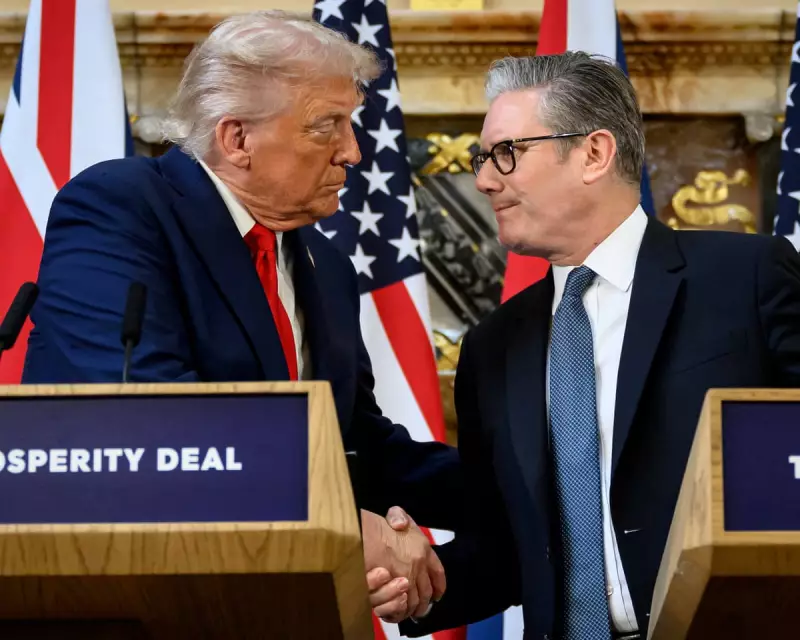
Prime Minister Keir Starmer and former US President Donald Trump shared a handshake at a press conference held at Chequers in Aylesbury on 18 September 2025. The carefully choreographed moment, captured by Reuters photographer Leon Neal, belied the profound diplomatic tightrope the British leader is now walking.
The Venezuela Conundrum: A Test of Principle and Pragmatism
The core of Starmer's present difficulty was laid bare by the US-led seizure of Venezuelan President Nicolás Maduro from Caracas. For 16 hours, Downing Street remained silent before issuing a statement that attempted to bridge the UK's commitment to international law and its clear policy of avoiding direct criticism of Trump.
Given Starmer's background as a human rights lawyer, he undoubtedly holds a personal view on the legitimacy of abducting foreign heads of state. Yet, as Prime Minister, his calculus is different. Britain's security remains heavily dependent on the United States, making public condemnation a risky gambit. The immediate stakes are high, with a critical meeting in Paris involving a "coalition of the willing" on Ukraine's defence, which Trump's negotiators will attend.

The question is stark: should Starmer satisfy his backbench by denouncing Trump's actions in Venezuela, potentially jeopardising US support for Ukraine? Or should he hold his tongue to maintain influence in Washington, prioritising Ukraine's immediate survival under Russian bombardment?
The Atlantic Bridge on Fire: Starmer's Strategic Ambiguity
The defence offered for Starmer's cautious approach is that his working relationship with Trump is better than many predicted. On Ukraine, he has played a leading role in a NATO charm offensive, successfully persuading Trump that Europe is now bearing the financial burden of the war and curbing his earlier eagerness to abandon Kyiv.
However, the economic picture is less rosy. Britain has not secured leniency under the new US tariff regime, and progress on a "tech prosperity deal" has stalled. Meanwhile, MAGA rhetoric paints London as the epicentre of a European civilisational decline.
Starmer consistently refuses to choose between the US and Europe, stating "I am never going to choose between the US and Europe." He speaks of closer EU economic ties but always with the caveat that nothing should compromise the Washington relationship. This ambition to resurrect Britain's role as an Atlantic bridge faces a fundamental problem: Donald Trump burns bridges.
Paralysis or Prudence? The Cost of Not Choosing
There is a realpolitik argument for not condemning Trump's military actions in Venezuela. It is the logic of a protection racket, where offending the protector carries severe consequences. The corresponding strategic move, however, should be a plan to reduce dependency on that protector as swiftly as possible.
The alarm caused by Starmer's caginess stems from the lack of evidence for such a plan. In a world disaggregating into regional blocs, his refusal to make vital choices may simply mean those choices are made by others—by Washington, Brussels, or the march of events. His verbal caution, necessary in dealing with a vindictive US administration, becomes indistinguishable from a broader indecision.
The case for a pragmatic prime minister who sometimes swallows his words relies on the belief that he has a serious, unspoken strategy. As the new world order is born not just in Venezuela but in Ukraine, in trade wars, and in the future of NATO, the British public and America's allies are left to wonder: what is Keir Starmer's plan?