Russian-Occupied Ukraine Faces Dire Infrastructure and Human Rights Crisis
Nearly four years into its full-scale invasion, Russia currently controls approximately 20% of Ukrainian territory. The estimated 3 million to 5 million people remaining in these occupied regions face severe hardships including inadequate housing, unreliable water supplies, frequent power outages, insufficient heating, and collapsing healthcare systems.
Forced Assimilation and Systematic Repression
Russian authorities have implemented aggressive policies forcing citizenship, language, and cultural norms upon residents. School curricula and textbooks have been altered to reflect Russian perspectives, while many residents live under constant fear of being accused of sympathizing with Kyiv. Human rights organizations document numerous cases of imprisonment, beatings, and killings targeting perceived opponents.
Oleksandra Matviichuk, head of the Nobel Peace Prize-winning Center for Civil Liberties, revealed that Russia has established "a vast network of secret and official detention centers where tens of thousands of Ukrainian civilians" are held indefinitely without formal charges. Russian officials have consistently refused to address United Nations allegations regarding the torture of civilians and prisoners of war.

Personal Accounts of Survival and Escape
Inna Vnukova's experience illustrates the terror many faced during initial occupation. She spent early days hiding in a damp basement with her family in the Luhansk region village of Kudriashivka, where Russian soldiers established checkpoints, looted homes, and bullied residents amid constant shelling. "Everyone was very scared and afraid to go outside," Vnukova recalled from Estonia, where she now resides.
In mid-March 2022, Vnukova fled with her 16-year-old son Zhenya, waving a white sheet amid mortar fire during their dangerous car journey to Starobilsk. Her husband Oleksii Vnukov, a court security officer, remained behind for nearly two weeks, facing death threats from Russian soldiers before eventually escaping. "The people there aren't living, they're just surviving," he said of the 150 remaining residents in their former village of 800.
Devastation in Key Urban Centers
The port city of Mariupol suffered particularly brutal occupation after weeks of siege, culminating in its fall in May 2022. The March 16, 2022 bombing of the Donetsk Academic Regional Drama Theater killed nearly 600 people according to Associated Press investigations, representing the war's single deadliest known attack against civilians.
A former Mariupol actor, now in Estonia and speaking anonymously to protect his elderly parents still in the city, described how most of the pre-war population of approximately half-million fled or hid in basements. His parents ultimately accepted Russian citizenship to access medical care and a one-time compensation payment equivalent to $1,300 per person for their destroyed home.
Housing remains critically inadequate despite the reduced population, with new apartments reportedly being sold primarily to Russian newcomers rather than displaced local residents. Complaints about this practice have been sent via video directly to President Vladimir Putin.
Collapsing Municipal Services and Infrastructure
Years of warfare and neglect have devastated municipal services across occupied territories. In Alchevsk, Luhansk region, over half of homes lack heating during the bitterly cold winter, forcing authorities to establish five emergency warming stations.
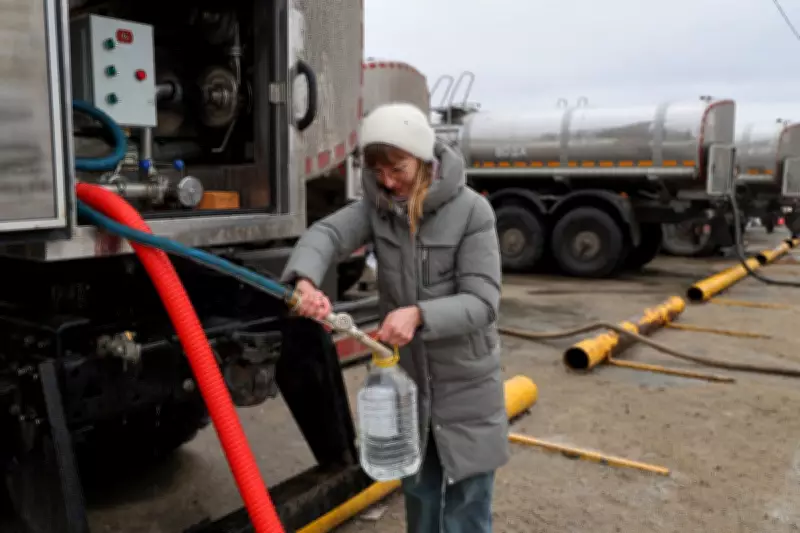
A Donetsk region resident speaking anonymously due to safety concerns described how water trucks fill barrels outside apartment blocks, but these frequently freeze solid in winter temperatures. "There's constant squabbling over water," she reported, highlighting the daily struggles for basic necessities.
Moscow actively encourages Russian citizens to relocate to occupied regions through various incentive programs. Teachers, doctors, and cultural workers receive salary supplements for committing to five-year residencies, while the northeastern city of Sievierodonetsk—once home to 140,000 people—now houses only 45,000 mostly elderly or disabled residents with just one ambulance crew serving the entire city.

Living Under Constant Surveillance and Fear
Stanislav Shkuta, 25, from Nova Kakhovka in Kherson region, narrowly escaped arrest multiple times before reaching Ukrainian-controlled territory in 2023. He recalled Russian soldiers stopping buses and forcing "men and women to strip to the waist to see if they had Ukrainian tattoos."
Mykhailo Savva of the Center for Civil Liberties confirmed that "Russian special services continue to identify disloyal Ukrainians, extract confessions, and continue to detain people," with residents facing frequent document checks and mass searches.
Human rights organizations document that Russia employed "filtration camps" early in the conflict to identify potentially disloyal individuals, targeting government workers, military relatives, journalists, teachers, scientists, and politicians. Ukrainian Human Rights Ombudsman Dmytro Lubinets estimates approximately 16,000 civilians have been illegally detained, though the actual number may be significantly higher due to incommunicado detentions.
Even President Putin acknowledged "many truly pressing, urgent problems" in the illegally annexed regions of Donetsk, Luhansk, Kherson, and Zaporizhzhia during September remarks, citing needs for reliable water supplies and healthcare access while announcing a "large-scale socioeconomic development program" that has yet to alleviate the profound suffering.