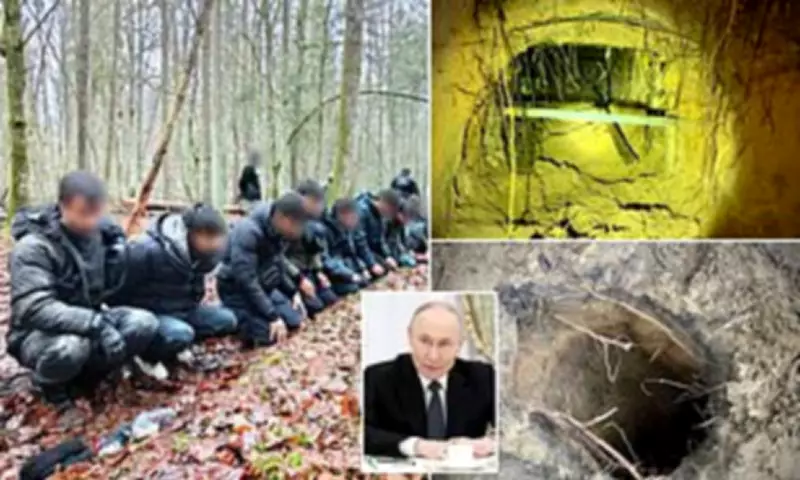
Russia and Belarus Deploy Tunnels to Smuggle Migrants into Poland
Russia is orchestrating a hybrid warfare campaign by flooding Europe with migrants sent through clandestine tunnels from Belarus into Poland. Thousands of migrants have been dispatched across Poland's eastern frontier, with Belarusian dictator Alexander Lukashenko, a key ally of Vladimir Putin, playing a central role in efforts to destabilise Western nations.
Sophisticated Underground Passages Uncovered
In 2025, Polish border officers discovered four tunnels under the border with Belarus, according to Lt Col Katarzyna Zdanowicz of the Polish border force. One of the largest tunnels was found in mid-December near the village of Narewka in eastern Poland. This tunnel measured 1.5 metres in height, with its entrance concealed in a Belarusian forest. It extended approximately 50 metres on the Belarusian side and 10 metres into Polish territory.
Physical and electronic security measures at the border, such as thermal imaging cameras and detection systems, allow us to immediately respond to any attempted violations of the state border, even underground ones, stated Lt Col Zdanowicz. Video footage released by the border guard revealed a dark, narrow tunnel reinforced with concrete struts to prevent collapse, providing just enough space for individuals to crawl through.

Migrant Smuggling and Expert Involvement
A total of 180 migrants, primarily from Pakistan and Afghanistan, utilised the tunnel to cross the border, with the majority arrested upon emergence. Polish officials assert that Belarus employed specialists from the Middle East to design these tunnels, attributing a high level of expertise to these individuals. Although difficult to verify, it is suspected that groups such as Islamic State, Hamas, Hezbollah, and Kurdish fighters may be involved.
Military expert Dr Lynette Nusbacher described it as plausible that Iranian-backed groups could participate, citing historical examples of tunnel construction in Lebanon and Gaza. Former Israeli intelligence colonel Sarit Zehavi added that Hezbollah and other Iranian proxies possess this capability, though Kurdish militias in Syria and ISIS also have similar knowledge.
Border Security and Escalating Tensions
Poland has responded by tracking down entry points and demolishing tunnels, yet concerns persist about new entrances emerging. Deputy Interior Minister Czesław Mroczek noted that the appearance of tunnels indicates the effectiveness of border forces in halting migration, prompting the use of specialised tunnelling techniques.
This discovery coincides with ongoing efforts by Russia and its allies to penalise the West for its military support to Ukraine. Prior to the 2022 invasion, Belarus was already sending migrants over the Polish border, leading Poland to construct a massive 200km fence equipped with 300 cameras. Since the war began, Russia has sabotaged factories and railways aiding Ukraine and launched attacks on European airports.
Broader Hybrid Warfare Tactics
Belarus has also dispatched balloons carrying contraband like bootleg cigarettes into NATO countries, initially targeting Lithuania and now Poland, to disrupt air traffic. Belarusian opposition leader Sviatlana Tsikhanouskaya warned that Lukashenko's regime is deepening Russia's military presence in Belarus, preparing for further escalation in Ukraine.
Her comments followed Vladimir Putin's deployment of the nuclear-capable Oreshnik missile system to Belarus, with Lukashenko announcing that ten such systems would be stationed there. The Oreshnik, an intermediate-range hypersonic ballistic missile system, can reach the UK within eight minutes and, while currently deployed with conventional payloads, has nuclear capabilities. This deployment significantly reduces the time for Russia to strike EU territory, interpreted by Western analysts as a show of force to intimidate Ukraine and its neighbours.

Implications for European Security
Tsikhanouskaya emphasised that about 300 Belarusian enterprises are supporting Russia's military production, and failure by the democratic world to ensure Ukraine's victory could embolden Putin to target other regions like Moldova, Armenia, and Georgia. If the democratic world will not help Ukrainians enough for them to win this war, it will embolden Putin and he will not stop where he is, she stated, warning that Belarus's future is inextricably linked to Ukraine's fate.
This hybrid warfare strategy, combining migrant smuggling, tunnel construction, and military escalation, underscores the multifaceted threats posed by Russia and Belarus to European stability and security.