Major Budapest Protest Seeks Minister's Ouster Over Racist Remarks
Over one thousand demonstrators, with a significant contingent from Hungary's sizable Roma community, staged a major protest in the capital Budapest on Saturday. The rally was organised to demand the immediate resignation of a prominent government minister, János Lázár, following inflammatory comments that participants labelled as overtly racist and deeply offensive.
The protestors converged outside the offices of Minister János Lázár, a key figure within Prime Minister Viktor Orbán's right-wing populist administration. Their central demands were a formal public apology from Lázár and his subsequent departure from government. The demonstration highlighted the simmering tensions between the state and Hungary's largest ethnic minority.
"Second-Class Citizens": A Community's Long-Standing Grievance
Among the crowd was István Soltész, a Roma man who travelled from southern Hungary to attend. He articulated a sentiment felt by many. "Unfortunately, we have always been made to feel that we are considered second-class citizens," Soltész stated. "Many of us also played our part in the world wars, in revolutions, in the construction of the country. But we were always just humiliated."

This protest underscores the profound marginalisation faced by Hungary's Roma population, which some estimates place at over one million people, representing more than ten percent of the national total. The community has historically endured systemic poverty, widespread discrimination, social segregation, and sporadic racial violence.
The Controversial Comments That Sparked Outrage
The controversy stems from remarks made by Minister Lázár during a community forum earlier this month. Addressing Hungary's chronic labour shortage, Lázár referred to the Roma—also known by the term Gypsies, which many consider pejorative—as an internal labour "reserve." He suggested they could perform work deemed undesirable by the ethnic Hungarian majority.
"If there are no migrants, and someone has to clean the toilet on intercity trains, then we must tap into our internal reserves," Lázár said, alluding to the government's strict anti-immigration stance. "Hungarian voters do not show up with great zeal to clean someone else’s (expletive) toilets, so the internal reserve is Gypsies in Hungary. This is the reality."
These statements provoked an immediate and fierce backlash. Critics were incensed by the clear distinction Lázár drew between "Hungarians" and "Gypsies," effectively questioning the Roma's full membership in the nation. Further offence was taken at the implication that the minority should be relegated to undesirable, low-wage labour.
Political Fallout and Electoral Implications
The timing of the incident is particularly sensitive, occurring just ten weeks before scheduled parliamentary elections on April 12th. The comments risk alienating Roma voters, who have traditionally been a reliable voting bloc for Orbán's Fidesz party. In response, the governing Fidesz party has attempted to downplay the tensions, instead accusing its main rival, the centre-right Tisza party, of stoking division.
Péter Magyar, the head of Tisza and its candidate for prime minister, has publicly condemned Lázár's remarks. Current independent polling shows Tisza holding a solid lead over Fidesz, positioning the upcoming election as the most serious challenge to Orbán's power since he first took office in 2010.
Prominent Roma leaders and celebrities expressed their fury on social media, and a group of activists disrupted another forum held by Lázár earlier this week. Although Lázár has since issued a public apology, he maintained that his statements had been misinterpreted, a defence that has done little to quell the anger.
A Protest of Symbols and Solidarity
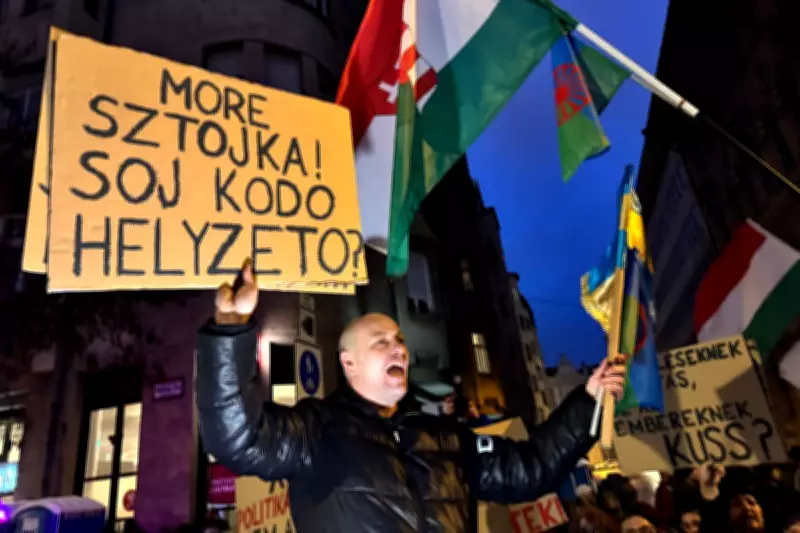
Saturday's demonstration was a vivid display of symbolic protest. Many participants waved Romani flags and held aloft toilet brushes, a direct reference to Lázár's controversial analogy. Roma musician István Szilvási captured the profound hurt felt by the community.

"It has deeply offended us in our humanity, it has offended our children, our mothers, our fathers, our ancestors, our culture and our future," Szilvási declared. He argued the remarks had "deeply offended the patriotism" of Hungary's Roma. Striking a note of political defiance, he added, "Lázár won’t resign, the government won’t resign, but it’s okay. On April 12, however, we will know for whom we should cast our vote."
The protest in Budapest stands as a powerful testament to a community's demand for dignity and equal recognition, setting the stage for a potentially pivotal moment in Hungary's political landscape as the nation approaches a critical election.