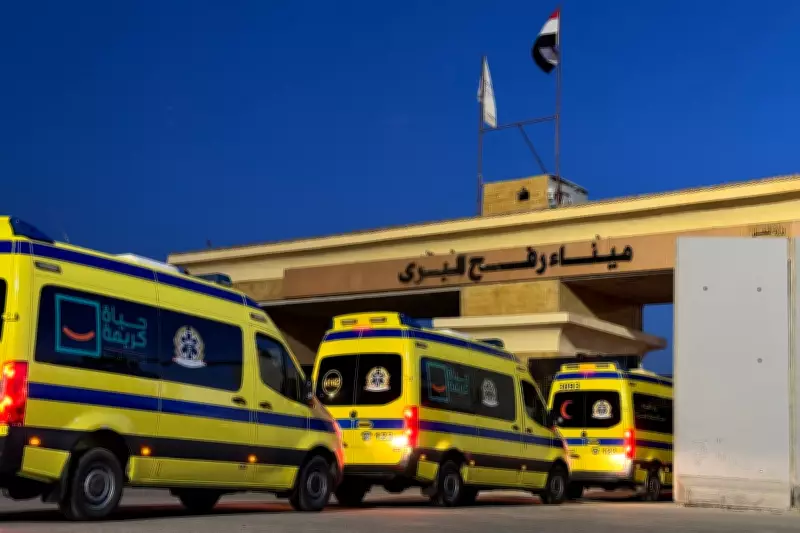
Israel has reopened the Rafah border crossing between Gaza and Egypt, permitting limited movement of Palestinians for the first time since May 2024. This development comes as over 20,000 injured and wounded individuals in Gaza await urgent medical treatment, with Israel allowing just 50 patients at a time to leave the enclave.
Ceasefire Agreement and Border Access
The reopening of the Rafah crossing represents a crucial component of US-brokered ceasefire negotiations between Israel and Hamas, spearheaded by US President Donald Trump. This marks the second stage of the agreement, following months of restricted humanitarian access during intense bombardment periods.
Rafah became highly politicised during the conflict's peak when thousands of aid trucks containing essential food and medical supplies were prevented from entering Gaza. The crossing now operates under strict conditions, with heavy surveillance, narrow lanes, barbed wire fencing, and extensive security checks characterising the checkpoint.

Humanitarian Concerns and Restrictions
While the crossing has reopened, significant limitations remain. Only people are permitted to pass through, with no goods allowed. Each patient may be accompanied by two relatives, but the scale of medical need dramatically exceeds the permitted numbers.
Palestinian officials report that approximately 100,000 people have left Gaza since October 2023, with the majority departing during the conflict's first nine months. Meanwhile, at least 30,000 Palestinians have registered with the Palestinian Embassy in Cairo seeking to return to Gaza.
International Response and Criticism
The United Nations has called on Israel to allow unfettered movement for Palestinians and humanitarian aid in accordance with international law. UN spokesperson Stephane Dujarric emphasised the need for both humanitarian cargo and private cargo to enter Gaza, alongside freedom of movement for Palestinians through Rafah crossing.
Save the Children has demanded the immediate and urgent opening of Rafah and all border crossings, alongside safe, unrestricted passage of humanitarian assistance. This call comes amid reports that over 90 percent of housing in Gaza has been destroyed, with the vast majority of the population now living in tents.
Aid Group Restrictions
Israel has recently banned Médecins Sans Frontières (MSF), accusing the medical aid organisation of being part of "military infrastructure" that "shields terrorism" after it refused to provide a list of Palestinian staff. MSF described this decision as a "pretext to obstruct humanitarian assistance."
The organisation joins 37 other aid groups facing restrictions, including ActionAid, Norwegian Refugee Council, World Vision International, and Oxfam Quebec. UN Special Rapporteur for the Occupied Palestinian Territories, Francesca Albanese, has stated that "Israel has NO authority to block anyone from entering the Palestinian territory it illegally occupies."
Casualty Figures and Genocide Claims
Over 71,667 people have been killed in Gaza, according to figures that the Israeli military accepted last week after previously disputing Gaza health ministry statistics. A two-year investigation into Israel's military actions in Gaza has concluded that Israel is committing genocide, claims that Israeli authorities have labelled as "false," "distorted," and "antisemitic."
Israel maintains that it does not obstruct aid flow into Gaza and that all security measures are necessary for protection purposes. The reopening of Rafah crossing represents a limited step toward addressing the humanitarian crisis while significant restrictions on movement and aid delivery persist.