Russia Unleashes Major Spring Offensive as Global Focus Shifts to Middle East
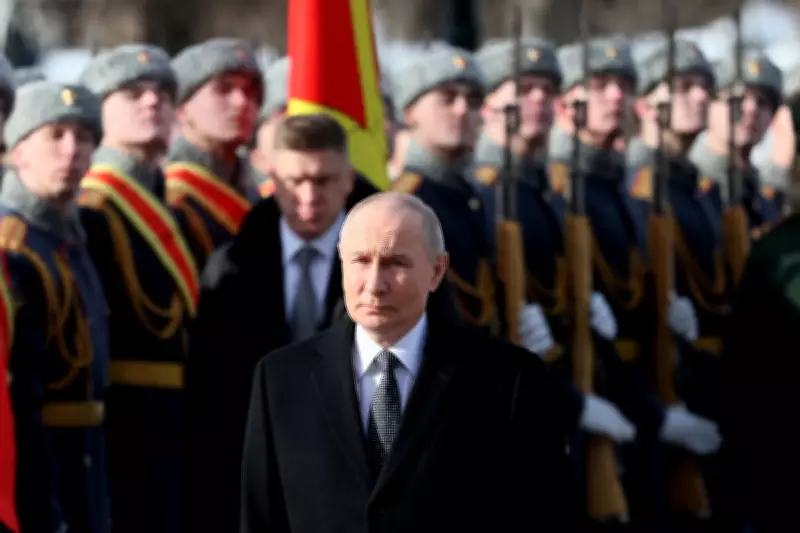
Vladimir Putin has initiated a significant spring offensive against Ukraine, launching the most extensive aerial assault since the war began. According to the Institute for the Study of War, Russia fired nearly 1,000 drones over 24 hours, alongside 23 cruise missiles and seven ballistic missiles, striking at least ten locations including a UNESCO World Heritage site. The attacks affected eleven regions and seven cities, resulting in at least six fatalities and marking the largest single-day aerial bombardment to date.
Diverted Attention Creates Window of Opportunity
Experts warn that escalating conflict in the Middle East has created a crucial opening for Russian aggression. Jaroslava Barbieri, a research fellow at Chatham House's Ukraine Forum, explains that the diversion of air defense systems and munitions toward the Middle East has left Ukraine increasingly vulnerable to renewed aerial attacks. "The escalation in the Middle East has diverted attention away from Ukraine," Barbieri states, noting that countries including the United States are inevitably prioritizing their own military operations against Iran.
Military assets previously destined for Ukraine through initiatives like the Prioritised Ukraine Requirements List are now being redirected to the Middle East. Preliminary analysis suggests that within the first weeks of the Middle East conflict, the United States has consumed munitions at a rate exceeding what Ukraine received over four years of full-scale war. If this pace continues, Ukraine will face significant vulnerabilities in its air defense capabilities.

Financial Windfall Fuels Russian War Machine
Reports indicate that the partial closure of the Strait of Hormuz and subsequent temporary spike in oil prices have generated additional revenues for Russia, which are being channeled directly into its war effort. While Barbieri cautions that "we don't know how long this extra injection of cash into Russia's war machine might last," the financial boost comes alongside temporary sanctions relief that is further filling Kremlin coffers according to Christina Haward at the Institute for the Study of War.
Russia has also been accused of assisting Iran with satellite imagery and weapon components to continue fighting the United States and Israel, though the Kremlin has denied these allegations. This cooperation underscores the interconnected nature of global conflicts and their impact on Ukrainian defense capabilities.
Peace Talks Stalled as Attacks Intensify
Despite what experts describe as the "theatre" of peace negotiations, Putin has demonstrated unwavering commitment to his war objectives, particularly the annexation of Ukrainian territory. Haward emphasizes that Russian troops are "not going to stop attacking," with continued assaults forming part of Moscow's negotiating strategy. "He has been trying for over a year now to convince the US that Ukrainian lines are about to collapse," she explains, noting these are false claims designed to pressure Kyiv into capitulation.
Peace talks have stalled around two primary issues: territorial concessions and security guarantees. The Kremlin has made zero concessions on either front, continuing to demand that Ukraine cede territory it still controls while rejecting any Western security guarantees for Ukraine.
Strategic Objectives in Donetsk Region
The "window of opportunity" created by improved weather conditions and Middle East distractions allows Russia to push toward heavily fortified positions in the Donetsk region, which remains partially under Ukrainian control. Donetsk has been a persistent sticking point in trilateral discussions, with Putin insisting on seizing the entire strategic region.
However, Haward suggests Russian progress may be slower than anticipated, particularly if the Middle East conflict concludes before summer. "Russian forces are unlikely to move anywhere fast on the battlefield," she states, noting their advances over the past year have been "creeping and slow." While Russia is unlikely to seize the Fortress Belt in Donetsk Oblast soon, it will likely suffer high casualties in the attempt, with Ukrainian forces inflicting increasingly significant losses.

Long-Term Outlook and Ukrainian Resilience
Despite the brutality of Russia's campaign, some analysts see potential advantages for Ukraine in the longer term. John Lough, a former NATO representative in Moscow and expert at the New Eurasian Strategies Centre, notes that the Kremlin hoped Donald Trump would pressure Volodymyr Zelensky into suing for peace, but this has not materialized. The winter air campaign targeting Ukraine's power generation system failed to persuade Ukrainian society to stop fighting.
"Putin is back at square one and is relying on the Russian army to grind forward," Lough observes. "The Ukrainians have the advantage of the defender and seem more confident than before the winter that they can keep the Russians at bay in 2026."
Nevertheless, Barbieri emphasizes the immediate challenges: "Ukraine has to brace itself for more years of war particularly if the US gets bogged down in the Middle East." For an already exhausted nation facing renewed aggression amid global distractions, she concludes: "It's a very delicate moment for Ukraine."