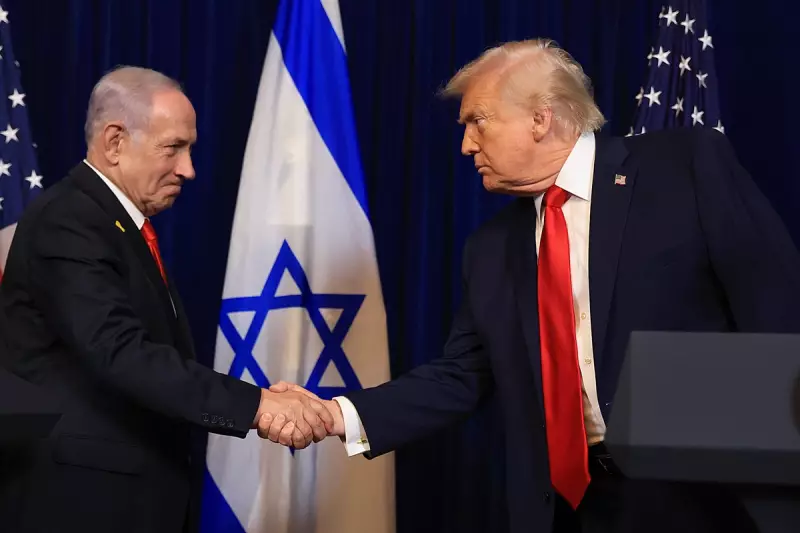
Israeli Prime Minister Benjamin Netanyahu has confirmed his acceptance of an invitation to join former US President Donald Trump's proposed "Board of Peace" for Gaza, marking a significant diplomatic shift. This development comes just days after Israeli officials had publicly objected to the membership structure of the board, highlighting the rapidly evolving nature of Trump's initiative.
Controversial Membership and International Reactions
The "Board of Peace" was originally conceived by Trump as a compact group of world leaders who would oversee the reconstruction of Gaza following Israel's two-year military campaign against Hamas. However, the administration has since expanded invitations to dozens of nations and prominent business figures who previously had no direct involvement in diplomatic efforts to resolve the conflict.
War Crimes Allegations Cast Shadow
Netanyahu's participation raises serious questions about the board's perceived objectivity, given the outstanding arrest warrant issued against him by the International Criminal Court. The ICC has accused the Israeli leader of war crimes and crimes against humanity, including allegations of using starvation as a method of warfare and intentionally targeting civilian populations. Israel has consistently denied these allegations.

Criticism has emerged from within Netanyahu's own government, with far-right Finance Minister Bezalel Smotrich advocating for Israel to assume unilateral responsibility for Gaza's future rather than participating in international boards. Palestinian officials have expressed concern that Netanyahu's involvement could obstruct progress on Phase Two of Trump's peace plan for the territory.
Expanding Roster of Controversial Figures
The Israeli prime minister joins a growing list of contentious world leaders who have received invitations to participate in the board. Azerbaijan's Ilham Aliyev and Belarusian leader Alexander Lukashenko have both accepted their invitations, while Russian President Vladimir Putin - who also faces an ICC arrest warrant for alleged war crimes - has reportedly been invited to join.
The Kremlin has acknowledged receiving an invitation and is currently "studying the details" to understand "all the nuances," according to spokesman Dmitry Peskov. Ukrainian President Volodymyr Zelensky, who has also been invited, expressed difficulty imagining cooperating with Russia on this or any other board.
European Reservations and Trump's Trade Threats
Several European nations have expressed reservations about participating in the initiative. Norway, Sweden, and France have indicated they will not join the board at this time, while Italy is reportedly set to reject the invitation according to national newspaper Corriere della Sera.
French Foreign Minister Jean-Noel Barrot stated: "Yes to implementing the peace plan presented by the president of the United States, which we wholeheartedly support, but no to creating an organisation as it has been presented, which would replace the United Nations."
Trump responded to French President Emmanuel Macron's likely refusal to participate with characteristic bluntness, telling reporters: "Nobody wants him because he's going to be out of office very soon. I'll put a 200% tariff on his wines and Champagnes and he'll join. But he doesn't have to join."
Board Structure and Operational Framework
The executive board will include prominent figures such as US Secretary of State Marco Rubio, Trump envoy Steve Witkoff, Trump's son-in-law Jared Kushner, former British Prime Minister Tony Blair, Apollo Global Management CEO Marc Rowan, World Bank President Ajay Banga, and Trump's deputy national security adviser Robert Gabriel.
The board will supervise a newly appointed committee of Palestinian technocrats responsible for managing Gaza's day-to-day affairs. Nickolay Mladenov, a former Bulgarian politician and UN Middle East envoy, will serve as the Gaza executive board's representative overseeing daily operations.

Continuing Violence and Humanitarian Crisis
The announcement comes against a backdrop of ongoing violence in the region. A ceasefire agreement between the IDF and Hamas has failed to prevent further bloodshed, with more than 450 Gazan citizens killed since the ceasefire was announced in October last year. According to Gaza's health ministry, more than 70,000 Palestinians have been killed since October 7, 2023.
The Gaza Strip remains divided by the Yellow Line established in October, separating the 47% of territory under Palestinian control in the western area from the 53% controlled by Israel in the eastern sector.
Trump is scheduled to formally announce the Board of Peace on Thursday at the World Economic Forum in Davos, Switzerland, where he will outline the initiative's structure and objectives to the international community.