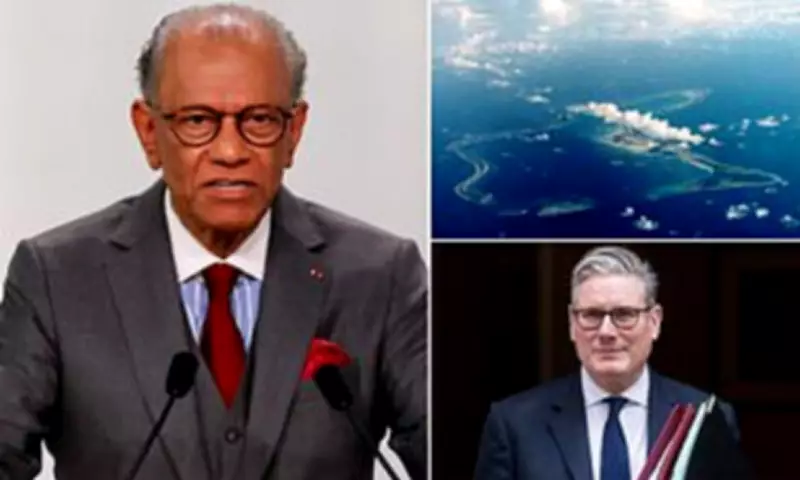
Mauritius Voices Frustration Over Delayed Chagos Islands Sovereignty Agreement
The government of Mauritius has publicly criticised Britain for delaying the implementation of a £35 billion sovereignty agreement concerning the Chagos Islands. An inter-ministerial committee in Port Louis, chaired by Prime Minister Navin Ramgoolam, formally expressed its "concern" that the deal, signed in May last year, has still not come into force.
Growing Diplomatic Pressure on Sir Keir Starmer
The committee highlighted that "despite the common will of the parties to bring the agreement into force expeditiously, it has not yet entered into force and there is no visibility as to when this would occur." This statement adds to mounting pressure on UK Prime Minister Sir Keir Starmer, who faces significant backlash over his decision to cede the strategically important Indian Ocean archipelago to Mauritius, a nation viewed as an ally of China.
Former US President Donald Trump recently intensified criticism of Sir Keir's approach, particularly regarding the initial refusal to allow America to use the joint US-UK military base on Diego Garcia—the largest island in the Chagos chain—for launching strikes against Iran. Trump's comments underscore broader transatlantic tensions, especially after Sir Keir later performed a partial U-turn following Iran's retaliatory attacks on British bases in the Middle East.

Foreign Office Resignation and Legal Controversies
In a related development, a senior UK diplomat, Ameer Kotecha, resigned from his position as head of Palestinian issues at the British embassy in Tel Aviv. Kotecha cited the government's decision to cede control of the Chagos Islands and Sir Keir's delayed response to Iran's attack on a British base in Cyprus as key factors influencing his departure.
In an article for The Times, Kotecha argued that UK foreign policy is being "dictated by what the lawyers tell us international law requires" rather than a clear assessment of national interest. He called for a more ruthless focus on British benefits within Whitehall, warning that "our impotence on Iran and craven surrender over Chagos happen when the long-term national interest is sacrificed."
A Foreign Office spokesman responded by stating, "We expect officers in the diplomatic service to uphold the highest standards of integrity and serve the government of the day impartially. If a member of staff feels they are no longer able to serve in that capacity, the correct course is for them to resign."
Mauritius' Stance on International Conflicts and Illegal Presence
Mauritius has also demanded an "immediate ceasefire" between the US and Iran, labelling American and Israeli strikes on Tehran as "illegal." The inter-ministerial committee referenced international lawyers who found that "the attacks by the US and Israel against Iran and Iran's retaliatory attacks against States not initially involved in the conflict, have no legal underpinning under international law."
Additionally, the committee criticised "the presence of unauthorised individuals on one of the islands of the Chagos Archipelago," noting that "a number of wealthy individuals, as well as certain politicians, are complicit in bringing about such illegal presence." This follows reports of a small group of Chagossians—evicted in the 1960s to make way for the Diego Garcia base—returning to the archipelago by boat to reclaim their homeland.
Political Support and Settlement Efforts
Former Tory MP Adam Holloway, who has since defected to Reform UK, assisted the Chagossians in returning to the territory and remained on one of the islands to help build a settlement. Reform leader Nigel Farage has been a vocal supporter of their cause, recently visiting the nearby Maldives and claiming the UK Government prevented him from travelling to the Chagos Islands.
The UK-Mauritius agreement ensures the operation of the Diego Garcia base for at least 99 years and permits Chagossians to return to the outer islands. However, the ongoing delays and diplomatic fallout highlight the complex geopolitical and legal challenges surrounding this contentious sovereignty transfer.