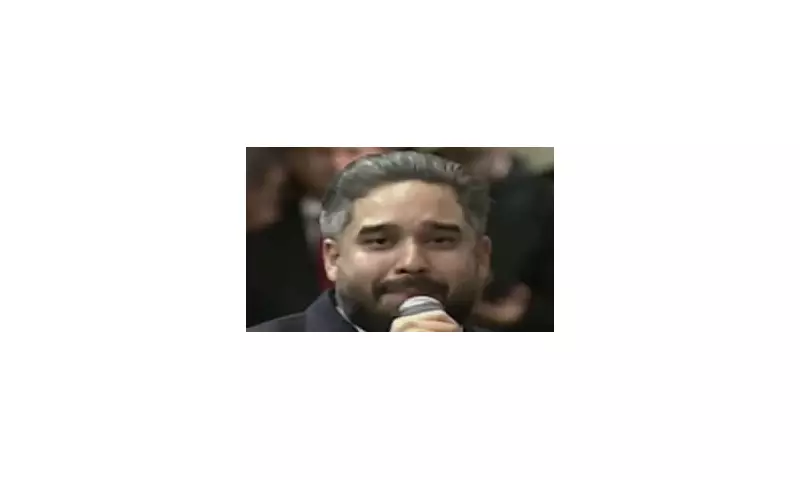
The political future of Venezuela hangs in the balance after the dramatic capture of its president, with his son delivering an emotional address to the nation's parliament. Nicolás Maduro Guerra, the 35-year-old son of the detained leader, broke down in tears on Monday as he spoke before the National Assembly in Caracas, following the US military operation that seized his father and stepmother.
An Emotional Plea and a Swearing-In Amid Crisis
Lawmakers aligned with the ruling United Socialist Party gathered for a scheduled ceremony to swear in the National Assembly for a term lasting until 2031. Amid this procedural event, Maduro Guerra, a high-ranking member and head of the Presidency's Special Inspectorate, made a tearful intervention. He denounced his father's capture as a "kidnapping" and warned of global implications. "If we normalise the kidnapping of a head of state, no country is safe," he said through sobs. "Today, it's Venezuela. Tomorrow, it could be any nation that refuses to submit."
Directly addressing his absent father, he vowed: "Papa, we are fulfilling our duty until you return. The motherland is in good hands, papa, and soon we're going to embrace here in Venezuela." He pledged his "unconditional support" to Delcy Rodríguez, Maduro's deputy who has assumed the role of interim president, and demanded the return of his father and stepmother, Cilia Flores.

US Indictments and Allegations of 'Massive-Scale' Trafficking
The emotional scene in Caracas unfolded as Nicolás Maduro and Cilia Flores made their first court appearance in a Manhattan federal courtroom on Monday, January 5, 2026. They pleaded not guilty to a series of conspiracy charges including narco-terrorism, cocaine importation, and weapons offenses. The charges stem from their astonishing capture by US special forces on Saturday, January 3, during a raid on their home on a military base.
US prosecutors have also named Maduro Guerra, known as 'Nicolasito', as a co-conspirator in the indictment. He is accused of involvement in "massive-scale drug trafficking", allegedly working with cartels to ship cocaine from Venezuela to the US via several Central American and Caribbean countries. The indictment claims he used a state-owned jet to transport cocaine from Margarita Island and employed scrap metal containers to smuggle drugs into Miami and New York.
Furthermore, it is alleged that in 2020, Maduro Guerra met with Colombian security officials to discuss moving cocaine and weapons through Colombia and into the US over a six-year period, with guns offered as payment.
Political Maneuvering and Conciliatory Overtures
Back in Venezuela, the political apparatus sought to project stability. Delcy Rodríguez, who served as vice president, was sworn in as interim president by her brother, Jorge Rodríguez, the re-elected speaker of the National Assembly. In her address, she struck a notably conciliatory tone towards the United States, a shift from initial defiance. "We invite the US government to collaborate with us on an agenda of cooperation," Rodríguez stated, saying Venezuela seeks "respectful relations".
This followed a threat from former US President Donald Trump that she could "pay a very big price" if she did not align with US demands. Secretary of State Marco Rubio clarified that the US would not govern Venezuela day-to-day but would enforce an existing 'oil quarantine' to pressure for policy changes, including halting drug trafficking and reforming the oil industry for public benefit.
In a significant development, a US State Department official indicated on Monday that the Trump administration has begun preliminary plans to potentially reopen the American embassy in Caracas, signalling a possible diplomatic shift.
The events of the past days mark a seismic moment in international relations and the fight against narcotics trafficking, leaving Venezuela's leadership in a precarious position and its former president facing a formidable legal battle in a New York court.