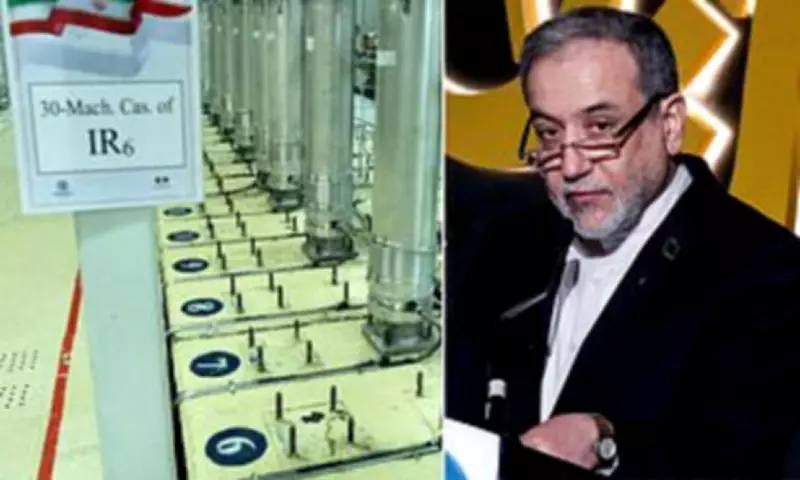
Iran has declared it will never surrender its right to enrich uranium, even if war is imposed upon the nation, according to statements made by Foreign Minister Abbas Araghchi on Sunday. The defiant remarks come amid ongoing pressure from Washington and regional tensions, highlighting Tehran's unwavering stance on its nuclear programme.
Defiance Against External Pressure
Speaking at a forum in Tehran, Araghchi emphasised that Iran has paid a heavy price for its peaceful nuclear activities and uranium enrichment. He stated, "Why do we insist so much on enrichment and refuse to give it up even if a war is imposed on us? Because no one has the right to dictate our behaviour." This declaration was made just two days after Araghchi met with US envoy Steve Witkoff in Oman for discussions.
Araghchi added, "I believe the secret of the Islamic Republic of Iran's power lies in its ability to stand against bullying, domination and pressures from others." He further argued that Western powers fear an Iranian atomic bomb, while Iran itself is not pursuing one. "Our atomic bomb is the power to say no to the great powers," he asserted, framing the issue as a matter of national sovereignty and resistance.

Regional Military Tensions
The foreign minister also addressed the US naval deployment in the Gulf, stating, "Their military deployment in the region does not scare us." This comment underscores the heightened military posture in the area, with US President Donald Trump having previously threatened to use force to compel Iran into a nuclear deal. Trump's administration initiated a troop build-up in response to Tehran's crackdown on nationwide protests, which resulted in thousands of deaths and tens of thousands of detentions.
Nuclear Programme Controversy
While Iran maintains that its nuclear programme is peaceful, the West and the International Atomic Energy Agency (IAEA) allege that Tehran had an organised military programme to develop nuclear weapons up until 2003. Iran has been enriching uranium to 60% purity, a technical step away from weapons-grade levels of 90%, making it the only non-weapons state to do so.
In recent years, Iranian officials have increasingly threatened that the country could seek a nuclear bomb, despite diplomats pointing to Supreme Leader Ayatollah Ali Khamenei's religious edict against building one. The IAEA has confirmed that Iran is the only country enriching uranium to such levels without possessing nuclear weapons.
Diplomatic Challenges
Iranian President Masoud Pezeshkian praised the recent talks in Oman as "a step forward," but Araghchi's remarks reveal the significant challenges ahead. Pezeshkian, who likely received Khamenei's blessing to pursue talks, wrote on social media, "Dialogue has always been our strategy for peaceful resolution. The Iranian nation has always responded to respect with respect, but it does not tolerate the language of force."
Araghchi expressed doubts about Washington's sincerity, citing continued sanctions and military deployments. "We are closely monitoring the situation, assessing all the signals, and will decide whether to continue the negotiations," he said, indicating that Iran's participation in future talks is contingent on US actions.
US Perspectives and Fears
US Secretary of State Marco Rubio emphasised last week that talks must address Iran's nuclear programme, ballistic missiles, support for proxy groups, and human rights issues. Meanwhile, US Vice President JD Vance, in an exclusive interview with the Daily Mail, revealed that President Trump does not believe Iran can produce a nuclear bomb during his administration, but fears a successor might appease Tehran.
Vance stated, "What I feel quite confident about is that Iran could not develop a nuclear weapon in the Trump administration. That's how much damage we did to their program," referring to Operation Midnight Hammer, which targeted Iranian enrichment facilities in June. He added that Trump's real concern is a future president who might not prevent Iran from acquiring nuclear weapons, potentially threatening Israel and US allies.

When questioned about regime change, Vance clarified, "The President's main goal in Iran, it's not this or that regime. It's Iran cannot have a nuclear weapon." He acknowledged that dealing with a rational regime in Iran would be in America's interest, but emphasised that the primary objective is nuclear non-proliferation.
As tensions persist, the standoff over Iran's nuclear ambitions continues to shape diplomatic and military dynamics in the Middle East, with both sides presenting firm positions that complicate the path to resolution.