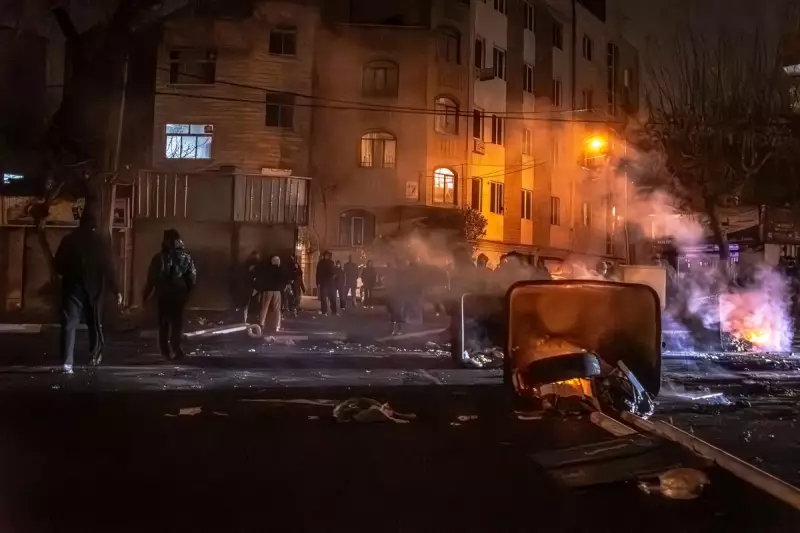
Iranian state television has issued the first official death toll from the recent wave of protests, confirming that 3,117 people were killed during the unrest. The announcement came as the country's foreign minister delivered the most direct threat yet against the United States, warning that Tehran would respond with full military force if attacked.
Official Figures and International Concerns
The official statements, carried by state television, came from both the Interior Ministry and the Martyrs Foundation, an official body that provides services to families of those killed in conflicts. According to these authorities, 2,427 of the deceased were civilians and security forces, though they provided no further details about the remaining casualties.
This official count has been met with skepticism by international observers. The U.S.-based Human Rights Activists News Agency, which maintains a network of activists within Iran to verify fatalities, places the death toll significantly higher at 4,560. The Associated Press has noted it cannot independently verify these conflicting figures.

Escalating Rhetoric and Military Movements
Foreign Minister Abbas Araghchi issued his stark warning in an opinion article published by The Wall Street Journal. "Unlike the restraint Iran showed in June 2025, our powerful armed forces have no qualms about firing back with everything we have if we come under renewed attack," Araghchi wrote, referencing the brief war with Israel that occurred last June.
The foreign minister insisted this was "not a threat, but a reality" he felt compelled to convey explicitly. He warned that any confrontation would be "ferocious" and would "engulf the wider region," affecting ordinary people globally. Analysts suggest these comments likely refer to Iran's substantial stockpile of short- and medium-range missiles, which could target U.S. bases and interests throughout the Persian Gulf.
Regional Tensions and Military Deployments
The heightened rhetoric coincides with significant military movements in the region. The USS Abraham Lincoln aircraft carrier group has been tracked moving westward from Asia toward the Middle East, passing through the strategic Strait of Malacca. While U.S. defense officials have not confirmed the carrier's destination, its current position in the Indian Ocean places it just days away from entering the region.
Additional U.S. military assets have been observed moving into position, including F-15E Strike Eagles arriving in the Middle East and HIMARS missile systems being deployed. These developments follow a major U.S. military operation in the Caribbean that saw troops seize Venezuelan leader Nicolás Maduro.
Historical Context and Domestic Crackdown
The current death toll represents the highest from any protest or unrest in Iran for decades, recalling the chaos of the 1979 revolution that established the Islamic Republic. The protests initially began over economic pressures but rapidly expanded to challenge the theocratic government itself.
Despite no recent protests being reported, concerns persist that the casualty figures may rise substantially as information gradually emerges from a country that has maintained a government-imposed internet shutdown since January 8th. The first indication of the scale of casualties came from Supreme Leader Ayatollah Ali Khamenei, who acknowledged "several thousand" deaths while blaming the United States for the unrest.
Arrests and International Response
According to the Human Rights Activists News Agency, nearly 26,500 people have been arrested during the crackdown. Statements from Iranian officials have raised fears that some detainees may face execution in a country that remains one of the world's leading practitioners of capital punishment.
The killing of peaceful protesters and potential executions have been identified as red lines by U.S. President Donald Trump in the ongoing tensions. Gulf Arab diplomats have reportedly lobbied the American president against military action in response to the protest deaths.

Cross-Border Incidents
In a related development, the National Army of Kurdistan, the armed wing of the Kurdistan Freedom Party (PAK), claims Iran launched an attack against one of its bases near Irbil in northern Iraq. The group reported one fighter killed and released footage showing fires in predawn darkness.
Iran has not acknowledged this alleged attack, which would represent its first foreign military operation since the protests began. Several Iranian Kurdish dissident groups have long maintained bases in northern Iraq's semi-autonomous Kurdish region, creating ongoing friction between Baghdad and Tehran.
As information continues to emerge from a country under internet restrictions, and with military forces positioning throughout the region, the situation remains dangerously volatile with potential implications far beyond Iran's borders.