Iran Plunged Into Succession Crisis Following Reported Death of Supreme Leader
The apparent death of Supreme Leader Ayatollah Ali Khamenei, reportedly killed when Israel dropped approximately thirty bombs on his compound, has triggered a profound political and religious earthquake across Iran. This catastrophic event leaves behind a perilous leadership vacuum that the regime, which Khamenei has dominated since 1989, must now urgently address to prevent complete societal and governmental collapse.
No Clear Heir Emerges From Fractured Power Structure
There exists no single, obvious successor who commands the unified support of Tehran's disparate factions, including the powerful clergy, the military establishment, and the political leadership. Multiple American and Israeli television networks have broadcast reports of Khamenei's death, citing Israeli intelligence sources. Neither the White House nor officials in Tehran have provided immediate confirmation of these reports.
For years, the hardline President Ebrahim Raisi had been viewed as a favorite to succeed the 86-year-old Khamenei. However, that potential succession path was eliminated when Raisi was killed in a helicopter crash in May 2024.

Potential Contenders and the Shadow of Military Rule
One prominent figure in the succession discussion is Mojtaba Khamenei, the 55-year-old second-eldest son of the Ayatollah. While he is recognized as a powerful and ideologically hardline operator behind the scenes, he has never held an official government position, which complicates his candidacy.
Experts are increasingly pointing to the possibility of a direct takeover by the Islamic Revolutionary Guard Corps (IRGC), which would fundamentally shift Iran from a clerical-led state to a military dictatorship. Recent assessments from the CIA suggested that if Khamenei were eliminated in a 'decapitation strike,' he would most likely be replaced by ruthlessly hardline figures from within the IRGC's ranks.
'Iran’s military commanders hold the country’s future in their hands,' stated Suzanne Maloney, vice president and director of the Brookings Institution’s Foreign Policy Program. 'That imperative could well expand their appetites, and when Khamenei passes from the scene - either as a result of natural causes or decapitation strikes - so too could any effort to sustain the pretense of religious legitimacy in favor of military rule.'
Such a military transition would almost certainly result in even more brutal crackdowns on domestic popular uprisings, occurring alongside continued U.S. encouragement for the Iranian people to overthrow their government. It would also severely hinder American diplomatic efforts to persuade Iran to abandon its nuclear weapons program.
Alternative Paths and Constitutional Mechanisms
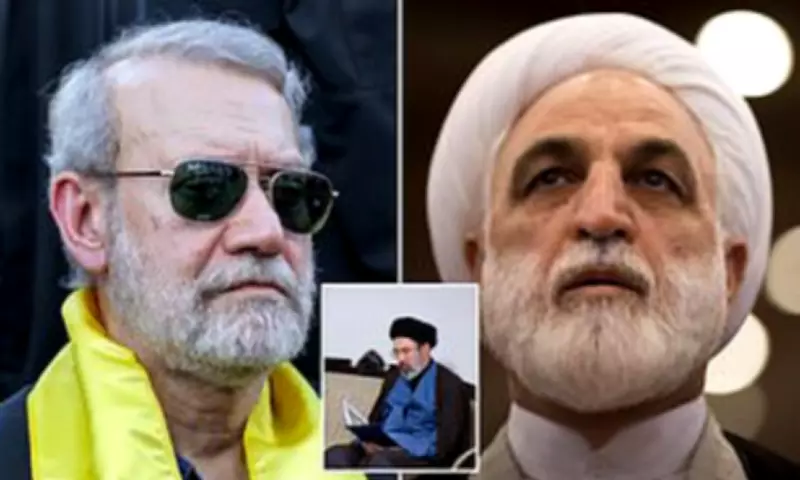
Alternatively, if the regime seeks to avoid a deeper descent into repression, it might appoint a figure capable of engaging diplomatically with the United States. A potential candidate in this mold is Ali Larijani, the chair of Iran's Supreme National Security Commission. In recent weeks, Khamenei had reportedly been granting Larijani increasing authority, sidelining President Masoud Pezeshkian.
Described as Khamenei's 'eminence grise,' Larijani is a former IRGC officer and former speaker of Parliament. Despite effectively helping to run the country, the philosophy professor and mathematician, known for wearing business suits, is not believed to be among three clerics secretly named by Khamenei as potential successors—a list that remains confidential.
Another possible interlocutor is Mohammad Bagher Ghalibaf, the current Parliament speaker, who maintains close ties to Mojtaba Khamenei and hardliners within the IRGC.
According to Article 111 of the Iranian constitution, a temporary three-member council—consisting of the President, the head of the judiciary, and a jurist from the Guardian Council—would assume control following Khamenei's demise. The permanent selection of the next Supreme Leader would then fall to the 88-member Assembly of Experts, whose members are vetted by the powerful, 12-member Guardian Council, half of which was appointed by Khamenei himself. All deliberations would be conducted behind closed doors.

Speculation on Secret Successor List
Speculation surrounds the identities on Khamenei's secret three-person list. Possibilities include Ayatollah Alireza Arafi, who leads Iran's seminaries and sits on the Guardian Council; Ayatollah Gholam-Hossein Mohseni-Ejei, the head of the judiciary; and Hojjat-ol-Eslam Mohsen Qomi, a senior adviser to Khamenei. Other names in consideration are Ayatollah Mohsen Araki, a member of the Assembly of Experts, and Ayatollah Hashem Hosseini Bushehri, who leads Friday prayers in the holy city of Qom.
'The promotion of one of Khamenei’s favored apparatchiks would perpetuate the current balance of power, essentially leading to "Khamenei-ism without Khamenei,"' Maloney further noted.
Conflicting Reports and Regional Fallout
Satellite imagery confirmed that one of the initial strikes in the operation, reportedly dubbed Operation Epic Fury, hit near Khamenei's office complex. Khamenei had not been seen publicly for several days prior to the attack, and his precise location at the time remains unclear, although one source from the previous Trump administration claimed they possessed 'exquisite' intelligence on the Supreme Leader's movements.
Israel's Channel 12, citing unnamed Israeli sources, reported 'growing indications' that Khamenei was dead. Conversely, Iranian Foreign Minister Abbas Araghchi stated that, 'as far as I know,' both Khamenei and President Pezeshkian were alive. Additional reports suggested that Iran's Defense Minister Amir Nasirzadeh and IRGC commander Mohammad Pakpour were also killed in the strikes.
Former President Donald Trump, a long-time advocate for leadership change in Iran who has labeled Tehran a 'terrorist regime,' has not specified who he believes should govern the country in the aftermath. The selection of a new Supreme Leader would mark only the second such transition since the 1979 Islamic Revolution, following Khamenei's own succession after the death of the republic's founder, Ayatollah Ruhollah Khomeini.